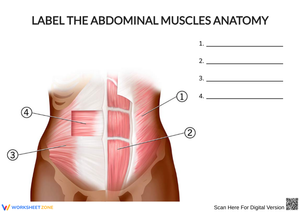
These abdominal muscle worksheets give anatomy and life science teachers a direct route into one of the more conceptually layered topics in the curriculum — four distinct muscle groups arranged in overlapping planes, each with a name, a fiber direction, and a function students must hold separately in memory. Each worksheet targets a specific skill: spatial identification, layer sequencing, function mapping, or terminology recall, so teachers can select exactly what a class needs at any point in the unit.
What Students Practice Across the Set
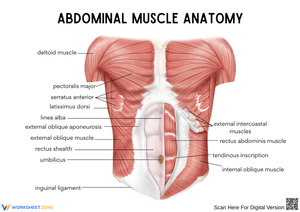
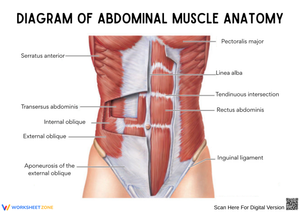
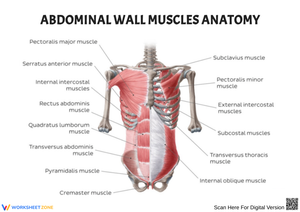
The content centers on the four primary muscles of the anterior and lateral abdominal wall. Students work with the rectus abdominis — the most superficial midline muscle, responsible for trunk flexion — alongside the external oblique, whose fibers run diagonally downward and medially to drive rotation and lateral bending. Beneath that layer sits the internal oblique, with fibers running almost perpendicular to the external layer, contributing to the same rotational movements but from the opposite angle. Deepest of all is the transverse abdominis, whose horizontal fibers wrap the torso to stabilize the spine and compress the abdominal cavity. Worksheet formats across the set include anterior-view labeling diagrams, function-matching tables, fill-in-the-blank layering sequences, cut-and-sort activities, short true/false quizzes, and vocabulary puzzles built around terms like oblique, transverse, flexion, and abdominis.
Where Students Consistently Go Wrong in This Unit
The most persistent confusion involves the oblique pair. Students who correctly place the external oblique on a labeling diagram will still reverse the fiber direction on a written description — drawing the internal oblique fibers running the same diagonal as the external, which reveals they have memorized position without understanding the perpendicular relationship between the two layers. A second pattern appears on function questions: many students treat "rotation" and "lateral flexion" as synonyms because both actions involve the obliques, and they collapse the two into a single answer. Using a labeling worksheet and a function-matching worksheet in sequence surfaces both errors efficiently, because the diagram question and the function question appear in different formats, making it harder to carry the same wrong answer across both tasks.
The transverse abdominis generates its own category of error. Students routinely place it at an intermediate depth — below the rectus abdominis but above the obliques — because "transverse" sounds less deep than it is. The cut-and-sort layering activity directly addresses this by requiring students to physically commit each muscle to a specific position before the sequence is complete, rather than selecting from a list where guessing carries less consequence.
Fitting These Worksheets Into Your Lesson Plans
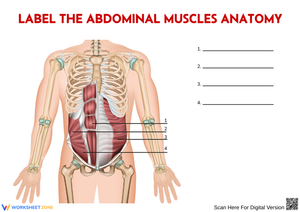
The most effective sequence starts with a labeling diagram on the first day of the muscle unit. Students build a visual anchor before any other content is introduced, which means subsequent function and layering tasks build on a map they already hold. Function-matching and fill-in-the-blank worksheets carry the unit through midweek, and a short true/false quiz serves as a midpoint formative check that takes under five minutes to score as a class.
One strategy that consistently improves retention: after students complete the cut-and-sort layering activity, have them place one hand flat on their own abdomen and contract each muscle group in sequence — a controlled crunch to isolate the rectus abdominis, a gentle twist to feel the obliques engage, and a deep bracing breath to activate the transverse abdominis. This three-minute kinesthetic interruption anchors the abstract layer sequence to a physical sensation students can recall during an assessment. The abdominal muscle worksheets handle the paper-based retrieval practice; the palpation moment makes the anatomy personal in a way that diagrams alone cannot replicate. Vocabulary puzzles work well during the transition after morning routines or as early-finisher tasks that require no additional teacher direction.
Tailoring Each Worksheet for Different Skill Levels
Students who need additional support benefit from labeling diagrams that include a word bank alongside the illustration. On matching activities, reducing the answer pool to a strict one-to-one correspondence — rather than presenting more options than muscles — removes the cognitive load of elimination and lets students focus on the name-function connection itself. Both modifications require nothing more than a quick edit before printing.
Advanced students respond well to a different kind of challenge: remove the word bank entirely, then add extension prompts that ask them to predict how a tear of the external oblique would affect a batter's swing, or how transverse abdominis weakness would change posture during a loaded carry. The abdominal muscle worksheets in base format cover the core content; those extension prompts shift the task from recall to clinical reasoning, which suits AP-level or dual-enrollment anatomy courses. English language learners benefit when worksheets pair the Latin anatomical term with a plain-language descriptor side by side — rectus abdominis alongside "straight belly muscle" — so content vocabulary and language acquisition build simultaneously rather than sequentially.
Standard Alignment
Specific instruction on named abdominal muscles does not appear in NGSS as a discrete performance expectation, but it fits naturally under NGSS HS-LS1-2, which asks students to develop and use models to illustrate the hierarchical organization of interacting systems within multicellular organisms. At the high school level, individual muscle anatomy aligns more precisely with state anatomy and physiology standards — typically within the musculoskeletal body system strand — where students are expected to identify, locate, and describe the action of named skeletal muscles. At the middle school level, abdominal muscle content usually appears within body systems units focused on structure-function relationships. The labeling and vocabulary formats suit the introductory middle school placement; the function-matching and layering activities carry the technical depth required in high school anatomy.
Frequently Asked Questions
What grade levels do these worksheets serve?
The set works across grades 6 through 12. Middle school life science courses use the labeling and vocabulary formats as an introduction to the abdominal wall. High school anatomy and physiology classes use the full range, particularly the function-matching, layering sequences, and extension tasks.
Do teachers need prior anatomy training to administer these worksheets?
No. Each worksheet is self-contained and includes an answer key. A teacher new to anatomy content can use the function-matching key to lead a class debrief without prior expertise in musculoskeletal anatomy. The cut-and-sort activity includes a completed reference diagram for teacher use during whole-class discussion.
How do these worksheets work alongside torso models or digital anatomy tools?
The abdominal muscle worksheets pair directly with physical torso models or browser-based tools like Visible Body. After students explore the model, a labeling worksheet serves as an immediate retrieval check while the visual is still fresh. The worksheet forces independent recall; the model provides the initial input. Used together, they complete an input-retrieval cycle that model exploration alone does not achieve.
Can individual worksheets serve as summative assessments?
The true/false and multiple-choice formats work as low-stakes unit quizzes. For a summative instrument, the stronger approach is combining a labeling diagram with two or three short-answer function prompts — a format that tests both spatial and functional knowledge in a single sitting. Most teachers use the individual worksheet formats as formative tools and build their summative from selected questions drawn across formats.