




























Views
Downloads

Printable Cursive Letter S Worksheet | Grade 1

Paste this activity's link or code into your existing LMS (Google Classroom, Canvas, Teams, Schoology, Moodle, etc.).
Students can open and work on the activity right away, with no student login required.
You'll still be able to track student progress and results from your teacher account.
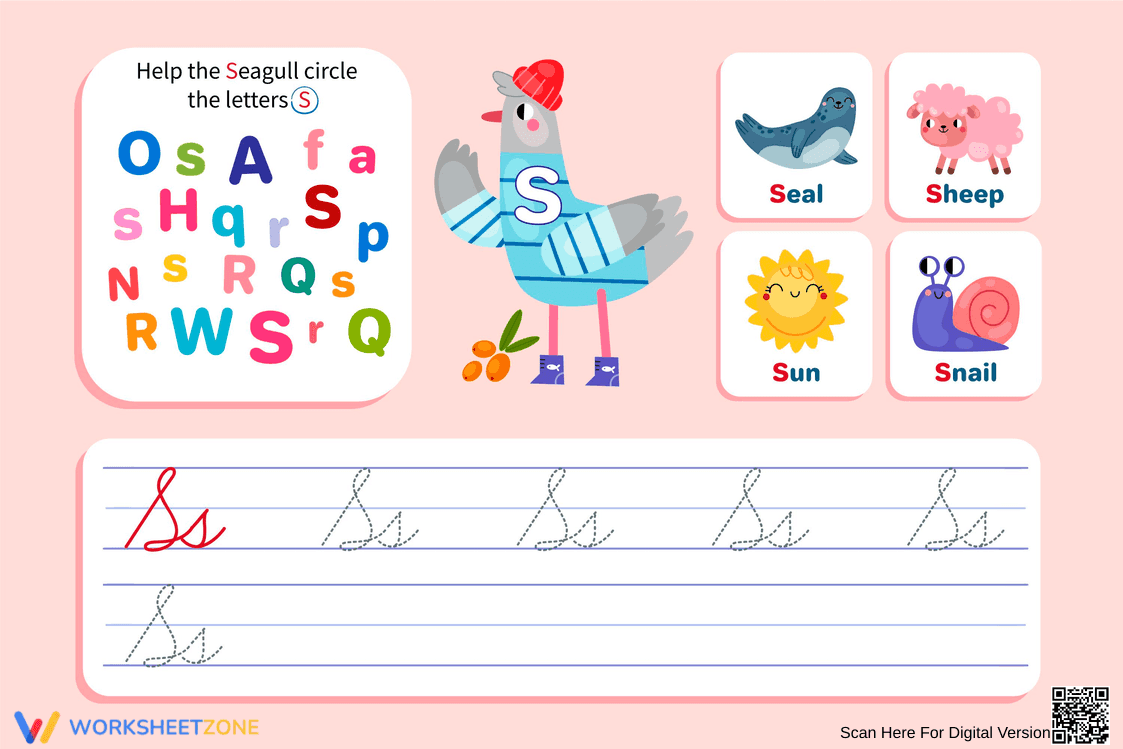
This Grade 1 handwriting worksheet provides focused practice on the cursive letter S. Students build fine motor skills and letter recognition by identifying the target letter among distractors and tracing both uppercase and lowercase forms. The engaging visual design keeps young learners motivated while mastering foundational cursive strokes.
At a Glance
- Grade: 1 · Subject: English
- Standard:
CCSS.ELA-LITERACY.L.1.1.A— Print all upper- and lowercase letters- Skill Focus: Cursive Letter S Formation
- Format: 1 page · 7 problems · PDF
- Best For: Independent practice
- Time: 10–15 minutes
Inside this single-page resource, educators will find two distinct task types. The top section features a visual discrimination activity where students circle the letter S among a mixed array of letters. The bottom section provides structured tracing lines with six pairs of uppercase and lowercase cursive Ss, complete with dotted guidelines to support proper letter proportion. Four illustrated vocabulary words provide phonetic context.
Zero-Prep Workflow
This worksheet is designed for immediate classroom implementation with minimal teacher setup:
- Print (1 minute): Simply download the PDF and print the required number of copies. The colorful design also prints clearly in grayscale.
- Distribute (1 minute): Hand out the worksheets along with pencils. The instructions are highly visual and self-explanatory for early readers.
- Review (3 minutes): Quickly check student work for proper stroke direction and letter identification accuracy.
With a total prep time of under two minutes, this resource is an excellent addition to emergency sub plans or morning work folders.
Standards Alignment
This activity aligns with CCSS.ELA-LITERACY.L.1.1.A, requiring students to print all upper- and lowercase letters. While the standard explicitly mentions printing, this worksheet adapts the foundational expectation to early cursive instruction, ensuring students maintain proper line placement and letter formation. Both standard codes can be copied directly into lesson plans, IEP goals, or district curriculum mapping tools.
How to Use It
Deploy this worksheet during independent literacy centers after a brief direct instruction session on cursive S strokes. It serves as an excellent transition activity between phonics lessons and writing blocks. As a formative assessment tip, observe students while they trace the letters to ensure they are starting at the correct point on the baseline rather than drawing the letters backward. Expected completion time ranges from 10 to 15 minutes.
Who It's For
This resource is primarily designed for first-grade students beginning their cursive handwriting journey, as well as kindergarteners ready for an advanced challenge. The visual discrimination task provides built-in scaffolding for students who need extra support recognizing the letter shape before attempting to write it. Pair this worksheet with a tactile sensory activity, such as tracing the letter S in sand or shaving cream, to reinforce muscle memory.
Developing automaticity in handwriting is a critical component of early literacy that directly impacts future writing fluency. This worksheet targets CCSS.ELA-LITERACY.L.1.1.A, helping students print all upper- and lowercase letters with accuracy and confidence. According to Fisher & Frey (2014), providing structured practice in letter formation reduces the cognitive load required for transcription, allowing young writers to dedicate more mental resources to idea generation. By combining visual discrimination tasks with guided tracing exercises, this resource supports the dual coding of letter shapes in the brain. The inclusion of phonetic vocabulary words further bridges the gap between isolated handwriting practice and meaningful reading skills. Consistent use of targeted tracing activities ensures that students build the fine motor strength and muscle memory necessary for long-term academic success.


