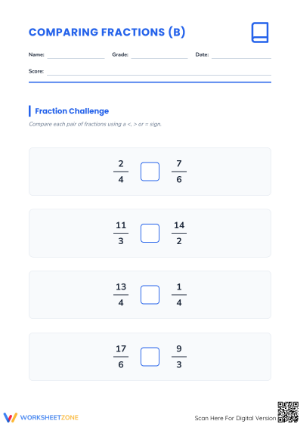
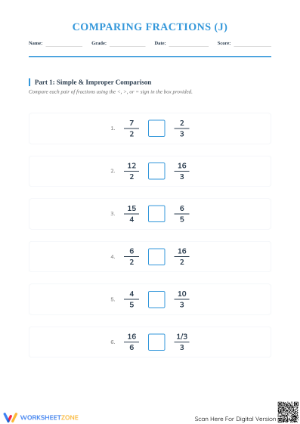
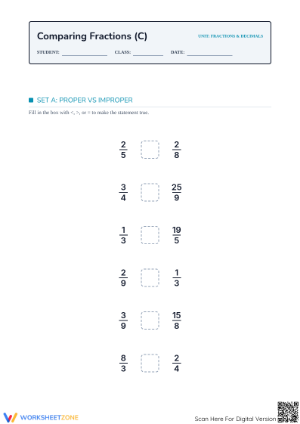
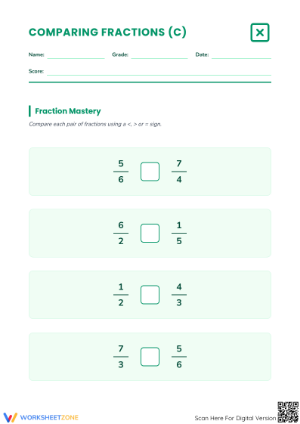
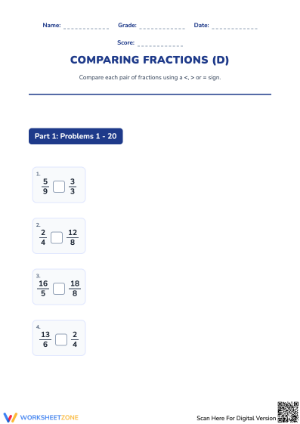
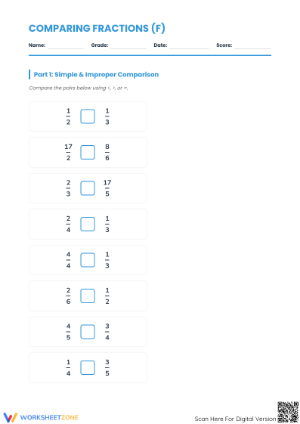
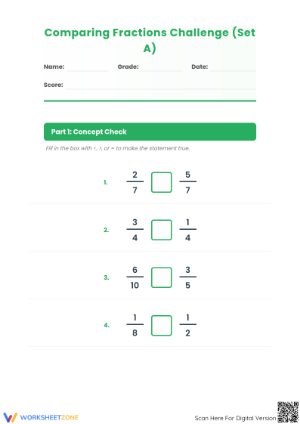
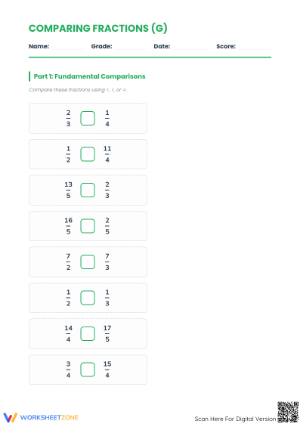
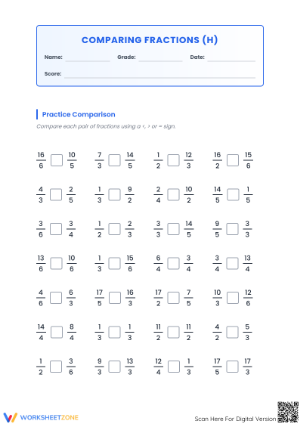
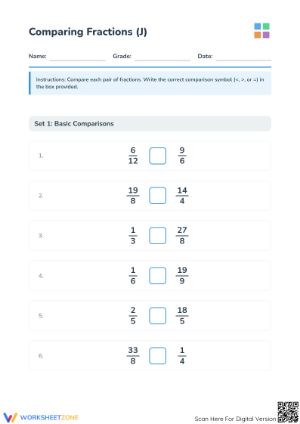
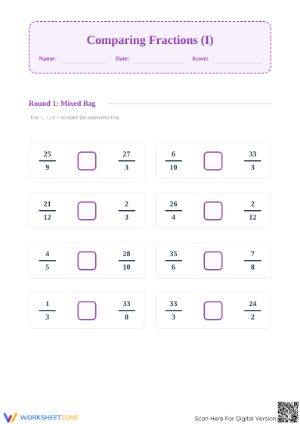
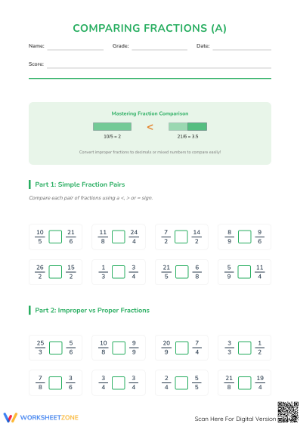
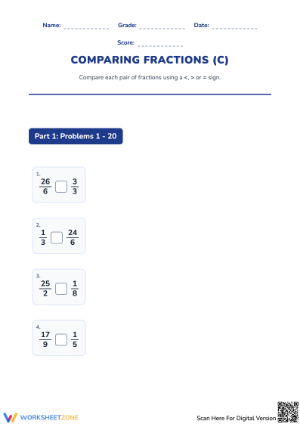
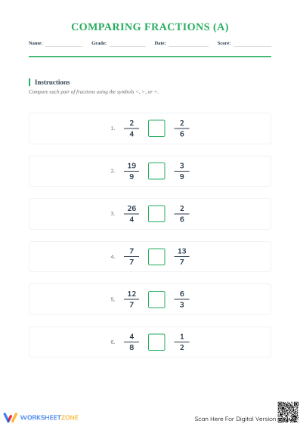
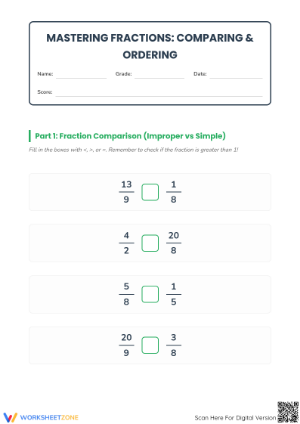
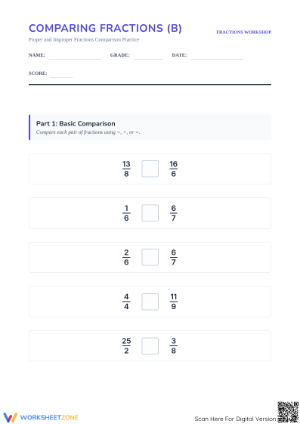
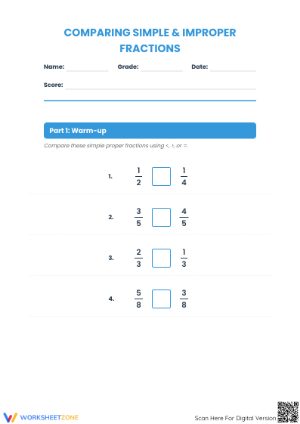
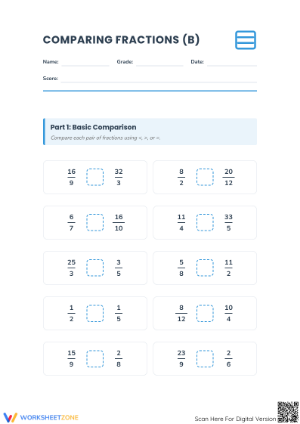
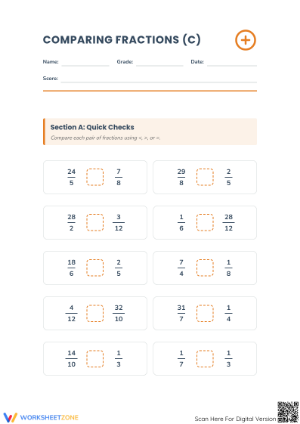
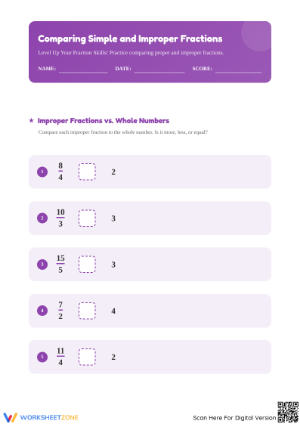
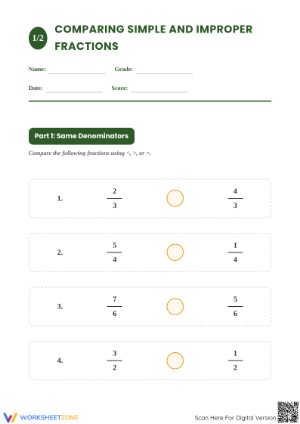
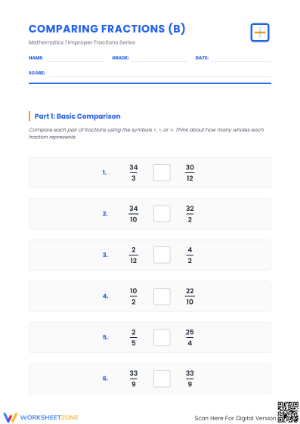
These 4th grade improper fractions printable worksheets give teachers practice resources that span the full instructional arc of this concept — from reading shaded area models to executing bare-number division conversions. Each worksheet targets one skill rather than mixing representations, so you can assign exactly what a student needs on a given day. The set moves in the same order most 4th grade fraction units do: visual models first, then number-line placement, then the conversion algorithm in both directions.
Skills These Worksheets Build
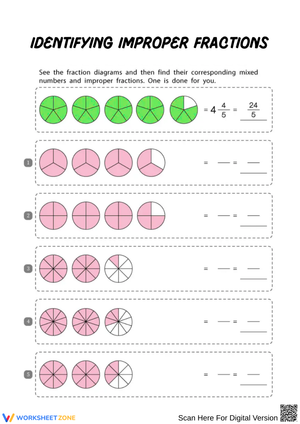
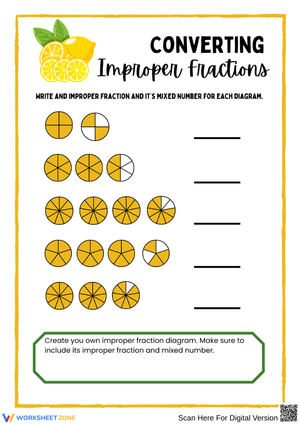
The resources target four specific competencies that students work through during this unit. First, students identify improper fractions from area models — circles or rectangles divided into equal parts, with more than one full shape shaded. They write the corresponding fraction, including cases where the shaded region spans two or three complete shapes. The second skill is number-line placement: given an improper fraction like 7/3, students locate and mark it on a pre-divided line. This task matters more than it looks because it forces students to treat the fraction as a single value — a point in space — rather than two separate numbers that happen to share a bar.
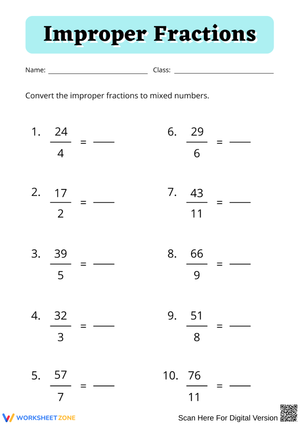
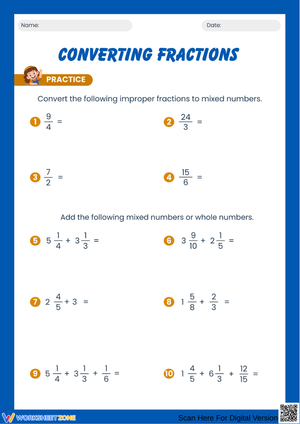
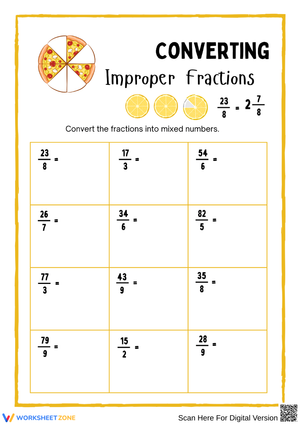
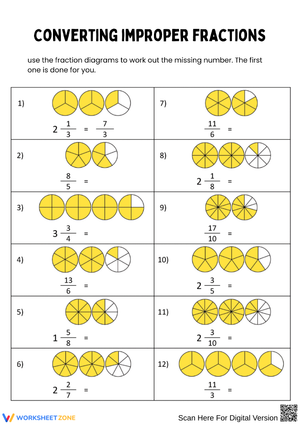
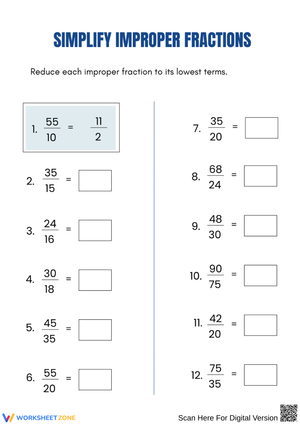
The conversion worksheets form the bulk of the set. Students practice converting improper fractions to mixed numbers by dividing the numerator by the denominator, writing the quotient as the whole number, and carrying the remainder as the new numerator while keeping the denominator unchanged. A separate worksheet reverses the process: given a mixed number like 3 2/5, students multiply the whole number by the denominator, add the numerator, and write the result over the original denominator. Both directions appear because 4th graders need to move between these forms fluidly before they can handle fraction addition with regrouping.
Student Errors Worth Watching For and Correcting
The denominator-reset error is the one to anticipate first. A student divides 11 by 4, correctly gets a quotient of 2 with remainder 3, and then writes 2 3/3 — using the remainder as both the new numerator and the new denominator. The division was right; the error is conceptual. The denominator names the size of each piece, and that size does not change when pieces are regrouped into wholes. Students who make this mistake have learned a procedure without understanding what the denominator represents. Naming the error clearly before independent practice — "the denominator stays the same, always" — prevents most of it.
The second error surfaces on the area-model worksheets. When three circles are each divided into fourths and nine sections are shaded in total, some students write 9/12 instead of 9/4. They count every section across all shapes and use that total as the denominator. The fix is quick — circle just the first shape and ask how many parts make one whole — but it may need repeating across several problems before it sticks. Students who make this error are still reading numerator and denominator as independent counts rather than as a ratio that describes one kind of piece.
Fitting These Worksheets Into Your Fraction Unit
The area-model worksheets belong at the start, before any formal algorithm is introduced. Students who can look at a diagram and write 9/4 have already internalized that the denominator comes from how one shape is divided, not from the total count of all parts. That understanding makes the conversion procedure much easier to teach. In practice, these make reliable warm-up material for the first few days of the unit — eight or ten minutes at the start of the math period, enough to check who can read the models correctly before moving to number lines.
The 4th grade improper fractions printable worksheets conversion set works well as an exit ticket later in the unit. Five problems at the end of a lesson give you a fast read on who has the quotient-remainder process down and who is still guessing. The same worksheets hold up during a math center rotation once the algorithm has been introduced in whole group. Students who finish early can be pushed to verify each answer by sketching an area model to match the mixed number they produced — a self-check that reinforces the connection between the visual and the numerical without requiring teacher intervention.
Standard Alignment
The central standard is CCSS.MATH.CONTENT.4.NF.B.3, which addresses understanding fraction addition and subtraction as joining and separating parts of a whole. The conversion between improper fractions and mixed numbers is not a separate skill stapled onto this standard — it is the mechanism that makes mixed-number addition with regrouping work. A student who cannot rewrite 2 3/4 as 11/4 will stall at exactly the moment a subtraction problem requires borrowing across the whole number. These 4th grade improper fractions printable worksheets target the procedural fluency that 4.NF.B.3c requires. The visual-model worksheets also support 4.NF.A.1, which asks students to explain fraction equivalence using area models and number lines — both formats appear in the set.
Adjusting the Resources for a Range of Learners
Students who are still treating a fraction as two separate numbers need more time on the area-model worksheets before touching the conversion algorithm. Letting them draw their own models beside each problem — rather than just working with the printed diagrams — slows the pace but builds understanding that holds. For these students, the conversion worksheet can be introduced with a labeled answer template: a designated box for the quotient, a separate box for the remainder, and the denominator already printed in the answer fraction. That format reduces the denominator-reset error while the student is still building fluency with the division step itself.
For students who move through the basic conversions quickly, the 4th grade improper fractions printable worksheets set includes problems that embed conversion inside a context — a word problem where the raw answer is an improper fraction the student must then express as a mixed number. These students can also be asked to explain in writing why 11/4 and 2 3/4 represent the same quantity. Writing out that explanation requires articulating the division relationship rather than just executing it, which pushes toward the kind of reasoning 5th grade fraction work demands.
Frequently Asked Questions
What order should I assign these worksheets in?
Start with the area-model identification worksheets, move to number-line placement, and introduce the bare-number conversion worksheets only after students have worked with visual models for at least two lessons. Students who encounter the algorithm before they have any conceptual grounding often reduce the whole concept to a memorized sequence of steps — and those students tend to fall apart when problems look slightly different from the ones they practiced.
Do these worksheets include answer keys?
Yes. Each worksheet comes with a matching answer key. For the conversion problems, the key shows the intermediate division step — quotient and remainder — alongside the final mixed number. That detail lets you see at a glance where a student's process broke down, not just whether the final answer was right or wrong.
Can I use these with 5th graders who missed this concept?
The area-model worksheets travel well to 5th grade for students who need to revisit the foundations. The visual format gives them an entry point that does not feel like obvious remediation — they are reading a diagram and writing a fraction, not completing something labeled "Grade 4." The conversion worksheets are grade-neutral enough to use across year groups without adjustment.
Are these worksheets appropriate for homework?
The conversion worksheets work as homework once the algorithm has been introduced and practiced in class. Keep the area-model worksheets in school — students who encounter a diagram at home with no teacher present often develop workarounds that introduce new errors. A worked example at the top of the worksheet helps with the homework context, but it does not fully replace classroom introduction for the visual tasks.













 Interactive Worksheet Maker
 Quiz Maker
 Word Search Maker
 Crossword Puzzle Maker
 Word Scramble Generator
 Sentence Scramble Generator
 Handwriting Worksheet Generator
 Name Tracing Generator
 Fill In The Blank Generator