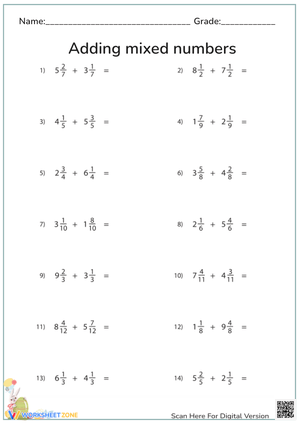
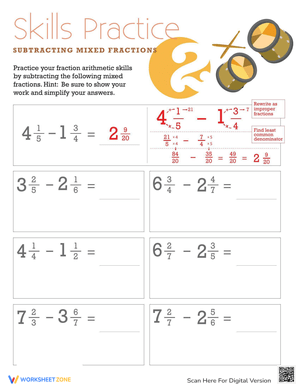
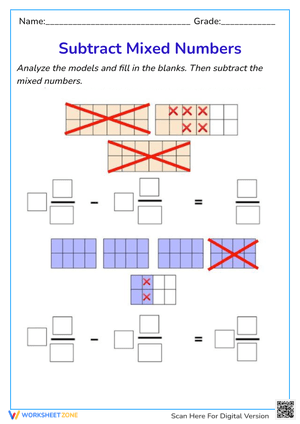
These mixed numbers printable worksheets for 4th grade cover the three areas where students most reliably need concentrated practice: reading and producing visual models, converting between mixed numbers and improper fractions in both directions, and decomposing mixed numbers into sums of unit fractions. Each worksheet targets a distinct skill type, so teachers can assign them selectively across a unit rather than using the full set in a single session.
What the Set Covers
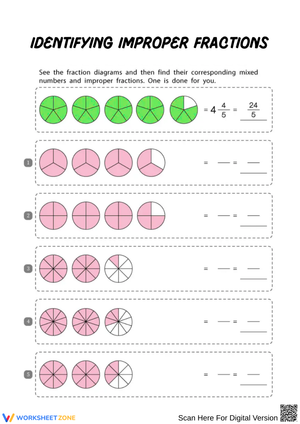
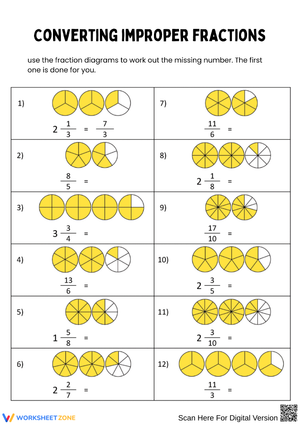
The visual model worksheets split into two complementary tasks. In the first, students receive a written mixed number and shade a pre-partitioned area model — circles divided into equal parts, rectangles sectioned into halves, thirds, or fourths — to represent it. In the second, the model arrives pre-shaded and students write the mixed number it shows. Both directions appear intentionally: production and recognition are separate cognitive demands, and students who read shaded models fluently can still hesitate when asked to construct one from scratch.
Number line worksheets require students to plot mixed numbers at precise locations, which calls for different thinking than area models do. A student who correctly shades 2 and 3/4 on a circle might still place it between 3 and 4 on a number line — area models support part-whole reasoning while number lines require students to think about magnitude and distance from a whole number. The word problem worksheets at the end of the set connect these skills to measurement and cooking contexts, where mixed numbers appear as quantities students must actually use rather than simply identify.
Converting Between Improper Fractions and Mixed Numbers
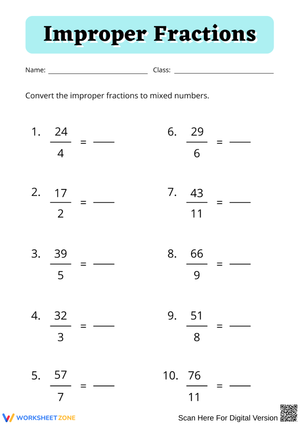
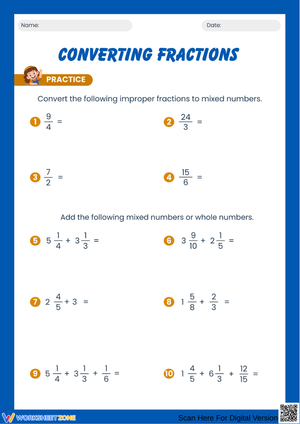
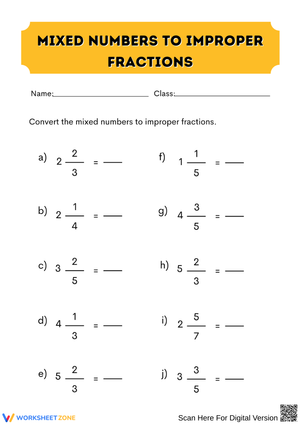
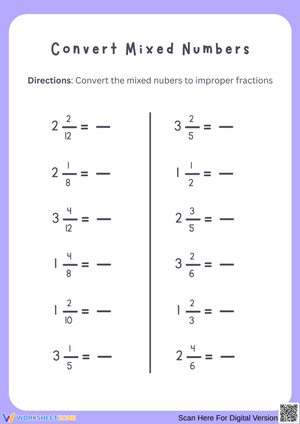
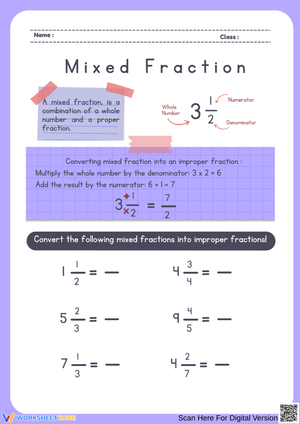
The mixed numbers printable worksheets for 4th grade in this collection approach conversion in both directions, moving from guided step sequences to independent practice to error analysis. Converting an improper fraction to a mixed number means dividing the numerator by the denominator — the quotient becomes the whole number and the remainder goes over the original denominator. Converting back means multiplying the denominator by the whole number, then adding the numerator. Both operations are clear in isolation but produce predictable errors when students work independently under time pressure.
A classroom technique that consistently reduces mistakes: have students draw an arc starting at the denominator, sweeping up through the whole number, and landing on the numerator. The motion traces the operation sequence — multiply first, then add — and students retain it in a way they do not always retain a written rule. The error-analysis items on these worksheets present worked examples with embedded mistakes. Students must locate the error and fix it, which means reading every step critically rather than just arriving at an answer.
The Mistakes That Show Up Most in Student Work
The most persistent conversion error is a remainder swap. A student converts 11/4 correctly — 11 ÷ 4 gives a quotient of 2 with a remainder of 3 — but writes 2 and 4/3 instead of 2 and 3/4, placing the remainder and the denominator in each other's positions. This error almost never appears on the first day students learn the algorithm. It surfaces on day two or three, once students think they have the process memorized and stop reading carefully. Telling students to underline the denominator at the start and carry it straight through, unchanged, catches this before it hardens into habit.
Decomposition surfaces a separate pattern. Students decomposing 1 and 2/3 into thirds sometimes write five thirds — 1/3 + 1/3 + 1/3 + 1/3 + 1/3 — rather than three plus two, treating the whole number as an open-ended supply of thirds rather than exactly 3/3. One worksheet in the set addresses this directly: students rewrite the whole number as a fraction first — "1 = 3/3" — before decomposing the rest of the mixed number. That single added step stops most students from over-counting.
Where These Fit in Your Fraction Unit
The model worksheets belong at the front of the unit, before any conversion algorithm appears. When students have already shaded eleven fourths across separate circles and counted two whole circles plus three leftover fourths, they arrive at "11 ÷ 4" with a visual reference in place. The algorithm then describes something they have already seen, which is a more durable starting point than introducing the rule and following it up with a picture later. The conversion worksheets fit in the middle of the unit, after model work. The word problem worksheets close out the sequence as a transfer task — students must decide how to use the skill, not just carry out a labeled procedure.
For warm-up use, a conversion worksheet runs about eight minutes when students already hold the concept but need repetition before applying it in a new context — useful at the start of a lesson on adding mixed numbers with like denominators, when re-entering the conversion skill right before it is needed in a new operation. These mixed numbers printable worksheets for 4th grade are sized for these targeted instructional slots, and the word problem worksheets in particular fit the ten minutes before afternoon dismissal, when students can read, analyze, and write without needing to launch a longer task.
Standard Alignment
The decomposition exercises address CCSS.MATH.CONTENT.4.NF.B.3.B, which asks students to decompose a fraction into a sum of fractions with the same denominator and record each decomposition as an equation. The conversion practice connects to CCSS.MATH.CONTENT.4.NF.B.3.C, which covers adding and subtracting mixed numbers with like denominators using equivalent fractions. In unit-planning terms, 4.NF.B.3.C arrives late in the fraction sequence — students need fluent conversion before they can regroup during subtraction — and the practice built by these worksheets directly feeds that later work. Placing the conversion exercises between model work and mixed-number operations, rather than at the end of the unit, makes the transition into regrouping noticeably smoother.
Working With the Full Range of Your Class
Students who are still uncertain about numerator and denominator roles should start with the model worksheets only. The shading and identification tasks give them something to count before they are asked to work with symbols. Pairing those students with fraction tiles alongside each worksheet — building the number physically before writing it — keeps early practice concrete without requiring separate lesson preparation.
For students who convert accurately and are ready for more depth, the error-analysis and word problem worksheets press them toward explanation rather than just computation. Ask those students to write a sentence below each word problem describing what the mixed number means in context, not just what it equals numerically. Students who fall in the middle — solid on the concept but inconsistent during independent work — benefit from the fill-in-the-blank conversion sequences, where one or two steps are already completed and they supply the rest. The mixed numbers printable worksheets for 4th grade in this set span enough variety that assigning by readiness is a matter of selecting from what is already here, not building separate materials from scratch.
Frequently Asked Questions
How do you explain the difference between a proper fraction and a mixed number to a 4th grader?
A proper fraction represents a quantity less than one whole — the numerator is smaller than the denominator. A mixed number represents a quantity greater than one whole, expressed as a whole number paired with a proper fraction. Showing both as area models side by side does most of the work: one shaded piece of a four-part circle is a proper fraction; two fully shaded circles plus one shaded piece of a four-part circle is a mixed number. Students who see that comparison side by side typically hold the distinction without much further explanation.
What is the most reliable conversion method for 4th graders to use?
Treat the fraction bar as a division symbol. Divide the numerator by the denominator. The whole-number quotient becomes the whole number part; the remainder becomes the new numerator; the denominator stays the same. Writing those three outputs in labeled boxes — quotient, remainder, denominator — before assembling the final mixed number reduces the remainder-swap error significantly, especially during the first several days of independent practice.
Why does decomposition appear in the same unit as conversion?
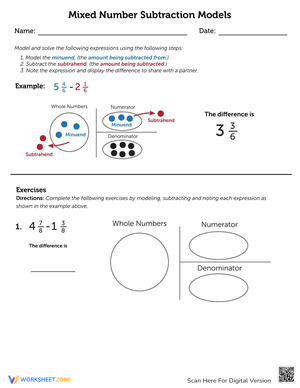
Decomposition is preparation for regrouping. When students subtract mixed numbers and the fractional part being subtracted is greater than the one they are subtracting from, they need to break one whole into fractional parts. Students who can fluently write 1 and 1/4 as 4/4 + 1/4 have already done the conceptual work that regrouping requires. Teaching decomposition early in the unit is not a detour — it builds the exact reasoning students will need before the unit ends.
Can these worksheets be used for review outside of a dedicated fraction unit?
Yes. The visual model worksheets work well as review at the start of 5th grade, when students revisit fraction concepts before moving into more complex operations. The conversion worksheets are also useful for targeted practice with students who passed the unit overall but remained uncertain on one specific conversion direction. Because each worksheet addresses one skill, pulling a single worksheet for a specific gap is straightforward without assigning the entire set.













 Interactive Worksheet Maker
 Quiz Maker
 Word Search Maker
 Crossword Puzzle Maker
 Word Scramble Generator
 Sentence Scramble Generator
 Handwriting Worksheet Generator
 Name Tracing Generator
 Fill In The Blank Generator