


























Views
Downloads


Comparing Simple and Improper Fractions Printable Worksheet
Paste this activity's link or code into your existing LMS (Google Classroom, Canvas, Teams, Schoology, Moodle, etc.).
Students can open and work on the activity right away, with no student login required.
You'll still be able to track student progress and results from your teacher account.
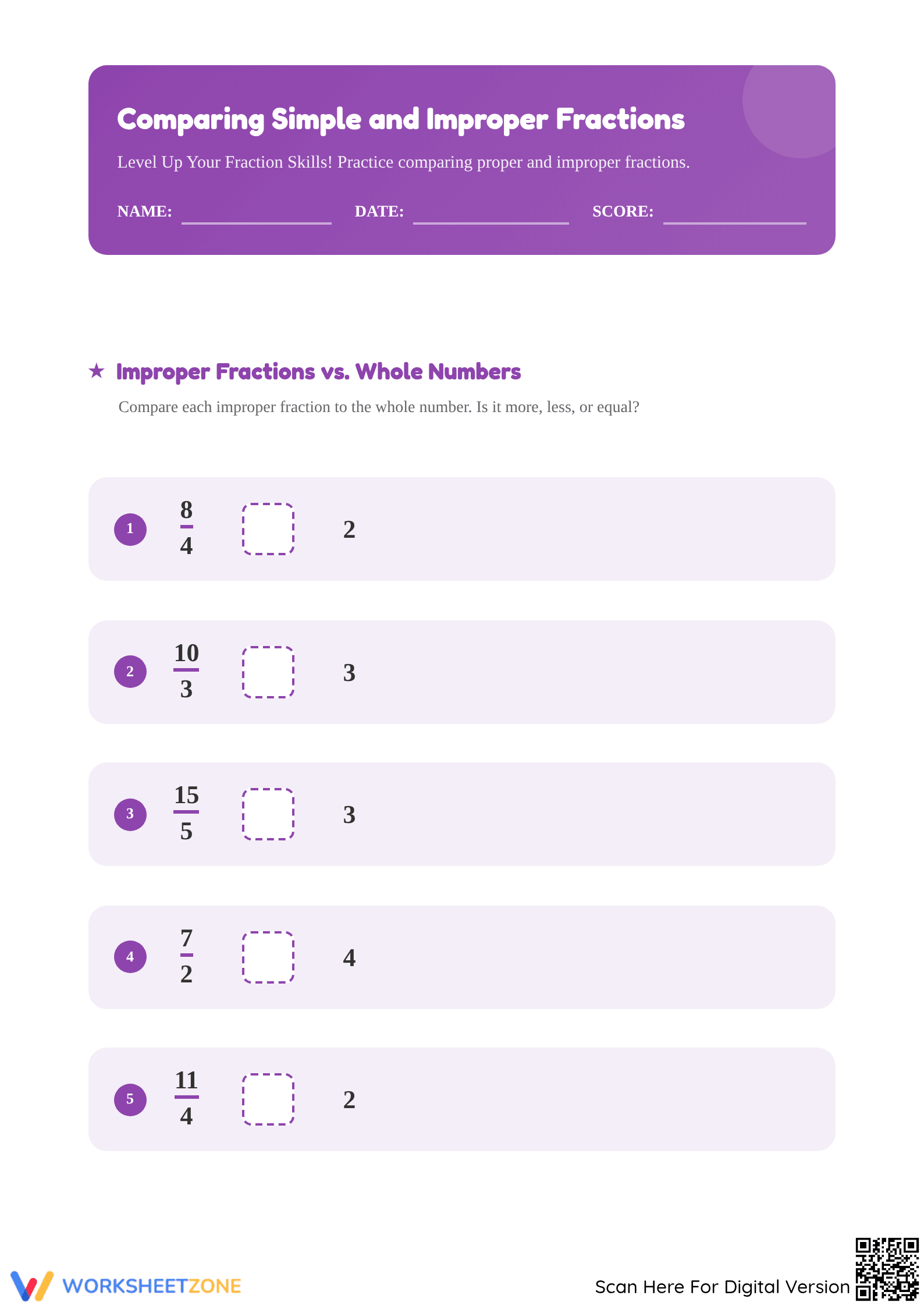
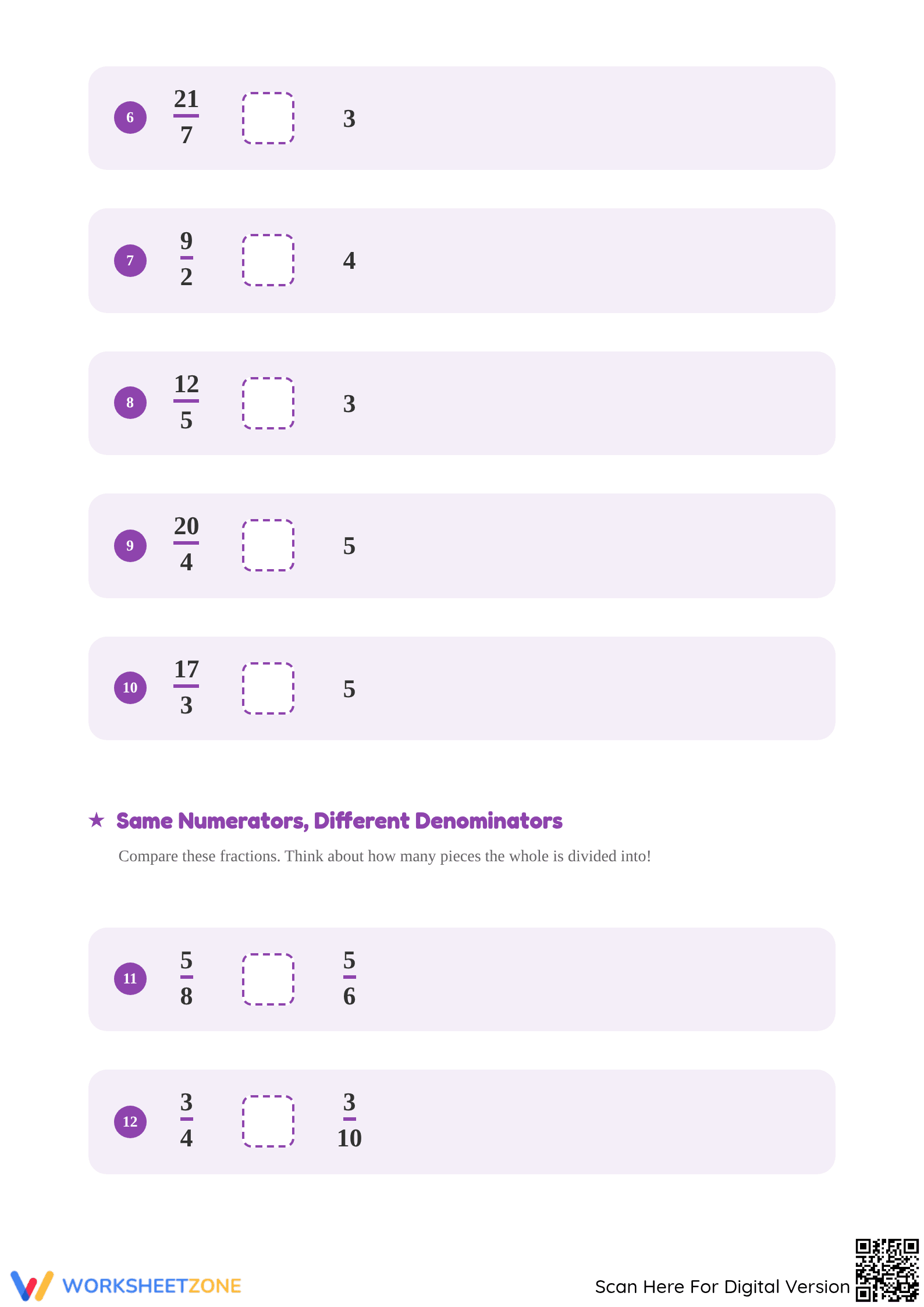
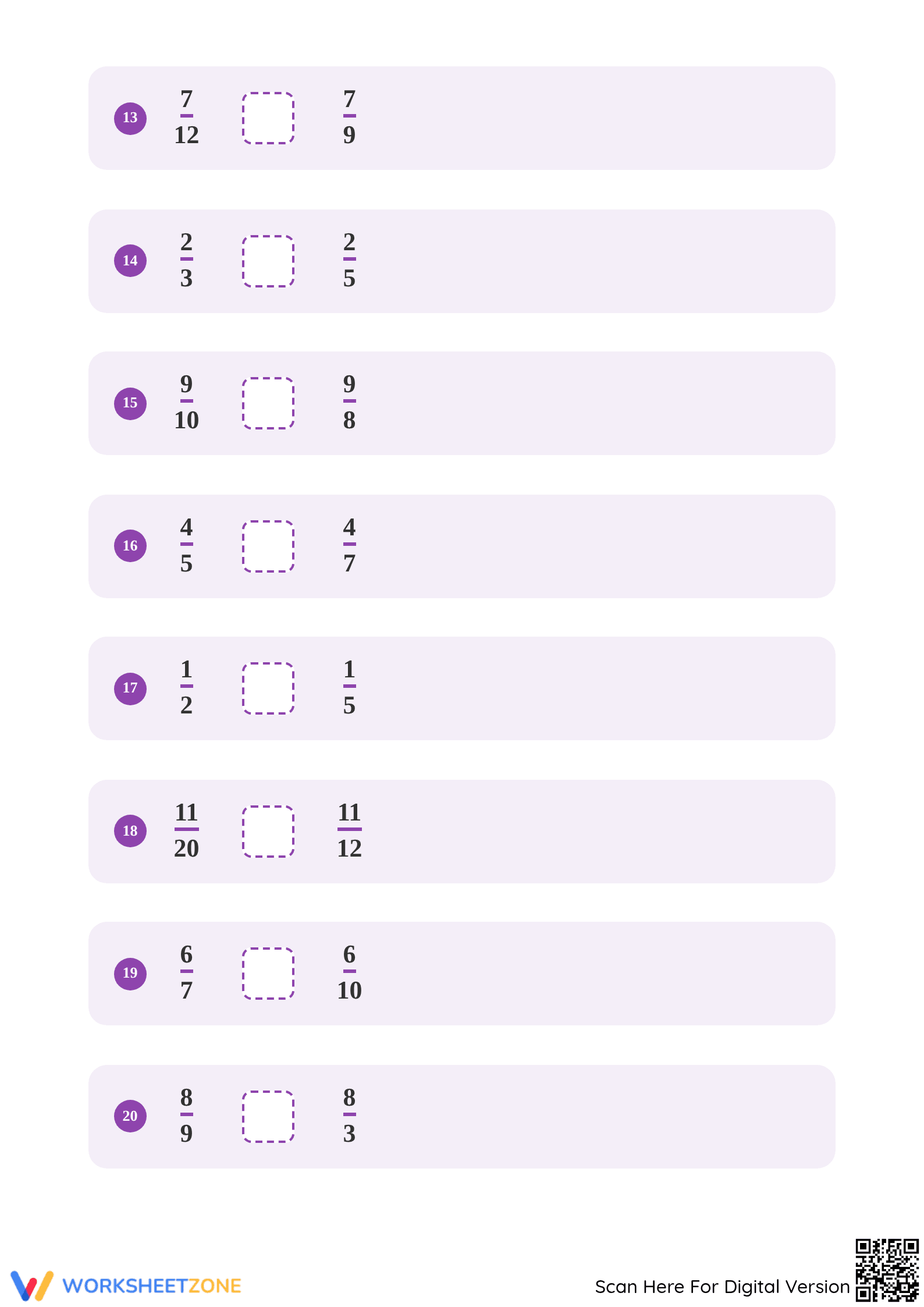
This comprehensive 5-page worksheet provides targeted practice for students to master comparing simple and improper fractions. By tackling 35 structured problems, learners develop a deep conceptual understanding of fraction magnitude, transitioning from simple proper fractions to more complex improper values and their relationships with whole numbers.
At a Glance
- Grade: 4 · Subject: Math
- Standard:
CCSS.MATH.CONTENT.4.NF.A.2— Compare two fractions with different numerators and denominators using symbols- Skill Focus: Comparing proper and improper fractions
- Format: 5 pages · 35 problems · Answer key included · PDF
- Best For: Independent practice and fraction review
- Time: 30–45 minutes
What's Inside: The packet contains 35 problems distributed across five clear pages. Students navigate three distinct sections: Improper Fractions vs. Whole Numbers, Same Numerators with Different Denominators, and a Mixed Comparison Challenge. The layout includes spacious response boxes for inequality symbols (<, >, =) and a complete answer key for rapid grading.
Skill Progression
- Guided Practice: The first 10 problems focus on improper fractions versus whole numbers, helping students visualize how fraction values exceed unity.
- Supported Practice: Tasks 11-20 introduce comparisons between fractions with identical numerators, forcing a focus on denominator magnitude and part size.
- Independent Practice: The final 15 problems offer a "Mixed Comparison Challenge" where students apply cross-multiplication or common denominator strategies.
This gradual release model ensures students build confidence with basic benchmarks before facing the most abstract and varied fraction challenges.
Standards Alignment: CCSS.MATH.CONTENT.4.NF.A.2 requires students to compare two fractions with different numerators and different denominators, e.g., by creating common denominators or numerators, or by comparing to a benchmark fraction such as 1. This standard code can be copied directly into lesson plans, IEP goals, or district curriculum mapping tools.
How to Use It: Use this resource during the "We Do" or "You Do" phase of a lesson on fraction equivalence. Teachers can observe student strategies—such as whether they convert improper fractions to mixed numbers or use cross-multiplication—to provide immediate formative feedback. It serves as an excellent 40-minute independent station activity or a comprehensive homework assignment.
Who It's For: This resource is designed for upper elementary students in Grades 4 and 5 who have mastered basic fraction naming. It supports diverse learners through clear section headers and repetitive formatting, making it a natural pairing for an anchor chart on fraction benchmarks or a visual number line lesson.
Research by Fisher & Frey (2014) emphasizes that effective mathematical instruction relies on a scaffolded approach to complex concepts like fraction comparison. This worksheet implements those findings by isolating specific comparison types—starting with whole-number benchmarks before moving to unequal denominators. Aligned with CCSS.MATH.CONTENT.4.NF.A.2, the material requires students to evaluate the relative size of improper fractions, a critical precursor to middle-school rational number operations. By providing 35 diverse tasks, the resource ensures sufficient repetition for procedural fluency while the mixed challenge section encourages the flexible use of mathematical strategies. This systematic design supports NAEP's call for increased focus on conceptual fraction understanding in early secondary transition years, ensuring students are "Essential" ready for algebraic thinking.


