


























Views
Downloads
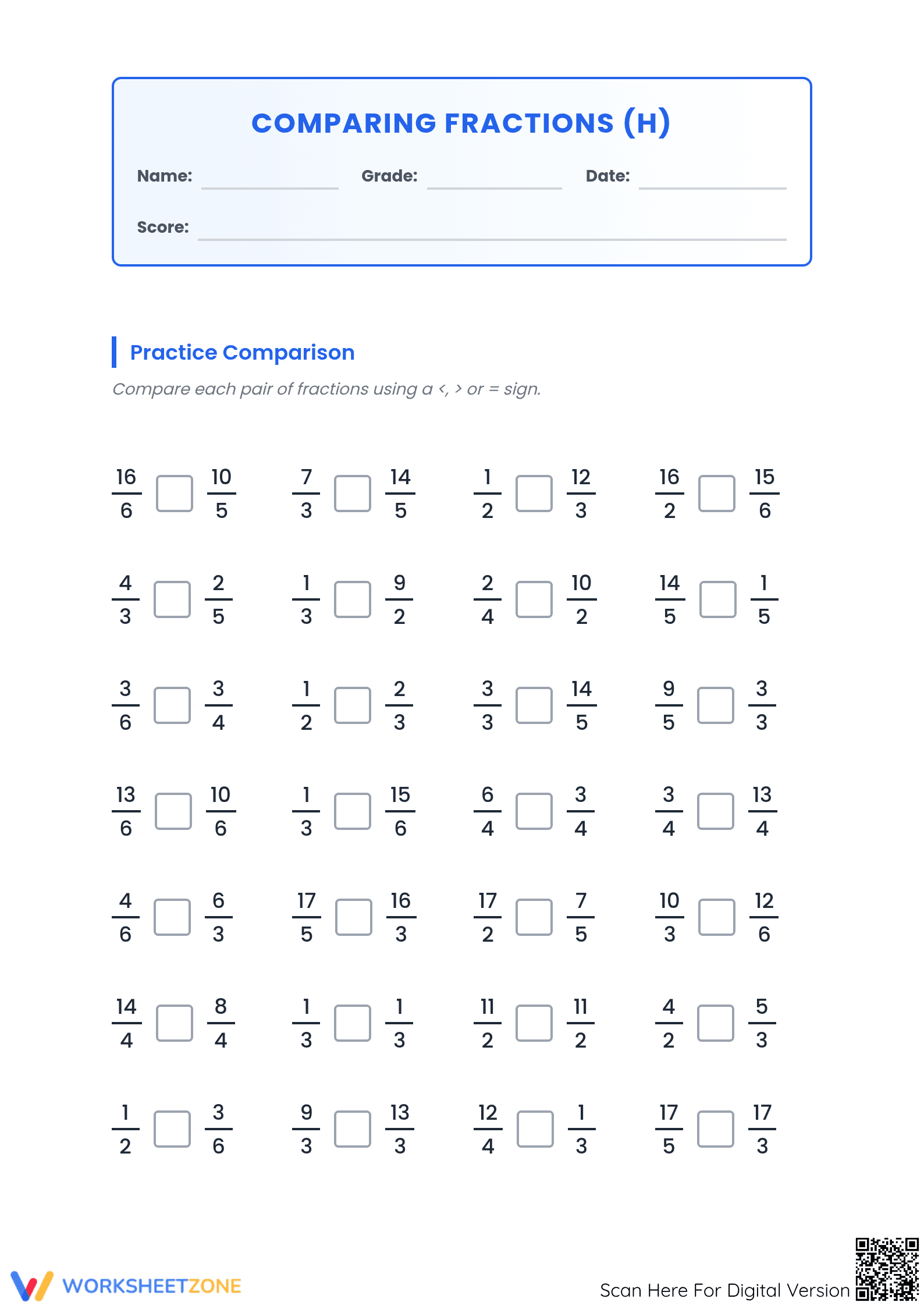


Grade 4 Comparing Improper Fractions | Essential Worksheet
Paste this activity's link or code into your existing LMS (Google Classroom, Canvas, Teams, Schoology, Moodle, etc.).
Students can open and work on the activity right away, with no student login required.
You'll still be able to track student progress and results from your teacher account.
This Grade 4 fraction comparison worksheet empowers students to master the relationship between simple and improper fractions. Before tackling complex operations, learners must confidently identify relative values using inequality symbols. This resource provides high-repetition practice to ensure fluency in comparing values greater than one, a critical precursor to addition and subtraction operations.
At a Glance
- Grade: 4 · Subject: Math
- Standard:
CCSS.MATH.CONTENT.4.NF.A.2— Compare two fractions with different numerators and different denominators by creating common denominators- Skill Focus: Improper Fraction Comparison
- Format: 2 pages · 40 problems · Answer key included · PDF
- Best For: Independent math center practice
- Time: 20–30 minutes
What's Inside
This comprehensive two-page PDF contains 40 targeted comparison problems and a unique conceptual challenge. The first page features 28 exercises focusing on identifying greater than, less than, or equal relationships. The second page provides 12 additional practice problems and a logic challenge requiring students to articulate magnitude concepts. A complete answer key is provided for immediate grading.
Zero-Prep Workflow
This worksheet is designed for maximum teacher efficiency and minimal setup. First, print the two-page document for your group in under 30 seconds. Second, distribute the sheets during your transition to independent work time. Finally, use the included answer key to quickly verify student work or allow for immediate self-correction during rotations. Total teacher preparation time is less than two minutes.
Standards Alignment
The primary alignment is `CCSS.MATH.CONTENT.4.NF.A.2`: "Compare two fractions with different numerators and different denominators." This standard is fundamental for building number sense with values exceeding one whole. Both standard codes can be copied directly into lesson plans, IEP goals, or district curriculum mapping tools to ensure instructional compliance.
How to Use It
This resource is best utilized during the independent practice phase of a gradual release model. Assign the first page after demonstrating common denominator strategies or benchmark fraction comparison. For a formative assessment tip, observe students during the logic challenge; if they struggle to explain the "whole," they likely need additional intervention with visual fraction models. Expected completion time is 25 minutes.
Who It's For
This worksheet is ideal for 4th and 5th-grade students who have moved beyond simple fraction identification and are ready for abstract comparison tasks. It serves as an excellent resource for RTI Tier 2 intervention groups or as a "Must-Do" activity in a blended learning classroom. Pair this sheet with a fraction wall or digital fraction strips to provide visual support.
According to research from Fisher & Frey (2014), the use of high-repetition practice in foundational math skills is essential for reducing cognitive load during more complex problem-solving tasks. This Grade 4 worksheet addresses `CCSS.MATH.CONTENT.4.NF.A.2` by requiring students to compare simple and improper fractions, a skill that NAEP data identifies as a predictor of later success in algebra. By providing 40 discrete comparison tasks, the resource allows students to move from calculation to intuitive number sense. The inclusion of a written logic challenge aligns with best practices in mathematical discourse, forcing learners to move beyond procedural tricks toward a conceptual understanding of fraction magnitude relative to the whole. This balance of procedural fluency and conceptual depth is a hallmark of high-quality instructional materials cited in current ScienceDirect TpT Analysis.


