


























Views
Downloads



Essential Comparing Simple and Improper Fractions Worksheet
Paste this activity's link or code into your existing LMS (Google Classroom, Canvas, Teams, Schoology, Moodle, etc.).
Students can open and work on the activity right away, with no student login required.
You'll still be able to track student progress and results from your teacher account.
Master fraction comparison with this comprehensive practice set. Students analyze relationships between proper and improper fractions to determine relative value using standard inequality symbols. This resource bridges the gap between basic visual fraction understanding and abstract numerical comparison, ensuring students can confidently handle fractions greater than one whole in various mathematical contexts.
At a Glance
- Grade: 4 · Subject: Math
- Standard:
CCSS.MATH.CONTENT.4.NF.A.2— Compare two fractions with different numerators and denominators using symbols- Skill Focus: Improper fraction comparison
- Format: 5 pages · 33 problems · Answer key included · PDF
- Best For: Independent practice and formative assessment
- Time: 25–35 minutes
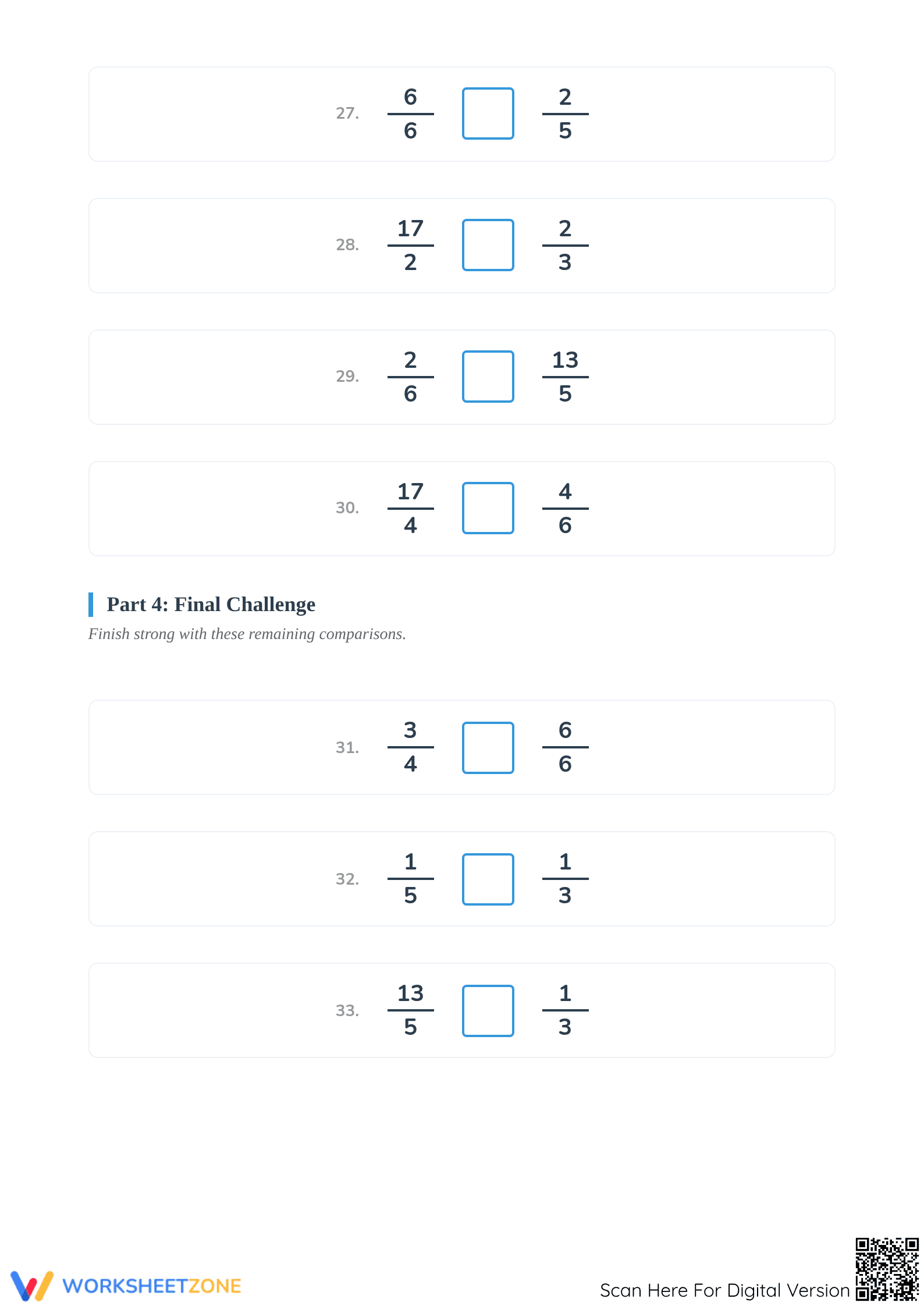
This multi-page packet contains 33 structured problems divided into four progressive sections. It includes 20 direct comparison tasks, a visual relationship guide with area models, and 13 advanced challenge problems. The layout provides spacious boxes for inequality signs, a dedicated workspace for calculations, and a complete answer key for rapid grading or student self-checking.
Skill Progression
- Guided Practice: Students begin with 10 fundamental comparison tasks involving small denominators to establish baseline fluency with proper and improper forms.
- Supported Practice: The visual relationship section uses area models to illustrate how improper fractions exceed one whole, providing a conceptual bridge for abstract reasoning.
- Independent Practice: The packet concludes with a final challenge involving 13 complex comparisons that require students to apply their understanding without visual scaffolds.
This progression ensures a gradual release of responsibility from visual aids to abstract numerical analysis.
This resource is specifically designed for `CCSS.MATH.CONTENT.4.NF.A.2`. Students must compare two fractions with different numerators and different denominators, recording the results with symbols >, =, or <. The inclusion of improper fractions also supports Grade 5 fraction operations. Both standard codes can be copied directly into lesson plans, IEP goals, or district curriculum mapping tools.
Assign the first page as a guided practice activity following a lesson on improper fractions. Use the final page as an exit ticket formative assessment to gauge mastery before moving to fraction addition. For a quick check, observe student strategy during the visual relationship section to ensure they recognize fractions greater than one whole correctly.
This is ideal for fourth-grade students developing fraction number sense or fifth-graders needing review. It supports diverse learners by providing visual scaffolds before transitioning to abstract numerical tasks. Pair this with a fraction tile manipulative set or a number line passage to strengthen the conceptual connection between visual and symbolic representations.
Mathematical proficiency in comparing fractions requires a transition from intuitive visual models to formal symbolic reasoning. According to a ScienceDirect TpT Analysis, effective fraction instruction must explicitly address misconceptions regarding improper fractions, which students often treat as two separate whole numbers rather than a single value. This worksheet addresses that need by providing 33 targeted problems that require students to evaluate fractions relative to a whole. By explicitly practicing `CCSS.MATH.CONTENT.4.NF.A.2` through both simple and improper examples, students build the numerical fluency required for middle-school algebra. Research from NAEP suggests that students who master fraction comparison early show significantly higher achievement in later rational number operations. This resource ensures that learners do not just memorize procedures but instead develop a robust understanding of fraction magnitude through varied, standards-aligned practice that can be easily integrated into any comprehensive math curriculum.


