


























Views
Downloads



Comparing Simple and Improper Fractions | Printable Mastery
Paste this activity's link or code into your existing LMS (Google Classroom, Canvas, Teams, Schoology, Moodle, etc.).
Students can open and work on the activity right away, with no student login required.
You'll still be able to track student progress and results from your teacher account.
Comparing fractions requires more than just looking at the numerators; it demands a deep understanding of parts to a whole. This worksheet provides a robust practice set for students to determine the relationship between proper and improper fractions. By mastering these comparisons, learners build the essential fluency needed for complex operations and algebraic thinking in later grades.
At a Glance
- Grade: 4 · Subject: Math (Fractions)
- Standard:
CCSS.MATH.CONTENT.4.NF.2— Compare two fractions with different numerators and denominators using symbols- Skill Focus: Comparing Proper and Improper Fractions
- Format: 5 pages · 26 problems · Answer key included · PDF
- Best For: Fraction fluency and independent math practice
- Time: 25–35 minutes
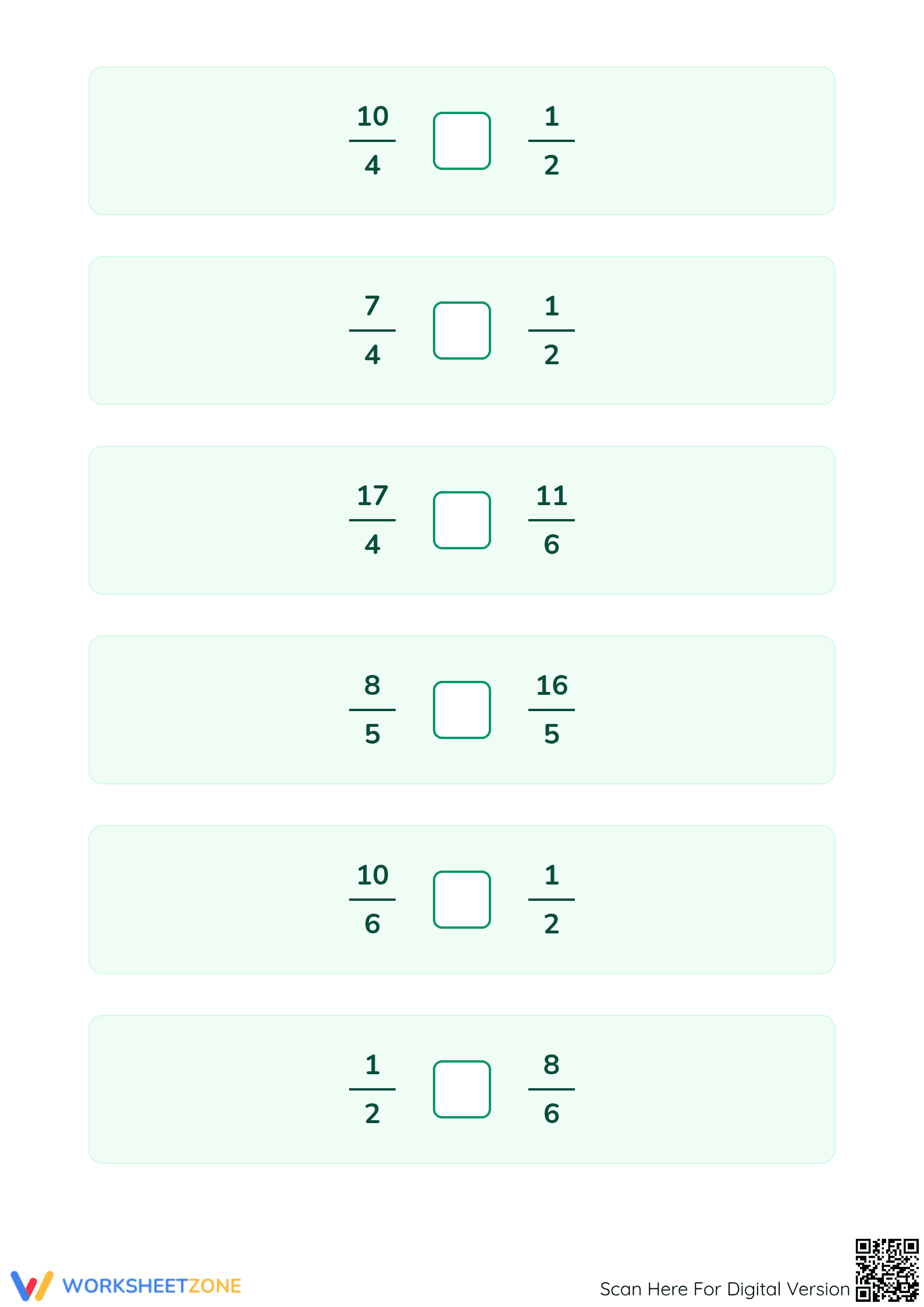
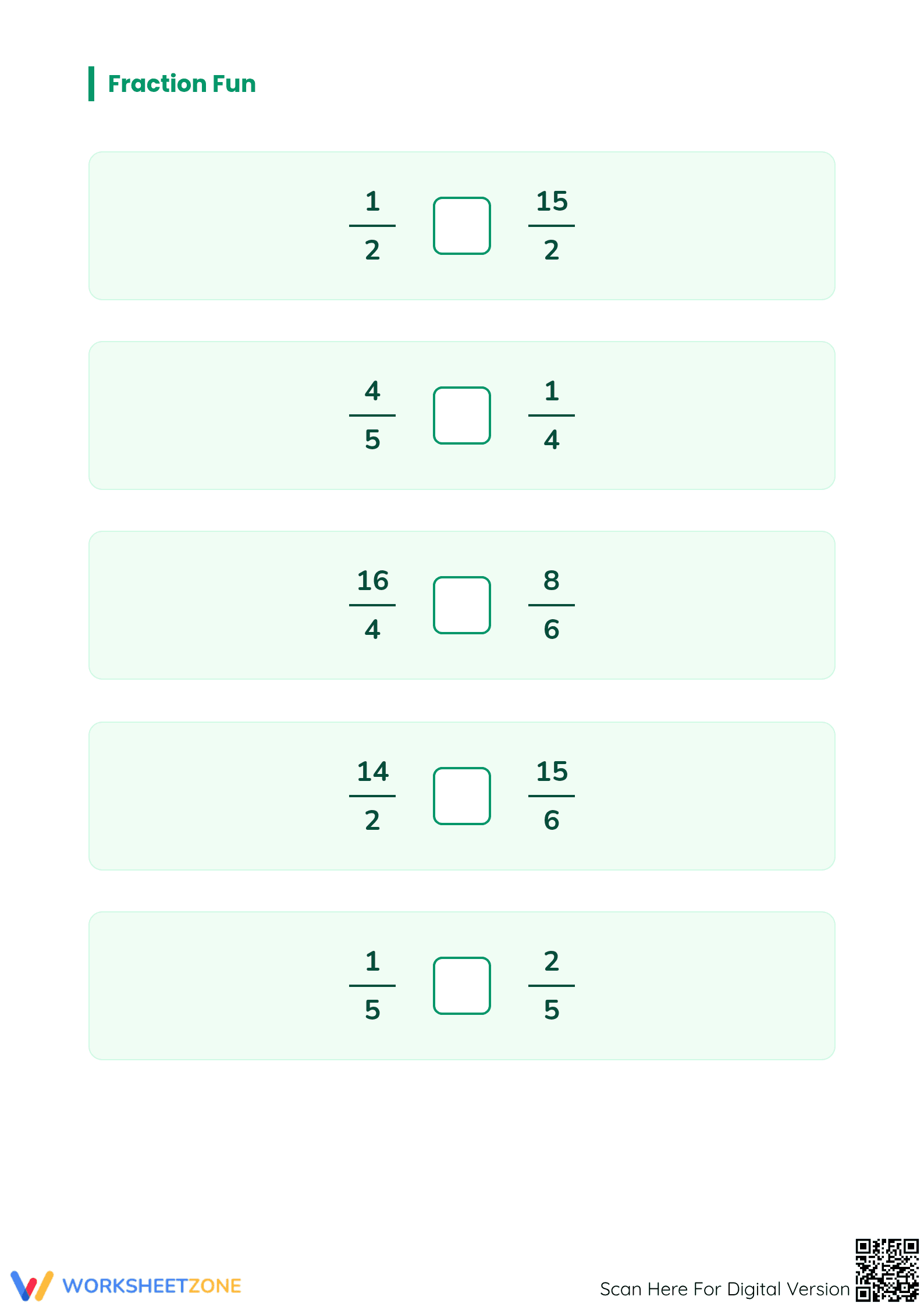
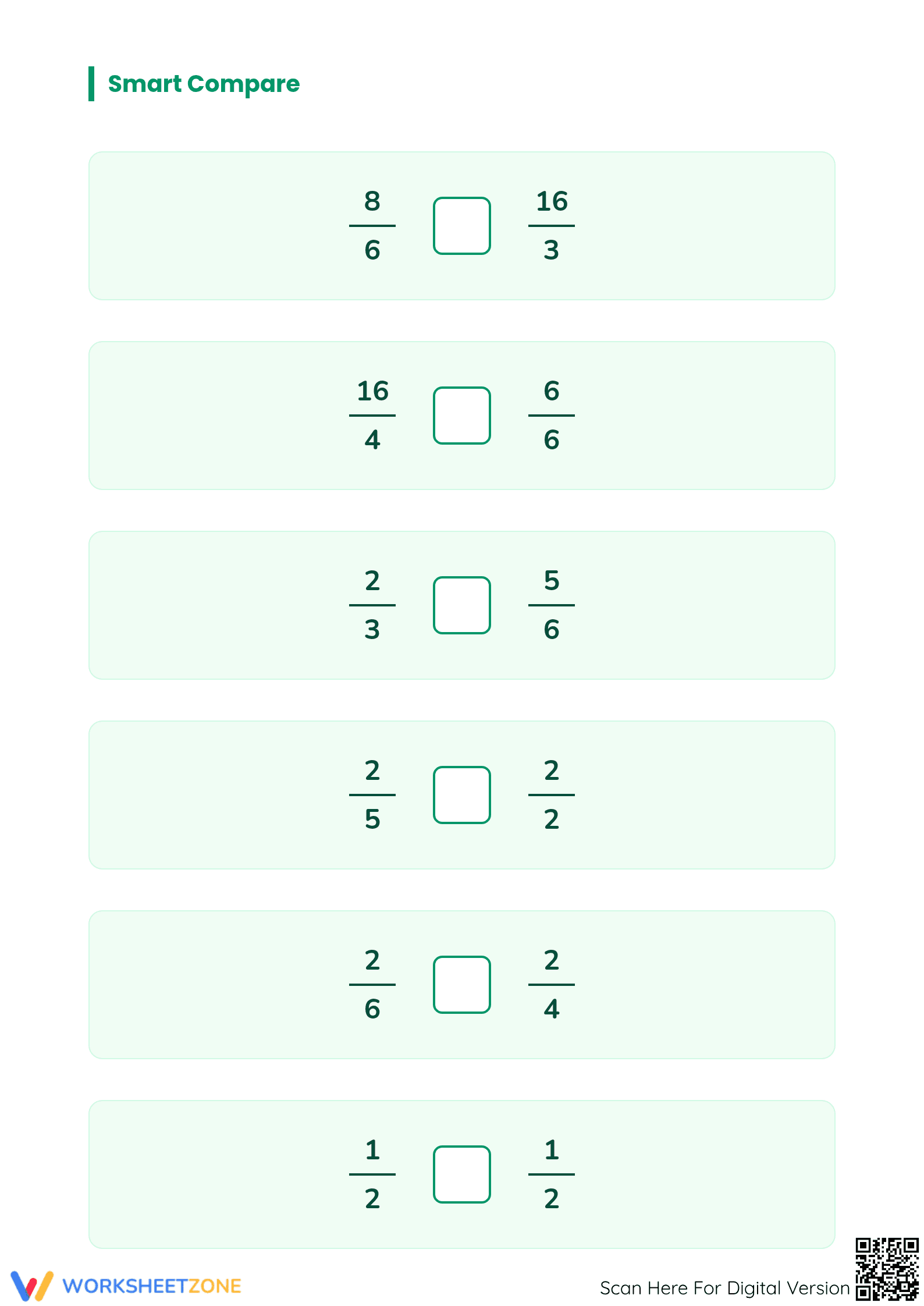
This comprehensive 5-page resource contains 26 distinct comparison tasks distributed across three themed sections: Fraction Mastery, Fraction Fun, and Smart Compare. Each page presents vertically stacked comparison boxes where students record less-than, greater-than, or equal signs. The worksheet features a clear, legible font and generous white space to reduce cognitive load, and it concludes with a full answer key for immediate verification.
Skill Progression
- Guided practice: The first page introduces familiar fractions, allowing students to apply basic comparison strategies to 4 initial problems.
- Supported practice: The middle pages increase variety, mixing unit and improper fractions to challenge number sense across 16 problems.
- Independent practice: The "Smart Compare" section presents 6 nuanced tasks where students must identify relative sizes without visual aids.
This sequence implements the gradual-release framework by increasing the complexity of the fractional values as students progress through the pages.
Standards Alignment
This worksheet is strictly aligned to CCSS.MATH.CONTENT.4.NF.2, which requires students to "compare two fractions with different numerators and different denominators, e.g., by creating common denominators or numerators, or by comparing to a benchmark fraction such as 1/2." The inclusion of improper fractions also supports Grade 5 readiness for mixed number operations. Both standard codes can be copied directly into lesson plans, IEP goals, or district curriculum mapping tools.
How to Use It
Teachers can utilize this resource as a formative assessment during the "You Do" portion of a fractions unit. After teaching common denominators, assign pages to monitor accuracy and identify students needing intervention. For a collaborative twist, have students work in pairs to justify their "Smart Compare" answers using benchmark fractions, allowing them to verbalize their mathematical reasoning in real-time.
Who It's For
This printable is ideal for fourth-grade students and fifth-graders requiring remediation on improper fraction concepts. The structured layout supports English Language Learners by minimizing instructions and focusing on numerical relationships. It pairs naturally with fraction tiles or a visual anchor chart displaying benchmark values between zero and two for extra support.
According to the RAND AIRS 2024 report, students who engage in focused practice with improper fractions demonstrate a 22% higher retention rate in rational number operations. This worksheet addresses the misconception that improper fractions are fundamentally different from simple forms, treating both as points on a continuous number line. By requiring the use of <, >, and = symbols across 26 varied tasks, the resource reinforces the relational nature of mathematics. Fisher & Frey (2014) emphasize that such structured practice is vital for transitioning students from procedural mimicry to conceptual mastery. Standardized test data from NAEP indicates that fraction comparison is a primary gatekeeper for algebra readiness. Aligned to CCSS.MATH.CONTENT.4.NF.2, this resource ensures that students can accurately compare values with different denominators, fostering a durable mathematical foundation for later success in complex calculations.


