


























Views
Downloads



Essential Comparing Improper Fractions Worksheet | Grade 4-5
Paste this activity's link or code into your existing LMS (Google Classroom, Canvas, Teams, Schoology, Moodle, etc.).
Students can open and work on the activity right away, with no student login required.
You'll still be able to track student progress and results from your teacher account.
Strengthen conceptual understanding with this comprehensive comparing simple and improper fractions worksheet. This Grade 4 resource bridges the gap between basic fraction identification and advanced rational number comparison. Students master relative size across 39 structured problems, ensuring they can accurately identify which values are greater, less than, or equal to one another using proper notation.
At a Glance
- Grade: 4 · Subject: Math
- Standard:
CCSS.MATH.CONTENT.4.NF.A.2— Compare two fractions with different numerators and different denominators by creating common denominators- Skill Focus: Comparing Proper and Improper Fractions
- Format: 5 pages · 39 problems · Answer key included · PDF
- Best For: Small group intervention or independent practice
- Time: 25–40 minutes
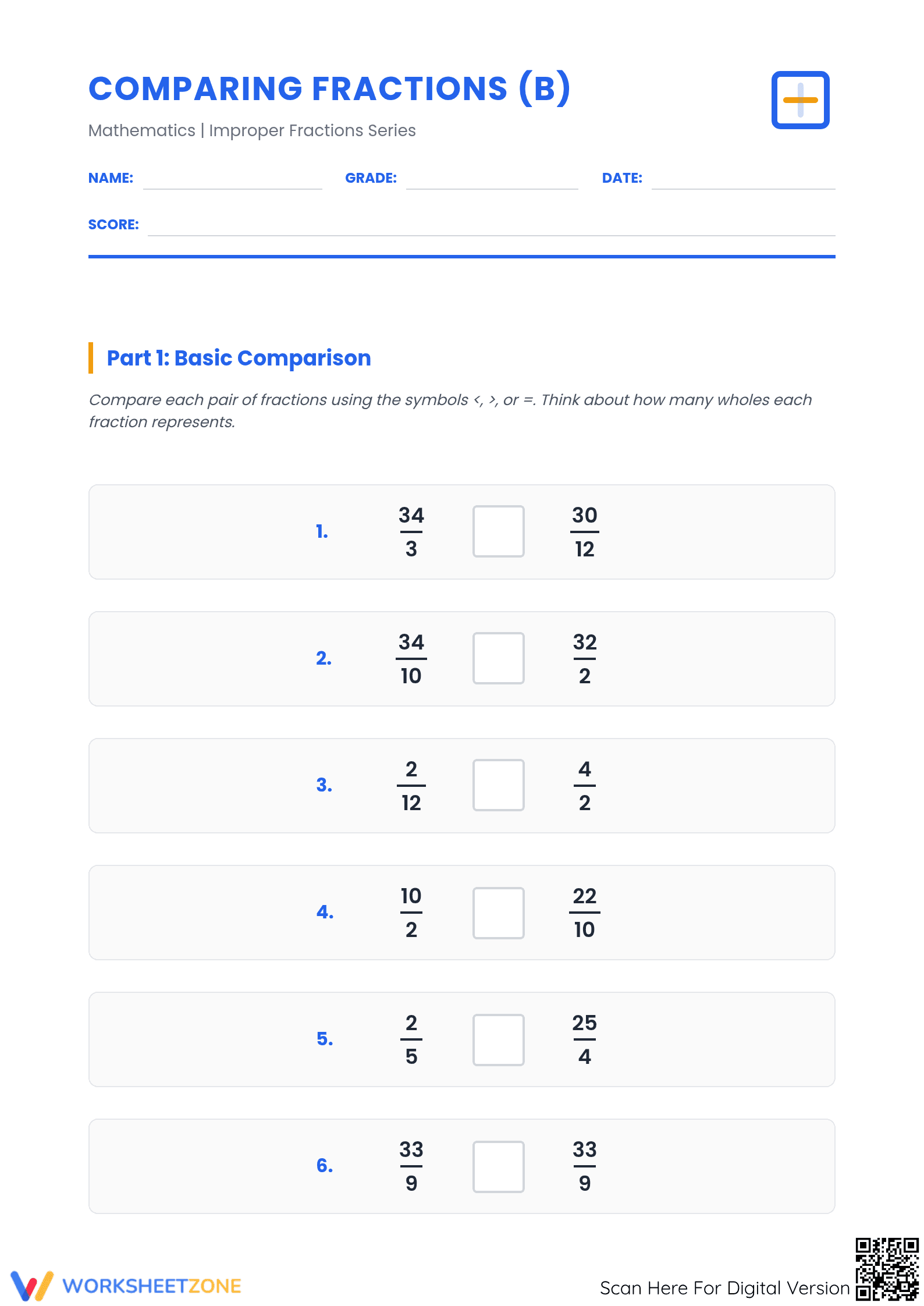
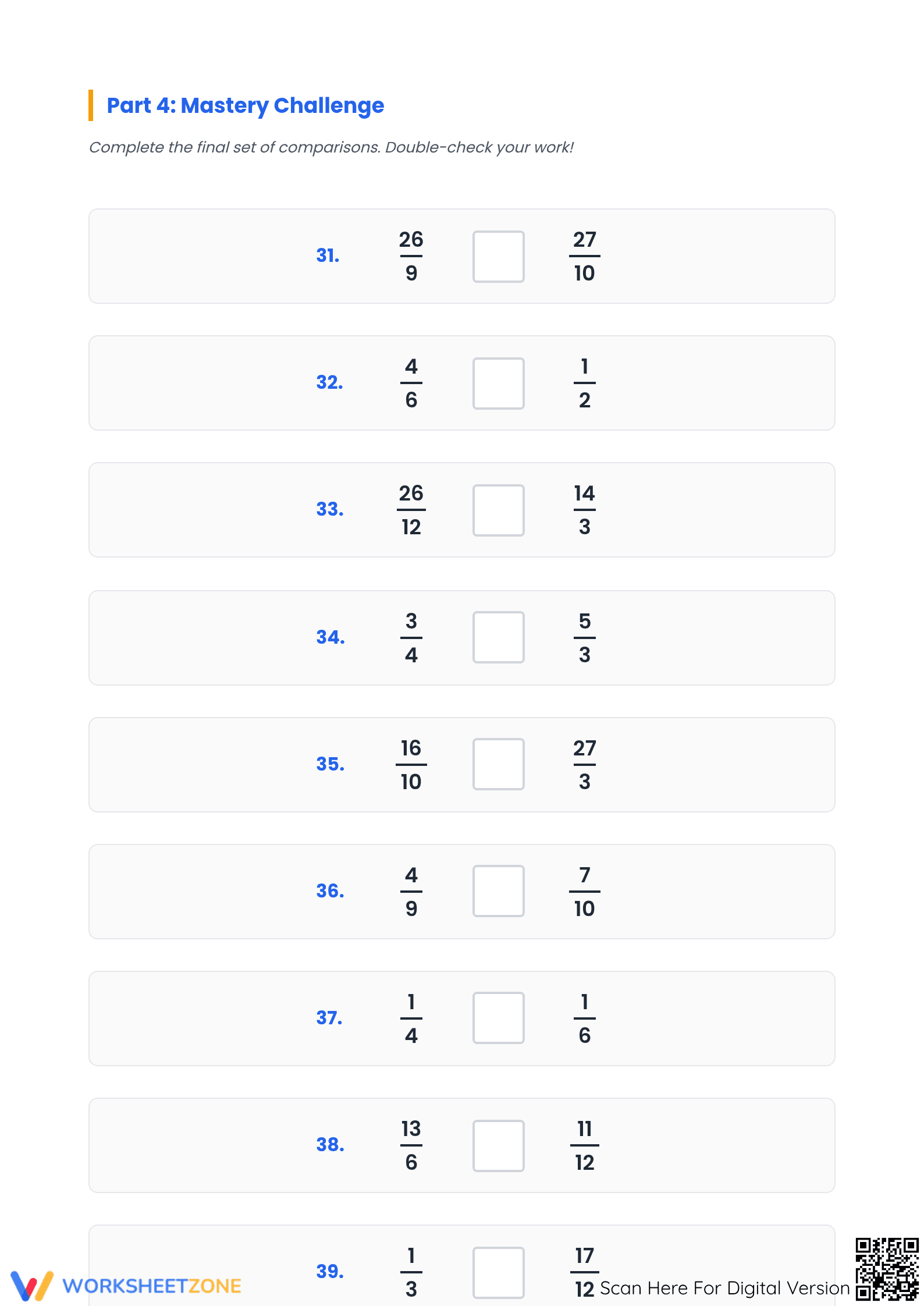
This 5-page PDF contains 39 unique fraction comparison tasks organized into four distinct difficulty tiers. The worksheet features a clean, student-friendly layout with dedicated boxes for inequality symbols. An exhaustive answer key is included, allowing for rapid grading or student self-correction. The structural design emphasizes the "Mathematics Improper Fractions Series" branding, ensuring students understand they are working with values that often exceed a single whole.
- Guided Practice: 10 problems focus on basic comparisons with small denominators to build benchmark-to-one confidence and establish initial comparison strategies.
- Supported Practice: 10 intermediate tasks introduce larger numerators, requiring students to apply common denominators or cross-multiplication strategies to verify their reasoning.
- Independent Practice: 19 advanced reasoning problems remove scaffolding, challenging students with complex pairs that closely approach whole numbers and final mastery checks.
This gradual-release model follows the I Do, We Do, You Do instructional framework to ensure every learner achieves mastery through systematic repetition.
This resource is primarily aligned with CCSS.MATH.CONTENT.4.NF.A.2, which requires students to compare two fractions with different numerators and denominators. It also supports CCSS.MATH.CONTENT.5.NF.A.1 by encouraging the use of equivalent fractions as a comparison strategy. Both standard codes can be copied directly into lesson plans, IEP goals, or district curriculum mapping tools.
Use this worksheet during the "We Do" phase of a lesson to observe how students handle improper fractions that appear visually similar. It serves as an excellent formative assessment tool; check if students are correctly using benchmarks or if they are defaulting to less efficient algorithms. We recommend allocating 30 minutes for completion during an independent work block or as a targeted homework assignment after direct instruction on common denominators.
This worksheet is ideal for Grade 4 students first encountering improper fractions and Grade 5 students needing a magnitude refresher. The tiered sections provide natural differentiation for students with varying levels of prior knowledge. Pair this resource with a visual number line or area model anchor chart to help students visualize why an improper fraction like 34/3 is significantly larger than a proper fraction like 2/12.
Effective fraction instruction requires moving beyond surface-level procedures to a deep conceptual understanding of relative size. According to the RAND AIRS 2024 report on mathematics proficiency, students who practice comparing improper fractions to proper fractions develop a stronger internal number sense and are better prepared for operations with rational numbers. This worksheet targets CCSS.MATH.CONTENT.4.NF.A.2 by requiring students to evaluate 39 different pairs across four distinct levels of cognitive demand. By focusing on the relationship between numerators and denominators in fractions greater than one, students learn to recognize the "wholeness" of a value without relying solely on cross-multiplication. This strategic approach to comparing simple and improper fractions ensures that learners can explain the reasoning behind their inequality symbols. This resource acts as a vital bridge between elementary fraction identification and middle-school ratio analysis, providing the repetition needed for long-term retention of these essential mathematical concepts.


