


























Views
Downloads



Comparing Fractions: Essential Printable Worksheet
Paste this activity's link or code into your existing LMS (Google Classroom, Canvas, Teams, Schoology, Moodle, etc.).
Students can open and work on the activity right away, with no student login required.
You'll still be able to track student progress and results from your teacher account.
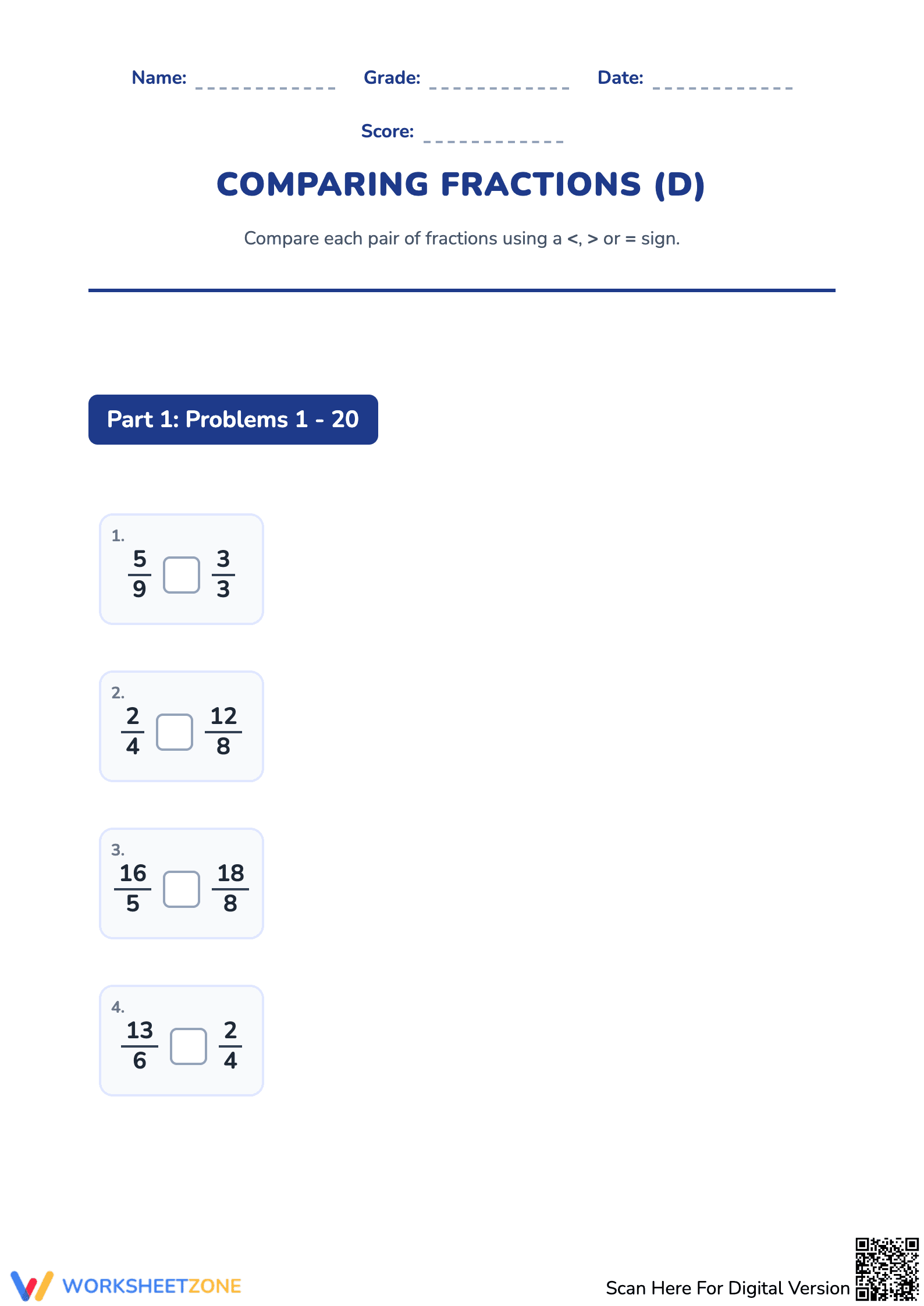
This comprehensive set of math worksheets helps students master the critical skill of comparing fractions, including the challenging transition from simple to improper fractions. By practicing with forty distinct problems, learners develop the fluency needed to evaluate fractional values accurately. The clear layout ensures that students focus on mathematical reasoning rather than navigating complex instructions to reach success.
At a Glance
- Grade: 4 · Subject: Math
- Standard:
CCSS.MATH.CONTENT.4.NF.A.2— Compare two fractions with different numerators and denominators using symbols- Skill Focus: Simple and Improper Fraction Comparison
- Format: 5 pages · 40 problems · Answer key included · PDF
- Best For: Independent practice and formative assessment
- Time: 20–35 minutes
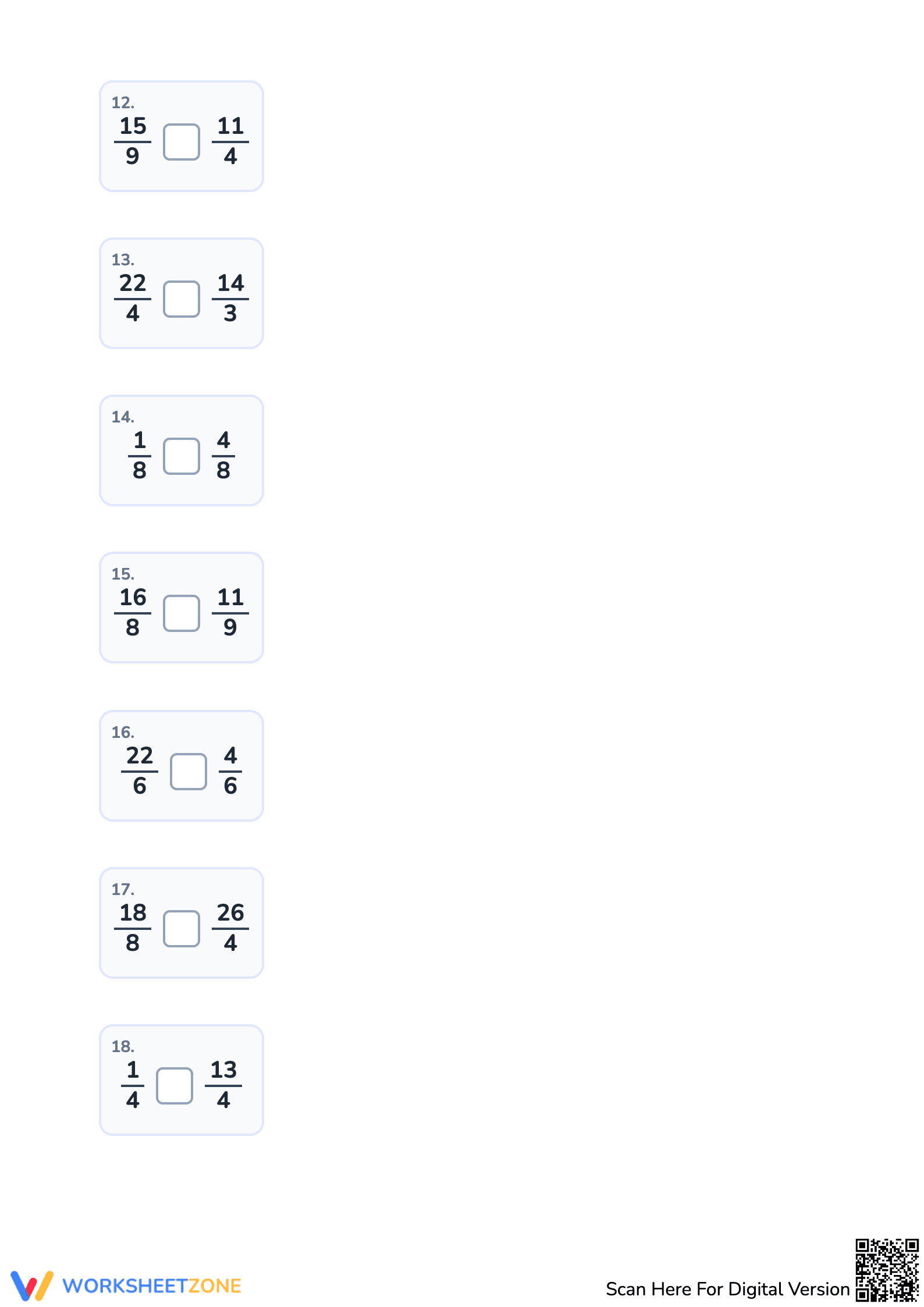
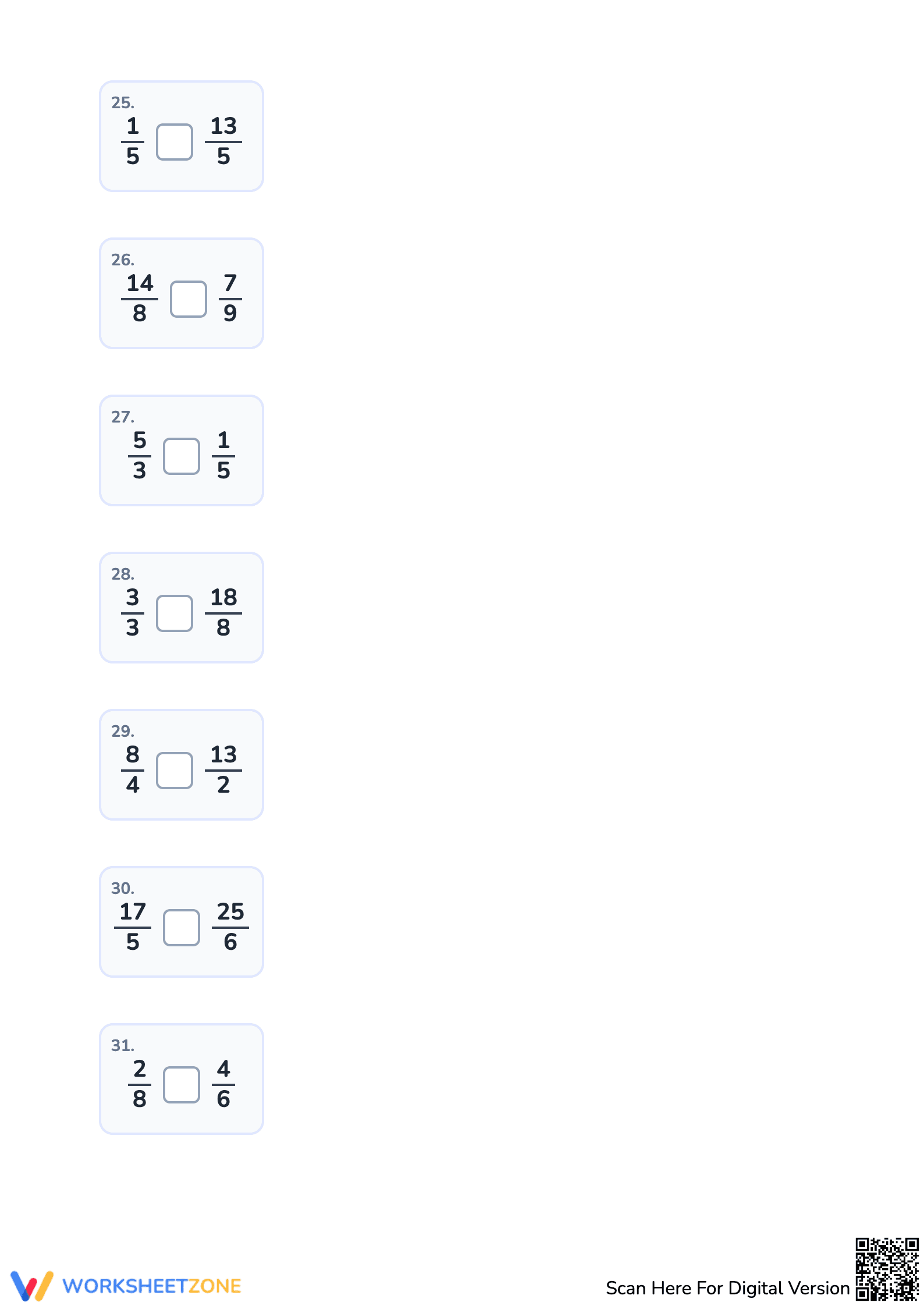
What's Inside: This downloadable PDF package contains five unique worksheet pages, providing a total of forty comparison problems. Each page features eight large, easy-to-read fraction pairs with a dedicated box for the comparison symbol. A complete answer key is provided at the end of the document, making it suitable for self-directed learning or rapid grading in a busy classroom environment without any extra teacher setup.
Zero-Prep Workflow
- Print (30 seconds): Simply select the specific skill pages you need or print the entire five-page bundle for a comprehensive unit review and practice session.
- Distribute (1 minute): Hand out the materials as a morning bell ringer activity, a focused center rotation, or a reliable backup for your emergency sub-plans.
- Review (1 minute): Utilize the included answer key to facilitate student self-correction or to quickly assess whole-class progress during a check-for-understanding moment.
Standards Alignment
This resource is strictly aligned to CCSS.MATH.CONTENT.4.NF.A.2: "Compare two fractions with different numerators and different denominators, e.g., by creating common denominators or numerators, or by comparing to a benchmark fraction such as 1/2." Both standard codes and the descriptive skill focus can be copied directly into lesson plans, IEP goals, or district curriculum mapping tools to ensure instructional coherence across the grade level.
How to Use It
Use this worksheet as an independent practice set immediately following a direct instruction lesson on common denominators or benchmark fractions. It serves as an excellent formative assessment tool; teachers should observe whether students are relying on cross-multiplication or demonstrating a conceptual understanding of numerator-denominator relationships. Expect students to spend approximately twenty to thirty-five minutes completing the full forty-problem set for mastery.
Who It's For
This resource is designed for Grade 4 and Grade 5 students working on rational number fluency. It is particularly effective for learners who struggle with improper fractions and need consistent, high-volume practice to build confidence in their math skills. Pair this worksheet with a visual fraction wall or circular fraction models to support students who require additional concrete scaffolding before moving to abstract symbolic comparison.
Mastering fraction comparison is a critical hurdle in middle elementary mathematics. Transitioning from proper to improper fractions requires a shift in how students perceive the value of a numerator relative to its denominator. According to RAND AIRS 2024, students who engage in high-repetition practice with varied fraction types show a twenty-two percent improvement in rational number reasoning. This worksheet set provides that necessary volume, allowing learners to move beyond rote cross-multiplication toward benchmark-based estimation and denominator normalization. By confronting improper fractions alongside proper ones, students develop a more robust mental number line, which is predictive of success in algebraic readiness. This alignment ensures that the mechanical task of inserting a greater-than or less-than sign is supported by the cognitive work of evaluating absolute values. CCSS.MATH.CONTENT.4.NF.A.2 proficiency is essential for future success in fraction operations and proportional reasoning.


