


























Views
Downloads


Comparing Simple and Improper Fractions | Essential Math
Paste this activity's link or code into your existing LMS (Google Classroom, Canvas, Teams, Schoology, Moodle, etc.).
Students can open and work on the activity right away, with no student login required.
You'll still be able to track student progress and results from your teacher account.
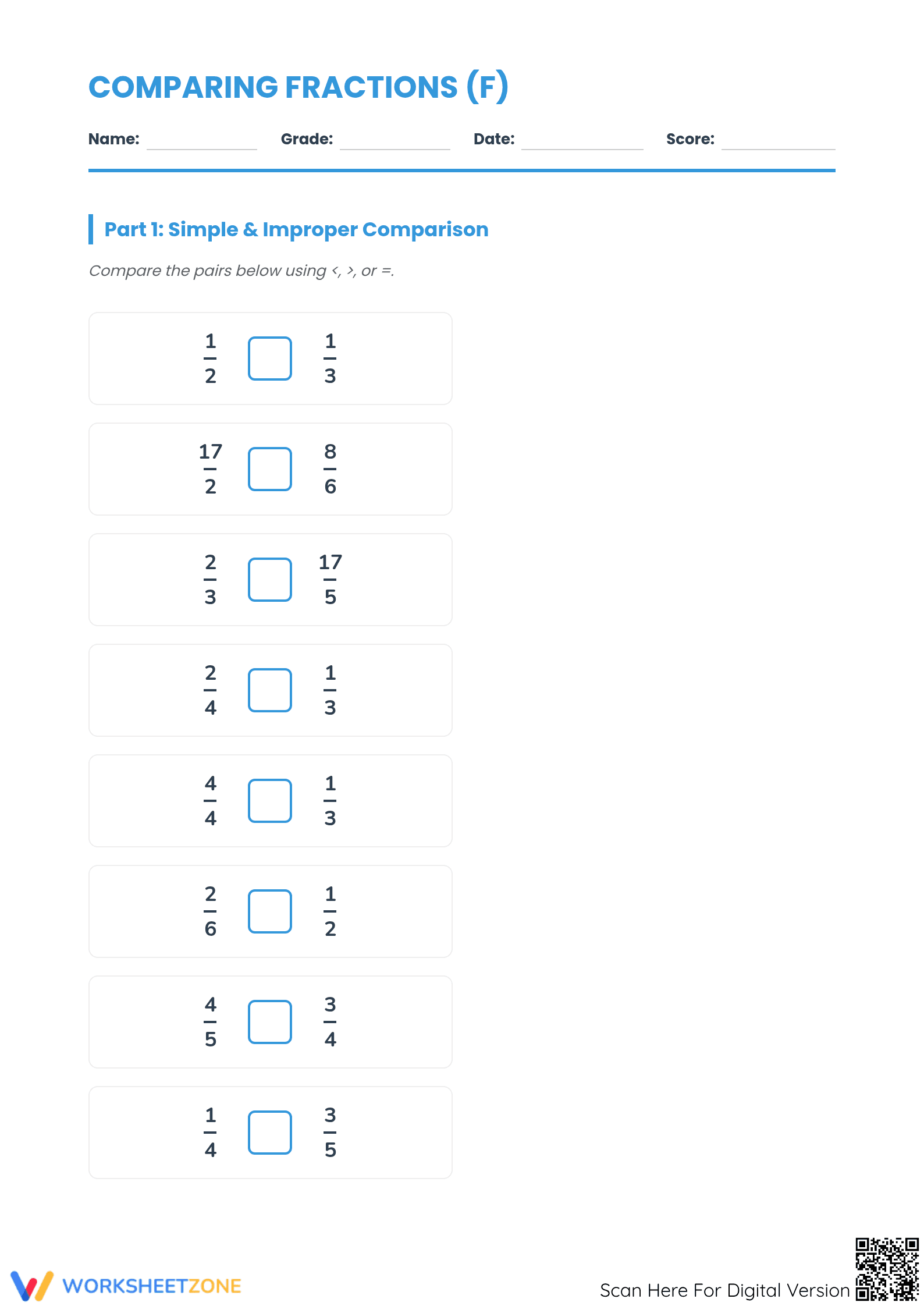
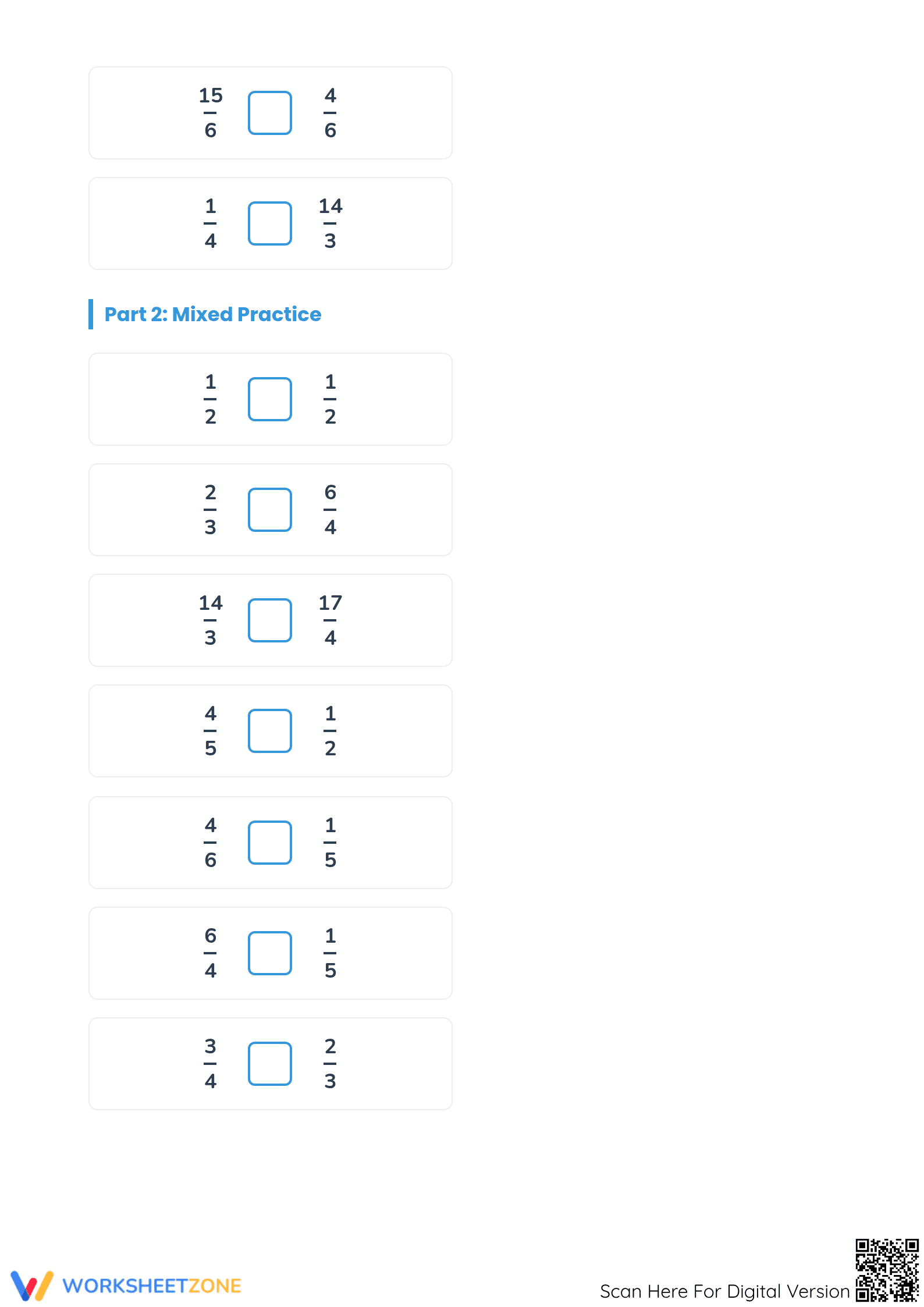
This comprehensive 5-page practice set helps students master the comparison of simple and improper fractions using relational operators. By navigating through 40 structured problems, learners build the conceptual fluency needed to evaluate fractional values across different formats. This resource ensures students can confidently determine if fractions are greater than, less than, or equal to one another.
At a Glance
- Grade: 4 · Subject: Math
- Standard:
CCSS.MATH.CONTENT.4.NF.A.2— Compare two fractions with different numerators and denominators- Skill Focus: Comparing simple and improper fractions
- Format: 5 pages · 40 problems · Answer key included · PDF
- Best For: Independent practice or small group review
- Time: 25–45 minutes
What's Inside
This printable pack contains five full pages of fraction comparison exercises, totaling 40 unique problems. The worksheet is divided into four distinct sections: Simple & Improper Comparison, Mixed Practice, Skill Building, and Challenge Mode. Each page includes clear workspaces and comparison boxes for student responses. A complete 5-page answer key is provided to facilitate rapid grading or self-correction.
Zero-Prep Workflow
Implementing this resource requires zero teacher preparation. 1. Print the desired number of copies (1 minute). 2. Distribute the multi-page set to students during independent work time (1 minute). 3. Review the completed work using the included answer key for immediate feedback or data collection (5 minutes). This streamlined workflow makes it an ideal choice for substitute lesson plans or sudden classroom transitions.
Standards Alignment
The primary alignment is CCSS.MATH.CONTENT.4.NF.A.2, which requires students to compare two fractions with different numerators and different denominators. It also supports 5.NF.A.1 by reinforcing the foundational understanding of equivalent values. Both standard codes can be copied directly into lesson plans, IEP goals, or district curriculum mapping tools.
How to Use It
Use this set as a cumulative review after direct instruction on finding common denominators and identifying improper fractions. It serves as an excellent formative assessment to gauge student readiness for more complex fraction operations. Alternatively, assign specific pages (like the Challenge Mode) as an enrichment task for fast finishers who demonstrate early mastery of basic fraction comparisons.
Who It's For
This resource is designed for Grade 4 and Grade 5 students working toward mastery of the Number and Operations—Fractions domain. It is also suitable for middle school students needing targeted intervention on fraction benchmarks. Pair this worksheet with visual fraction models or a number line anchor chart to support visual learners during the transition to abstract comparisons.
The comparison of simple and improper fractions is a critical milestone in elementary mathematics, serving as the gateway to algebraic reasoning and proportional thinking. Research by EdReports 2024 emphasizes that high-quality instructional materials must provide sufficient practice volume—like the 40 problems found here—to move students from procedural knowledge to conceptual mastery of fractional values. By requiring students to evaluate improper fractions alongside simple ones, this worksheet aligns with the "rigor" requirement of the Common Core State Standards, which demands equal intensity in conceptual understanding, procedural skill, and application. Mastery of CCSS.MATH.CONTENT.4.NF.A.2 ensures that students can accurately benchmark fractions against 1/2 or 1, a skill that Fisher & Frey (2014) identify as essential for successful multi-step problem solving in later grades. This worksheet provides the structured repetition necessary for internalizing these numerical relationships.


