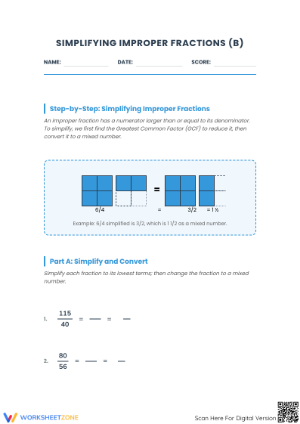
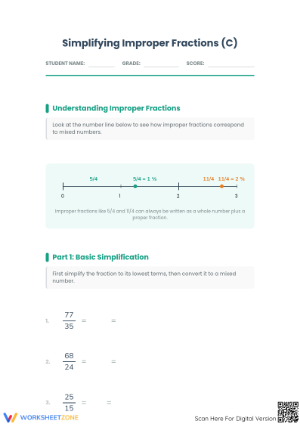
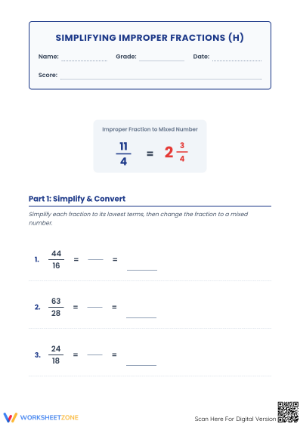
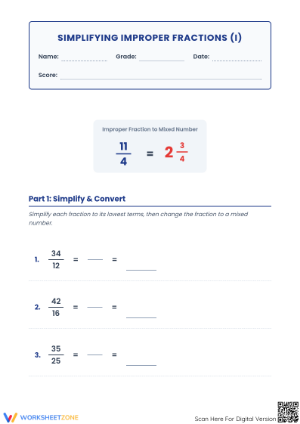
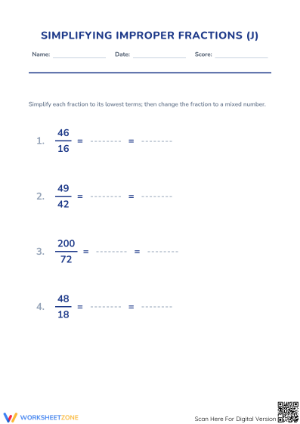
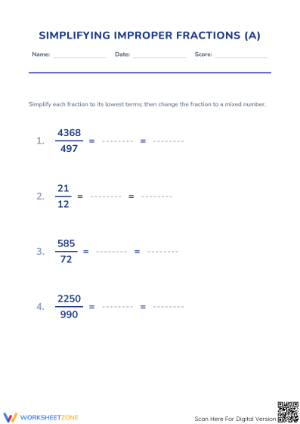
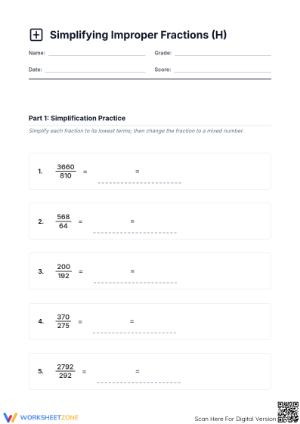
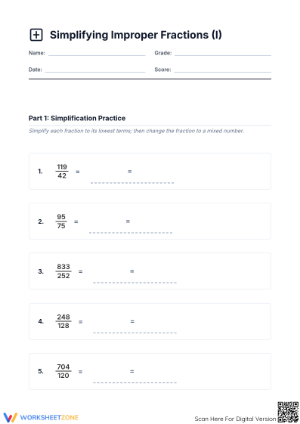
Improper fractions to mixed numbers printable worksheets for 4th grade give teachers the kind of focused, repeatable practice that actually moves this skill forward — not in one sitting, but across a week of short bursts and targeted follow-up. Fourth grade is the first time most students work intentionally with fractions greater than 1, and the conceptual leap from "this fraction is just a big number on top" to "it means three wholes and a leftover piece" is not small. The set works through that transition by pairing visual entry points with division-based conversion, so students build understanding before they rely on procedure.
What's Inside the Set
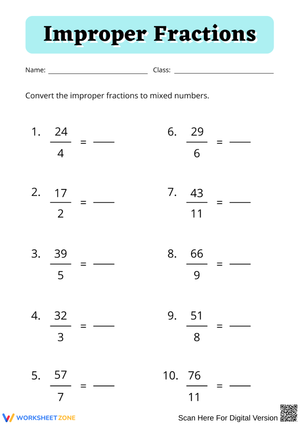
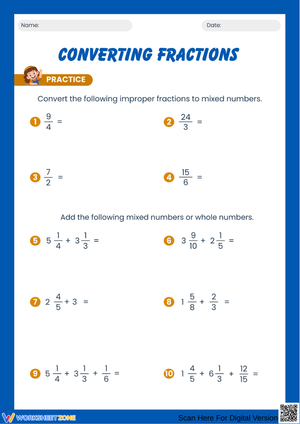
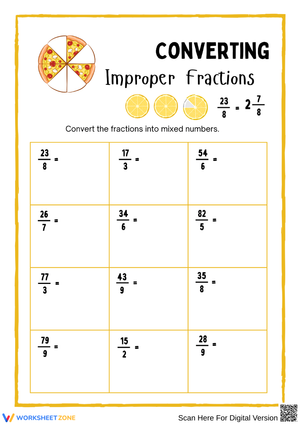
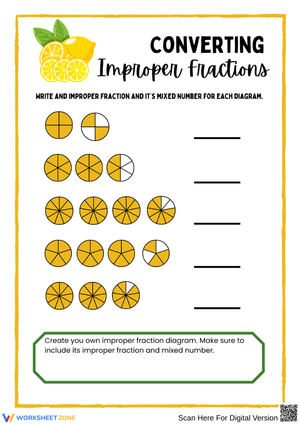
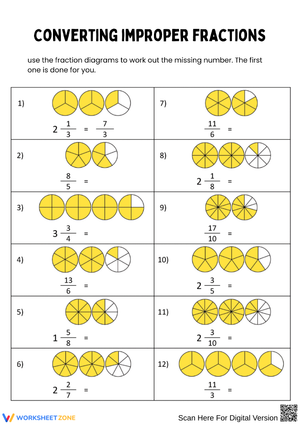
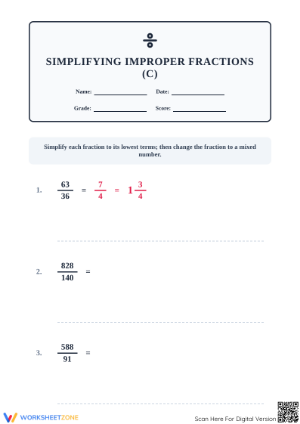
Each worksheet targets the conversion process at a specific level of support. Early worksheets use fraction bar and number line models — students count the complete whole groups shown, then identify the remaining fractional part. That counting experience is the conceptual anchor that makes the division step meaningful rather than arbitrary. Later worksheets move to symbolic notation: students divide the numerator by the denominator, record the quotient as the whole number, and write the remainder over the original denominator. A few worksheets in the set add a simplification step, asking students to reduce the fractional part once they've completed the conversion.
The specific actions students perform across the set:
- Identify fractions greater than 1 using bar and circle models
- Annotate number lines to mark where an improper fraction falls between two consecutive whole numbers
- Divide the numerator by the denominator and record both the quotient and remainder before writing the mixed number
- Write the resulting mixed number with the correct whole number and fractional part
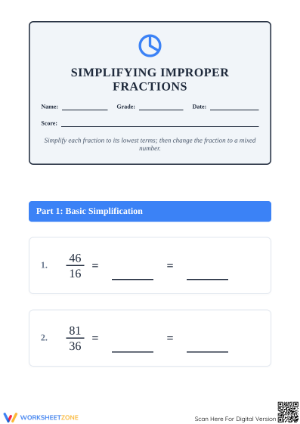
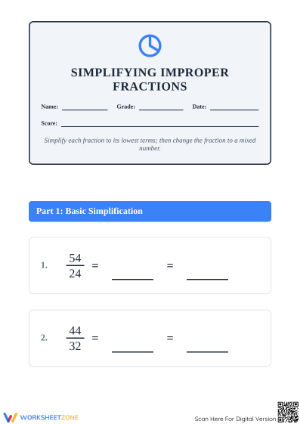
- Simplify the fractional part when the remainder and denominator share a common factor
- Verify answers by estimating whether the mixed number falls in a reasonable range
Frequent Student Errors Worth Watching For
The most persistent error in this skill is denominator substitution — and it happens more reliably than most teachers expect the first time through. A student converts 11/3 correctly up to the division step: 11 ÷ 3 = 3 remainder 2. But when writing the mixed number, they put 3 2/11 instead of 3 2/3. The numerator catches their eye because it looks like the original number, and the denominator gets swapped in without a second thought. One practical fix: have students lightly circle the denominator before beginning each problem. That small move keeps the number visually anchored and makes conference conversations faster — you can see in seconds whether the error is in the division or in the fraction-writing step.
A second pattern is the dropped remainder. Students who are still shaky on long division sometimes land on the quotient and stop, writing 11/3 as simply 3 instead of 3 2/3. This is a division fluency issue as much as a fraction issue. Worksheets that include a dedicated work box for the division step — showing quotient and remainder separately before assembling the mixed number — make that error visible rather than hidden in mental math. A third error worth watching: students sometimes correctly identify the whole number and the remainder but flip their positions, writing 2 3/3 instead of 3 2/3. Catching this one early in guided practice keeps it from becoming automatic.
Fitting These Worksheets Into Your Weekly Math Block
These resources fit most naturally into three or four distinct spots across the instructional week. During initial instruction, one worksheet with visual models works well alongside physical fraction strips — students work a few problems independently, then you debrief the denominator rule together before they try more. The following day, a computation-focused worksheet runs cleanly as a 10-minute warm-up while you take attendance and handle morning logistics. That second exposure, spaced roughly 24 hours after the first, does more for retention than extending the original lesson would have.
When improper fractions to mixed numbers printable worksheets for 4th grade are included in a center rotation, the format matters. Worksheets with a self-checking component — color-by-code or a cut-and-sort arrangement — let students work more independently, which preserves your attention for the group that needs you most. For exit tickets, four or five conversion problems at mixed difficulty levels give a clear read on who is ready to move on and who needs a reset with models before the next lesson.
Standard Alignment
These worksheets connect directly to CCSS 4.NF.B.3, which asks students to understand a fraction a/b where a is greater than 1 as a sum of fractions 1/b. Converting an improper fraction to a mixed number is a direct application of that standard: students identify how many complete groups of the unit fraction fit into the total, then name the leftover piece. The standard sits within the broader 4.NF cluster on building fractions from unit fractions — the same cluster that leads to addition and subtraction of mixed numbers. Students who cannot convert fluently hit a wall when those operations begin, so this practice serves as preparation for the more demanding fraction work that follows in the same unit.
Adapting the Set for a Range of Learners
Students who are not yet fluent with basic division need a different entry point than the computation-only worksheets. Give those students the model-based worksheets first — fraction bars with denominators of 2, 3, and 4 — and have them count complete groups before attempting any division. That counting process mirrors what the algorithm does, so the division step feels like a shortcut rather than a new rule when you introduce it. Limiting denominators to single-digit values keeps the cognitive load on fractions rather than arithmetic for students in this group.
Students who convert accurately and quickly need the worksheets that include a simplification requirement — converting 14/4 to 3 2/4, then reducing to 3 1/2. That step is where improper fractions to mixed numbers printable worksheets for 4th grade connect to earlier GCF work, and it extends the challenge without requiring a separate resource. For students ready to go further, any worksheet in the set can be extended by reversing the task — given a mixed number, write it as an improper fraction — which reinforces the relationship between forms rather than treating conversion as a one-direction trick.
Frequently Asked Questions
What fraction concepts should students have in place before starting these worksheets?
Students need to recognize that the denominator counts equal parts and the numerator tells how many of those parts are present. They should also know that a fraction like 4/4 equals exactly one whole — that understanding is what makes the counting-of-whole-groups approach make sense. Basic division fluency with single-digit divisors helps on the computation-heavy worksheets, though students with weaker division skills can still access the model-based ones while that fluency continues to develop.
Do the visual worksheets and the computation-only worksheets need to be used in sequence?
They work as both a sequence and as standalone resources. Used in order, they move from concrete to symbolic — models first, then division steps with a model available nearby, then computation without visual support. Used on their own, the computation worksheets serve students who have already grasped the concept and need fluency-building repetition, while the model-based worksheets are the right starting point for students returning to the skill after initial instruction didn't fully land.
What should a teacher do when a student consistently gets the wrong denominator in the final answer?
Return to a fraction bar model before assigning more computation practice. Showing the student that the denominator names the size of each part — and that dividing into groups doesn't change what size the parts are — reorients most students faster than additional problems do. Ask the student to point to the denominator on the model and explain what it means, then connect that directly to what goes in the denominator of the mixed number. The denominator-circling strategy mentioned above also gives students a reliable self-monitoring habit to carry through independent work.
Can these worksheets be used for students who are revisiting the skill later in the year?
That is one of the more practical uses of improper fractions to mixed numbers printable worksheets for 4th grade. A student who partially learned the conversion in the fall and needs to rebuild it before a spring assessment benefits from starting with the visual worksheets and moving to the computation set over two or three sessions — not jumping straight into a drill. The same resources that served initial instruction work equally well for targeted remediation, which means teachers do not need to locate separate materials when reteaching this skill.













 Interactive Worksheet Maker
 Quiz Maker
 Word Search Maker
 Crossword Puzzle Maker
 Word Scramble Generator
 Sentence Scramble Generator
 Handwriting Worksheet Generator
 Name Tracing Generator
 Fill In The Blank Generator