


























Views
Downloads
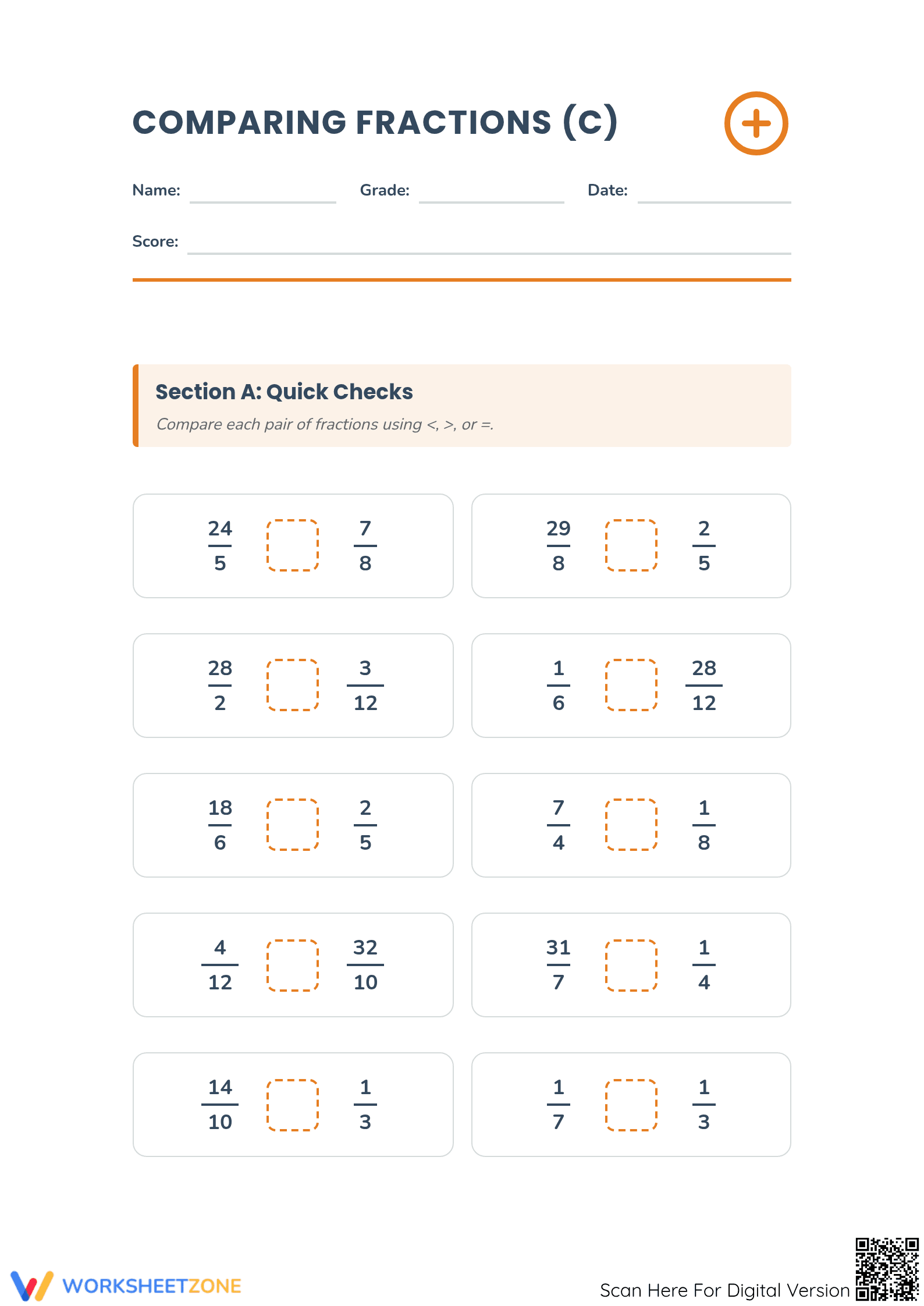
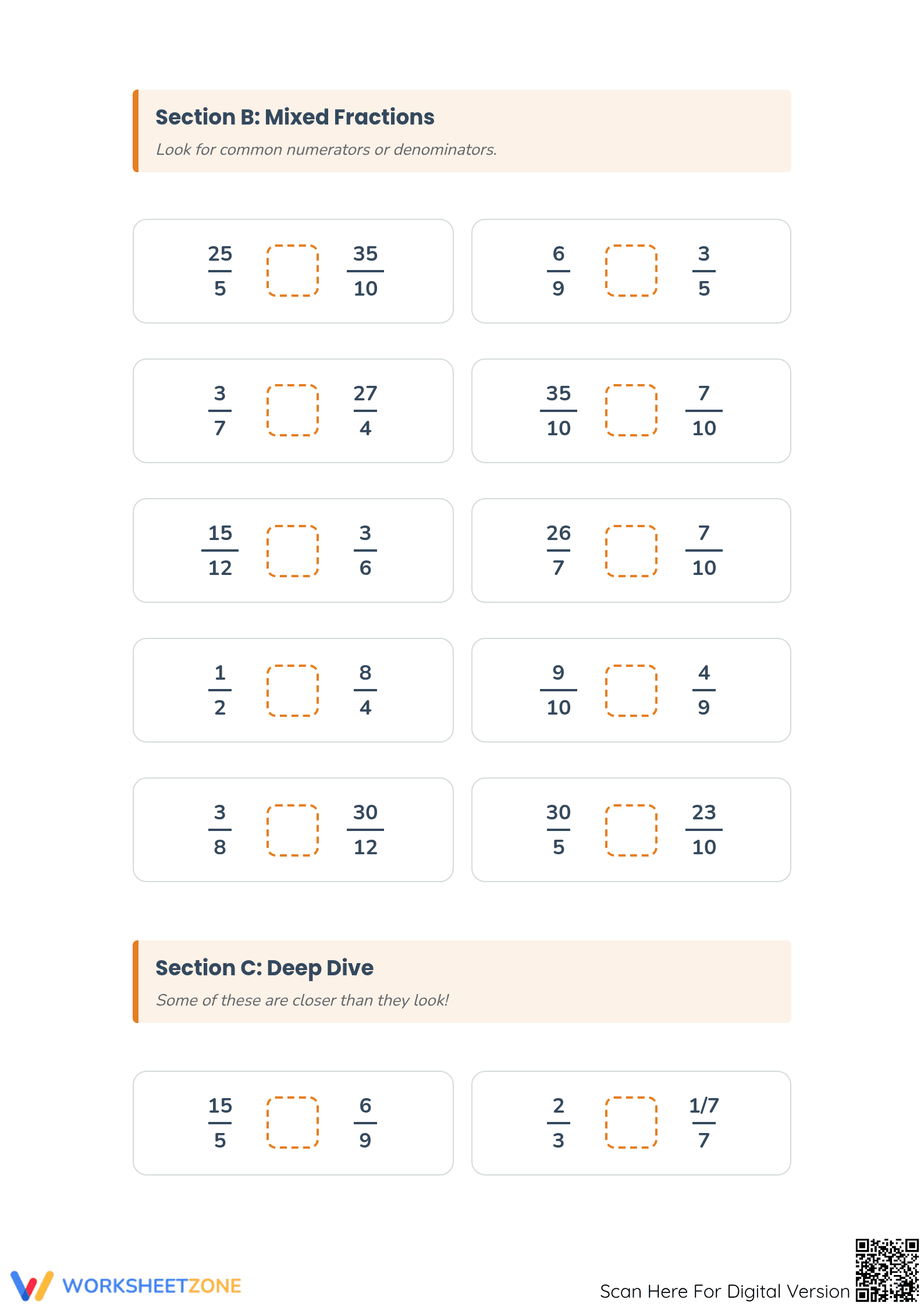
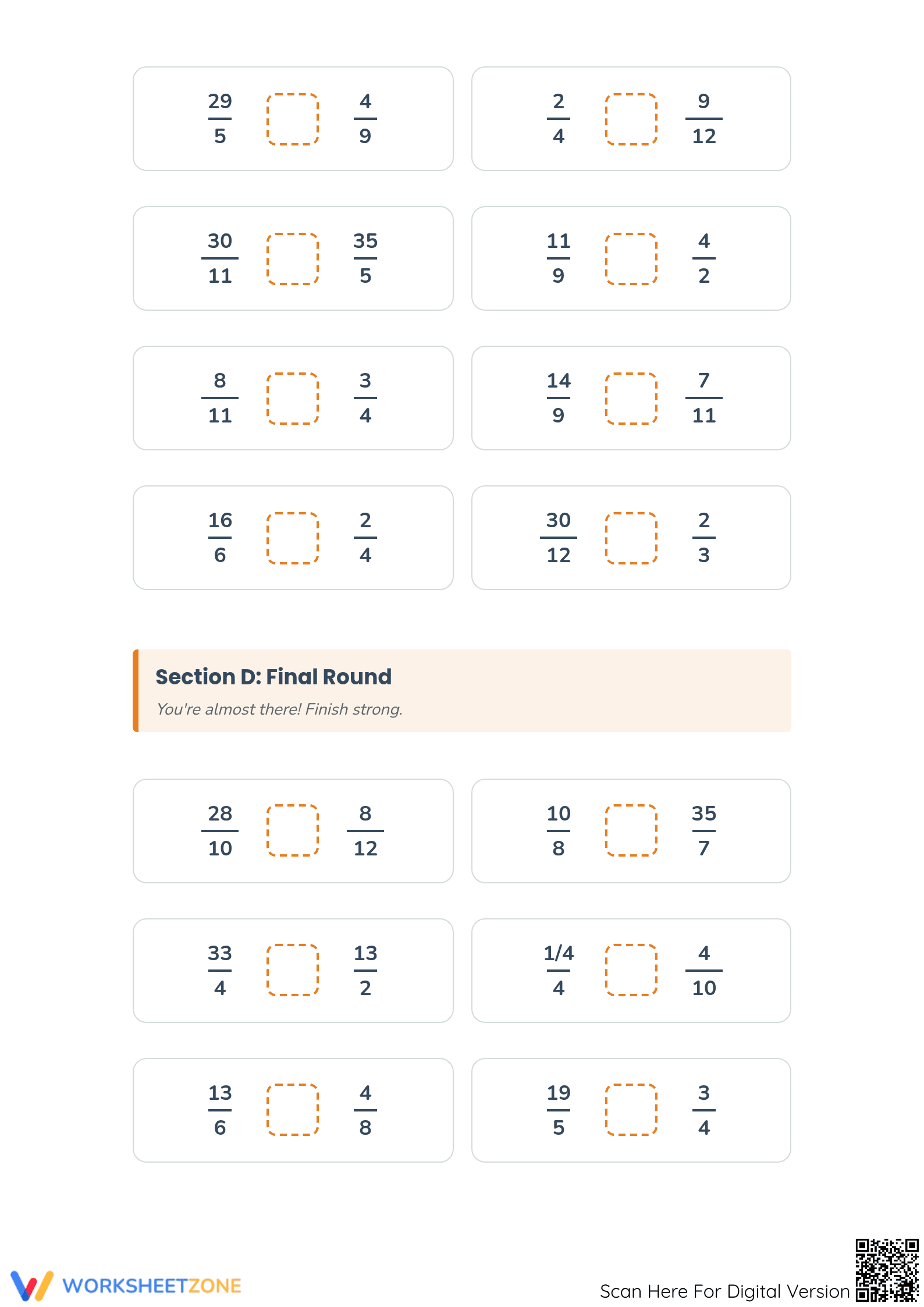
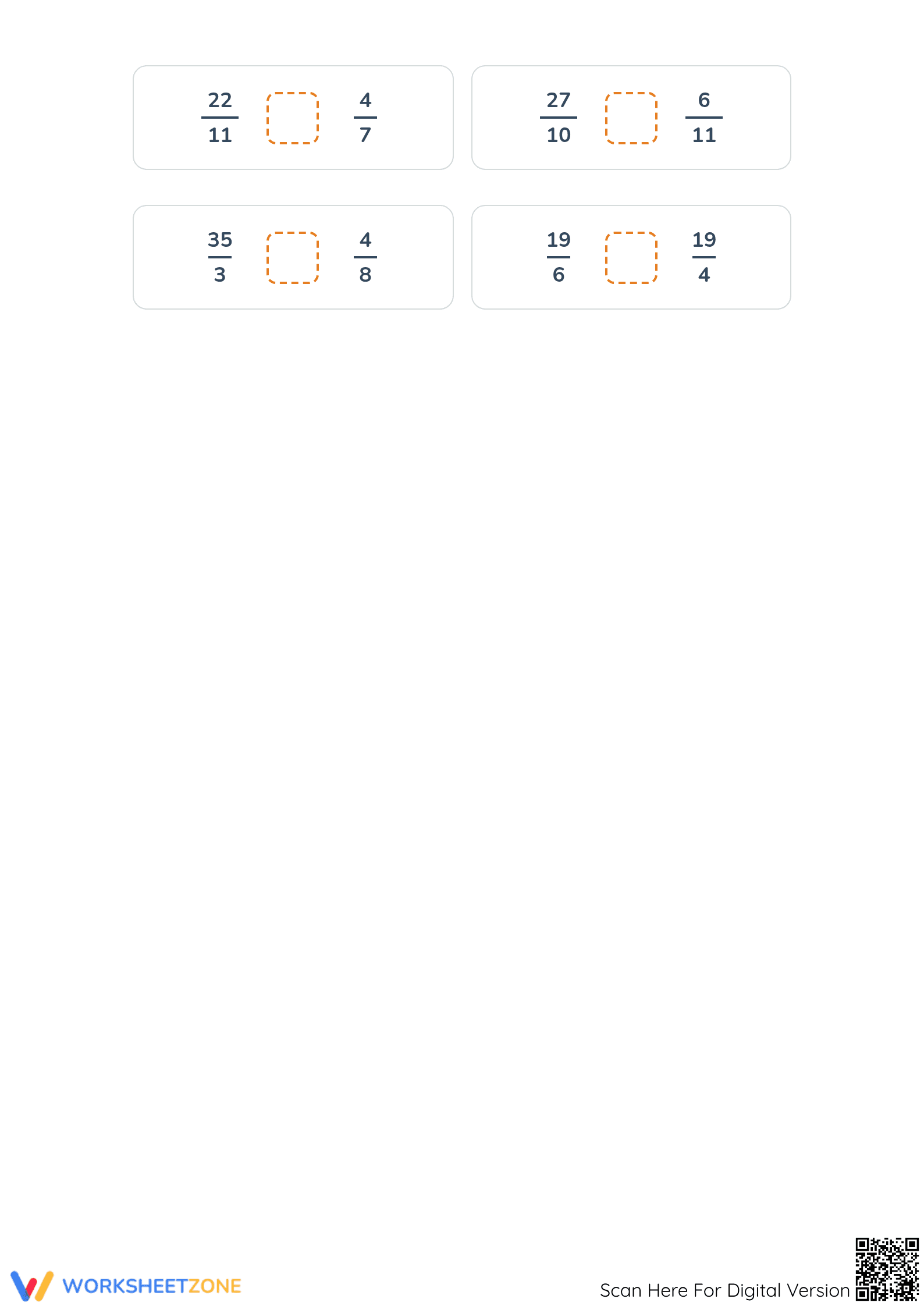

Printable Comparing Simple and Improper Fractions Worksheet
Paste this activity's link or code into your existing LMS (Google Classroom, Canvas, Teams, Schoology, Moodle, etc.).
Students can open and work on the activity right away, with no student login required.
You'll still be able to track student progress and results from your teacher account.
Students master the logic of fraction magnitude by comparing diverse pairs of simple and improper values. This worksheet provides 40 structured comparisons to build fluency in recognizing relative values across different denominators. Students apply mathematical reasoning to determine greater than, less than, or equal relationships effectively.
At a Glance
- Grade: 4 · Subject: Math
- Standard:
CCSS.MATH.CONTENT.4.NF.A.2— Compare two fractions with different numerators and different denominators- Skill Focus: Fraction comparison fluency
- Format: 4 pages · 40 problems · Answer key included · PDF
- Best For: Independent practice and formative math assessment
- Time: 30–45 minutes
This comprehensive 4-page PDF contains 40 distinct comparison problems organized into four strategic sections: Quick Checks, Mixed Fractions, Deep Dive, and a Final Round. It features a clear layout with dashed boxes for inequality symbols, ensuring students stay focused on the mathematical operation. A complete answer key is provided for rapid grading.
Skill Progression
- Guided practice: The initial "Quick Checks" section provides 10 foundational comparisons to establish the baseline logic of comparing simple and improper fractions.
- Supported practice: "Mixed Fractions" and "Deep Dive" sections introduce 20 problems with varying denominators and closer values, requiring students to find common ground.
- Independent practice: The "Final Round" offers 10 complex comparisons where students must apply their refined mental models to mixed sets without additional cues.
This structured progression follows a gradual-release model, transitioning from basic identification to complex numerical reasoning.
Standards Alignment
The primary standard addressed is CCSS.MATH.CONTENT.4.NF.A.2, which requires students to "compare two fractions with different numerators and different denominators, e.g., by creating common denominators or numerators, or by comparing to a benchmark fraction such as 1/2." This resource directly supports this goal by providing ample opportunities to justify conclusions using inequality symbols. Both standard codes can be copied directly into lesson plans, IEP goals, or district curriculum mapping tools.
How to Use It
Use this resource as a post-instruction practice set after students have been introduced to improper fractions and the concept of a common denominator. It serves as an excellent formative assessment tool during a mid-unit review to identify students who struggle with mental number line placement. Teachers should observe whether students are drawing visual models or using cross-multiplication strategies to solve the comparisons. Completion typically takes 35 minutes.
Who It's For
Designed for Grade 4 students mastering fractions, this resource is also highly effective for Grade 5 and 6 students requiring remediation in rational number logic. It pairs naturally with fraction tile sets or number line anchor charts to provide a visual bridge for abstract comparisons.
According to the NAEP framework for mathematical fluency, students who engage in repeated, structured practice with rational number comparisons demonstrate higher retention of algebraic concepts in later grades. This worksheet aligns with the evidence-based recommendations found in the RAND AIRS 2024 report, which emphasizes the necessity of varied problem sets for developing deep conceptual understanding of fraction magnitude. By practicing with 40 unique pairs—including improper fractions that exceed a value of one—students move beyond rote memorization toward a robust internal number sense. The inclusion of a "Deep Dive" section challenges students to compare fractions with nearly identical values, a key indicator of mathematical proficiency. This resource ensures that the plain-English skill of fraction comparison is met through rigorous, standards-aligned practice that can be easily integrated into any elementary math curriculum.


