


























Views
Downloads



Essential Comparing Proper and Improper Fractions Worksheet
Paste this activity's link or code into your existing LMS (Google Classroom, Canvas, Teams, Schoology, Moodle, etc.).
Students can open and work on the activity right away, with no student login required.
You'll still be able to track student progress and results from your teacher account.
This comprehensive worksheet set provides students with rigorous practice in comparing proper and improper fractions. By moving beyond basic models to complex numerical comparisons, learners develop a deep conceptual understanding of fractional values relative to benchmarks like one. Students will master the inequality symbols through structured, multi-part practice that builds confidence and mathematical fluency.
At a Glance
- Grade: 4 · Subject: Math
- Standard:
CCSS.MATH.CONTENT.4.NF.A.2— Compare two fractions with different numerators and denominators using symbols- Skill Focus: Proper and Improper Fraction Comparison
- Format: 5 pages · 34 problems · Answer key included · PDF
- Best For: Independent math workshop or substitute plans
- Time: 30–45 minutes
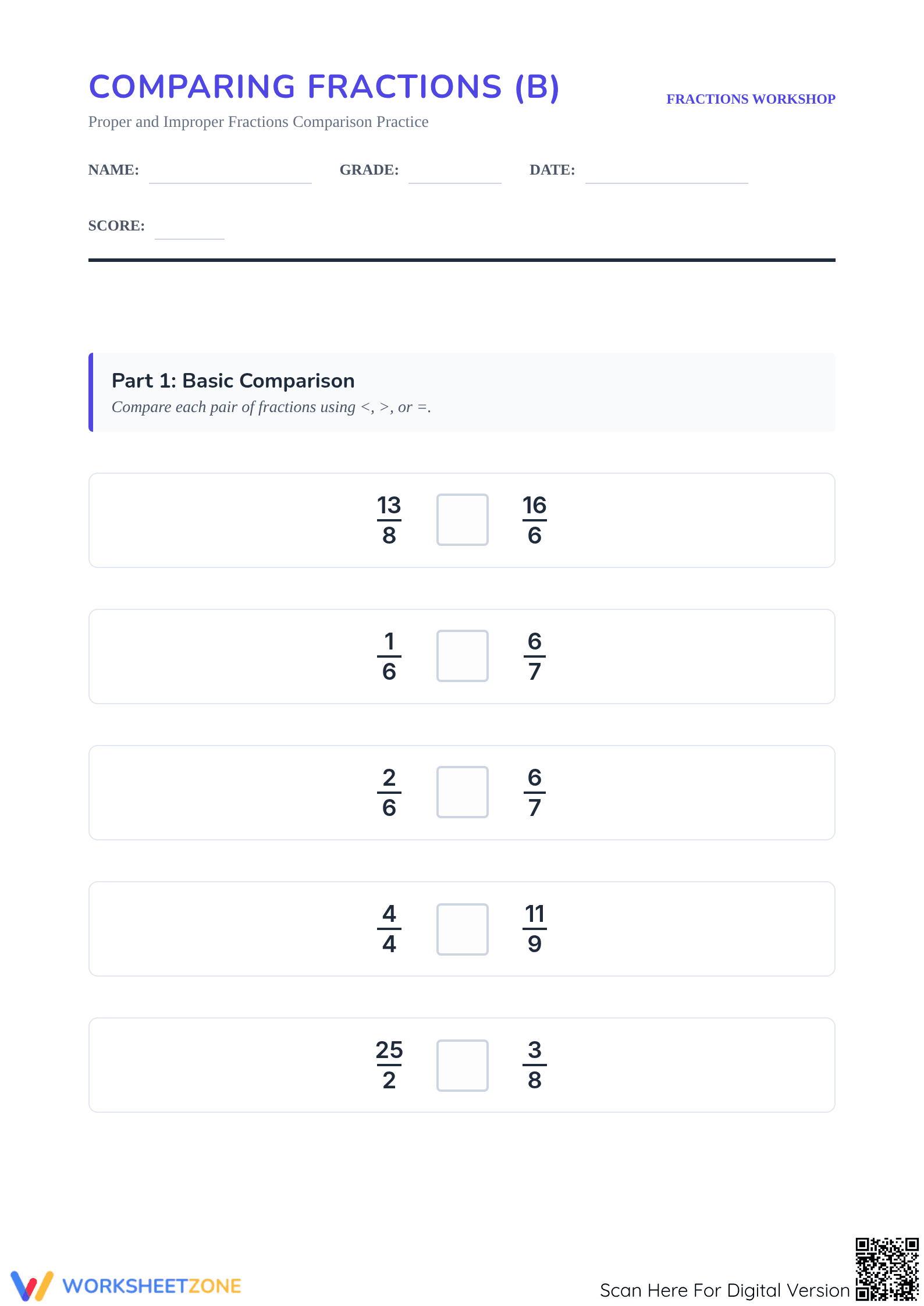
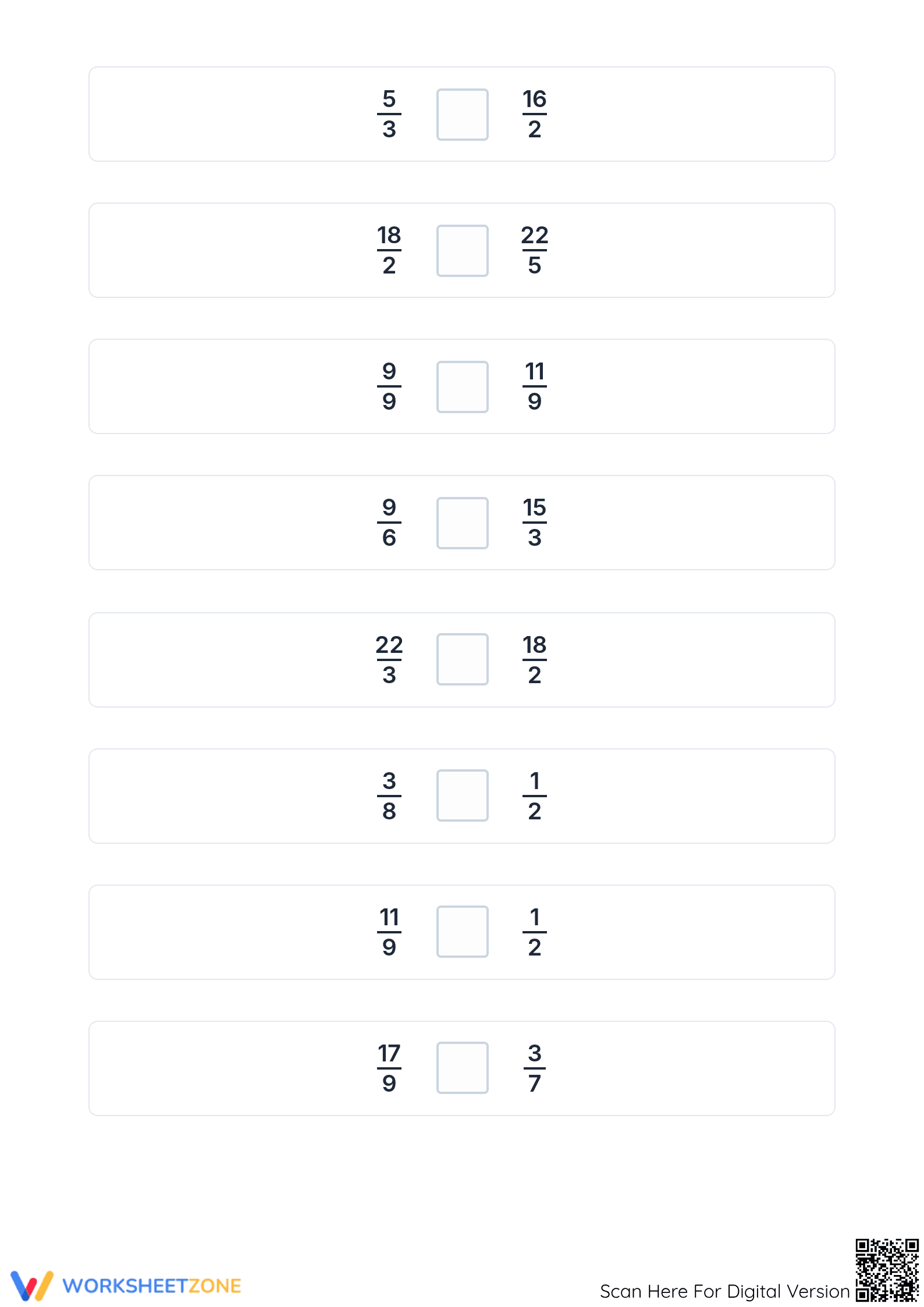
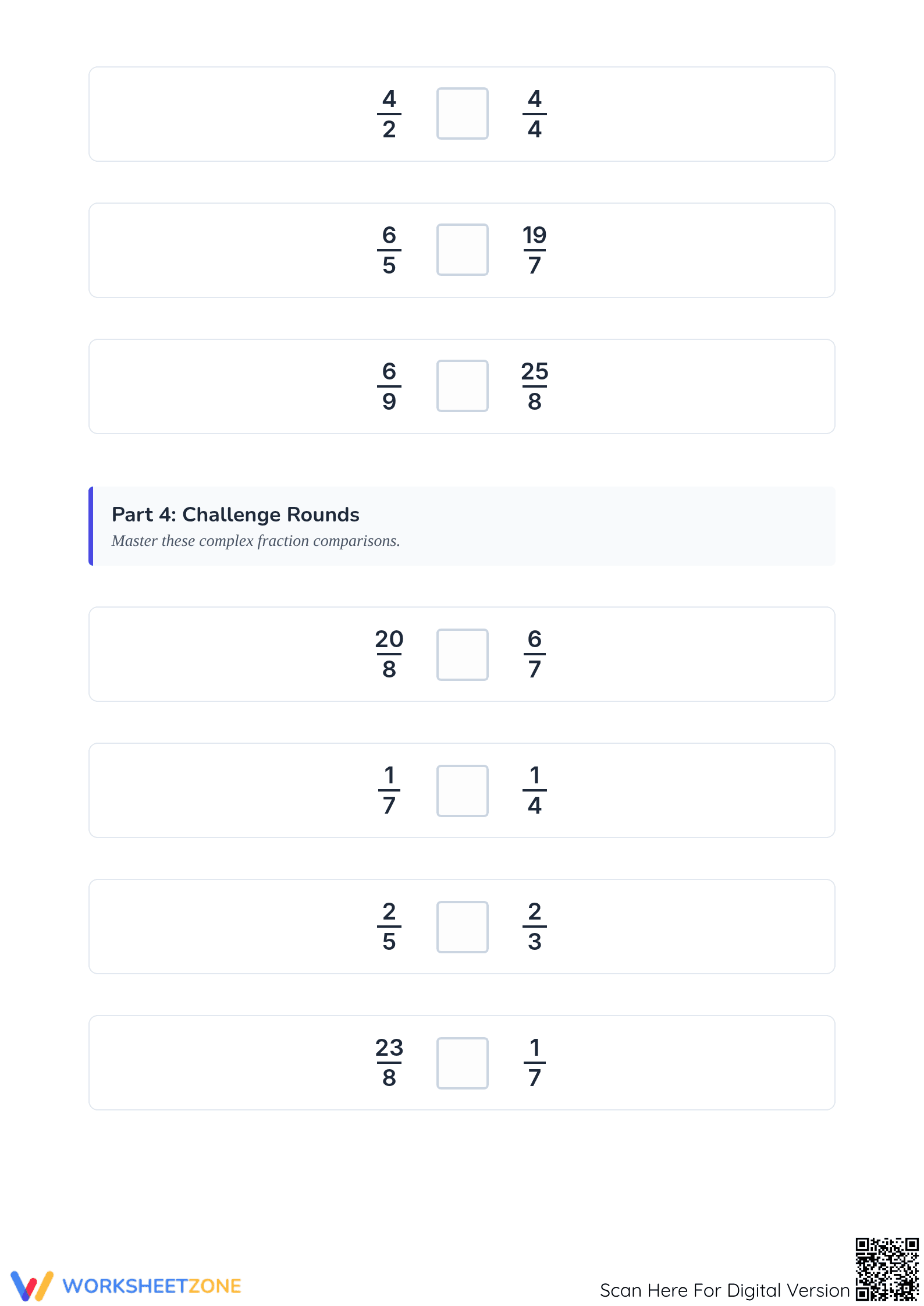
The download includes a five-page student packet designed for a complete fractions workshop session. It features 34 distinct comparison tasks divided into four specialized sections: Basic Comparison, Proper & Improper Mix, Advanced Fractions, and Challenge Rounds. The layout is clean and spacious, providing ample room for students to show their cross-multiplication work or find common denominators, with a full answer key provided for quick grading.
The zero-prep design of this resource allows for immediate classroom implementation. First, print the five-page packet (30 seconds). Second, distribute the worksheets to students during your fractions unit (1 minute). Third, use the included answer key to review results together or as a self-check station (1 minute). This workflow ensures that instructional time is maximized while teacher preparation time remains under two minutes, making it an ideal emergency sub plan or Friday review activity.
Standards Alignment
This resource is directly aligned to CCSS.MATH.CONTENT.4.NF.A.2. This standard requires students to compare two fractions with different numerators and different denominators by creating common denominators or numerators, or by comparing to a benchmark fraction like 1/2. Both standard codes can be copied directly into lesson plans, IEP goals, or district curriculum mapping tools.
How to Use It
Use this worksheet during the "Independent Practice" phase of a lesson on improper fractions. It is particularly effective after students have learned to use the number 1 as a benchmark, as seen in Part 2 of the packet. For a formative assessment, observe students during Part 3 to see if they are accurately applying cross-multiplication or finding common denominators. Students should complete the full packet in 30 to 45 minutes.
Who It's For
This resource is designed for Grade 4 and 5 students who are mastering fraction comparison. It is also suitable for middle school students who require intervention or reinforcement of core fraction concepts. For differentiation, you may assign the Challenge Rounds only to advanced learners or provide fraction tiles as a scaffold for students working on the Basic Comparison section.
The ability to compare fractions with varying structures, specifically moving between proper and improper forms, is a critical predictor of later success in algebra and proportional reasoning. According to a RAND AIRS 2024 analysis of instructional materials, high-quality practice sets must include non-routine comparisons that force students to think beyond simple visual models. This 34-task worksheet aligns with these findings by utilizing benchmark comparison and cross-multiplication strategies. By requiring students to relate improper fractions to the number one, the resource builds the fraction sense necessary for 4.NF.A.2 mastery. Fisher & Frey (2014) emphasize that such structured practice provides the cognitive load necessary for students to move from guided to independent mastery. This worksheet serves as a standalone tool for developing procedural fluency while maintaining a focus on the conceptual relationship between numerators and denominators in diverse fractional contexts.


