


























Views
Downloads

Printable Comparing Simple and Improper Fractions Worksheet
Paste this activity's link or code into your existing LMS (Google Classroom, Canvas, Teams, Schoology, Moodle, etc.).
Students can open and work on the activity right away, with no student login required.
You'll still be able to track student progress and results from your teacher account.
This Grade 4 Math worksheet provides a comprehensive approach to mastering fraction magnitude. Students will learn to accurately compare simple and improper fractions using inequality symbols, ensuring they can determine which value is greater regardless of its form. By working through structured problem sets, learners build the fluency needed to tackle complex multi-step math problems with confidence.
At a Glance
- Grade: 4 · Subject: Math
- Standard:
CCSS.MATH.CONTENT.4.NF.A.2— Compare two fractions with different numerators and denominators using symbols- Skill Focus: Proper and Improper Fraction Comparison
- Format: 2 pages · 40 problems · Answer key included · PDF
- Best For: Small group instruction and independent practice
- Time: 15–25 minutes
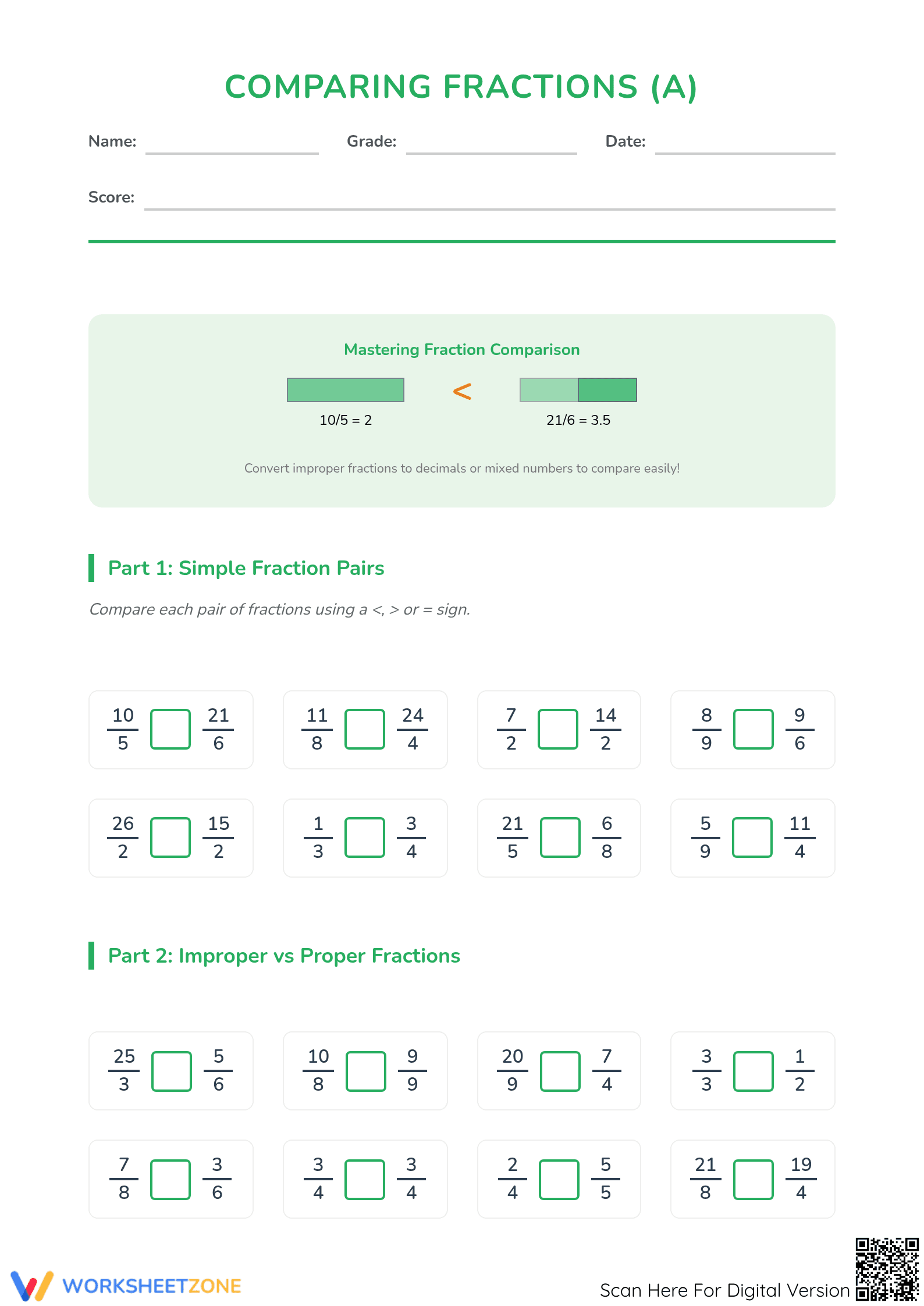
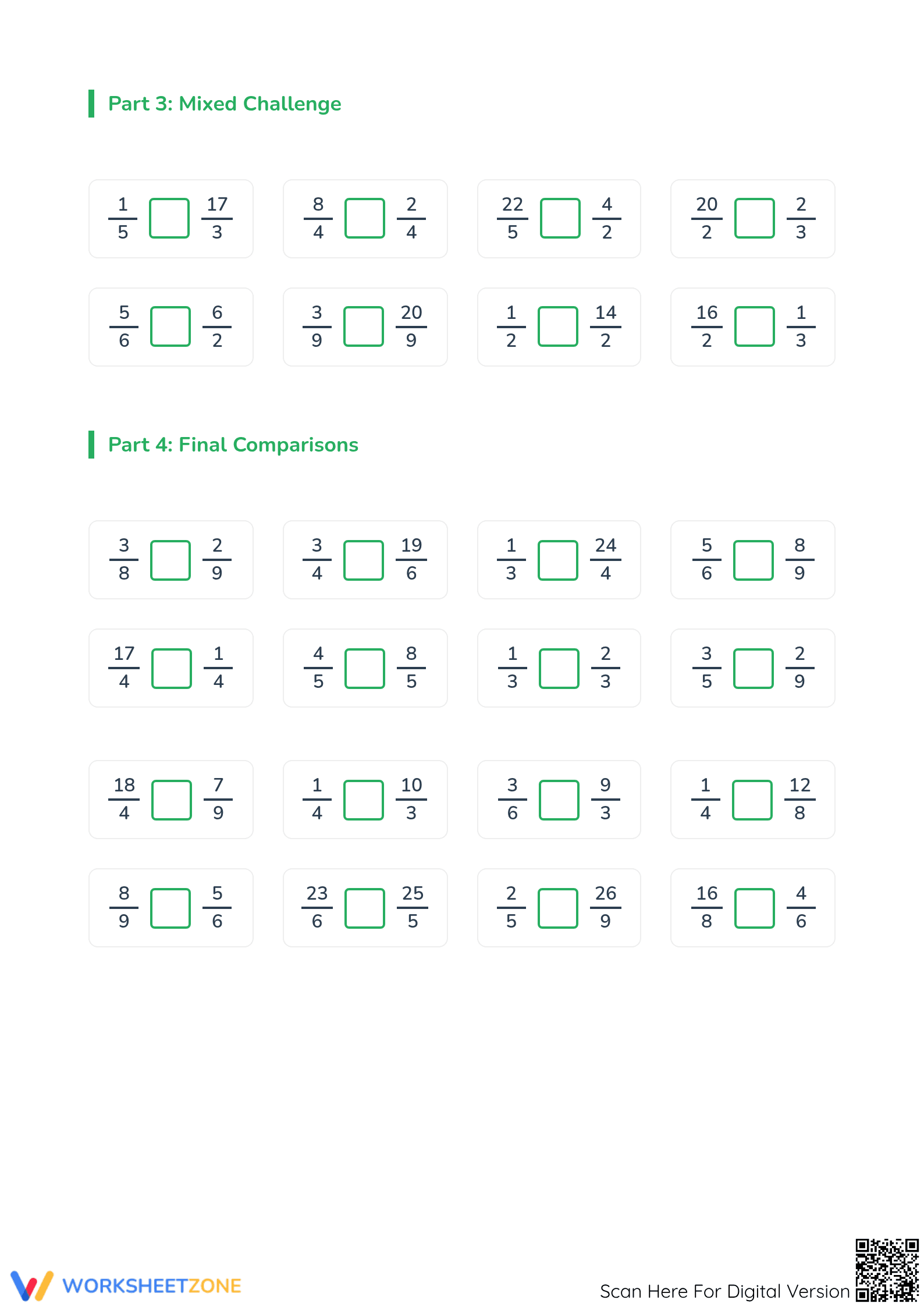
Inside this two-page PDF resource, you will find 40 unique fraction pairs organized into four distinct parts. The layout includes a helpful 'Mastering Fraction Comparison' header with a worked example, followed by sections dedicated to simple pairs, improper versus proper comparisons, and a mixed final challenge. A complete answer key is included for rapid grading.
Skill Progression
- Guided Practice: The introductory section provides a visual model comparing 10/5 and 21/6, demonstrating how to convert improper fractions to decimals or mixed numbers to facilitate easier comparison.
- Supported Practice: Parts 1 and 2 offer 16 problems where students compare simple pairs and proper versus improper fractions, using familiar structures to build initial confidence.
- Independent Practice: Parts 3 and 4 present 24 challenge problems with varying denominators, requiring students to apply their chosen strategy independently to reach mastery.
This progression follows a gradual-release model, moving from visual scaffolding to abstract problem-solving.
Standards Alignment
This resource is directly aligned with `CCSS.MATH.CONTENT.4.NF.A.2`. This standard states that students should compare two fractions with different numerators and different denominators, e.g., by creating common denominators or numerators, or by comparing to a benchmark fraction such as 1/2. Both standard codes can be copied directly into lesson plans, IEP goals, or district curriculum mapping tools.
How to Use It
This worksheet is best used during the independent practice phase of a lesson on fraction magnitude. Assign the first page as a mid-lesson check to observe if students are correctly identifying improper fractions as values greater than one. The second page works excellently as a high-engagement homework assignment or a summative exit ticket. Expect completion in 15 to 25 minutes.
Who It's For
Designed for fourth and fifth-grade students, this material is ideal for learners who have mastered basic fraction identification but need practice with mixed forms. It provides essential support for students receiving Tier 2 interventions. This worksheet pairs naturally with a fraction number line or physical manipulatives to help students visualize the values they are comparing.
The ability to evaluate and compare fractions, particularly when navigating the transition between proper and improper forms, is a critical milestone in upper elementary mathematics. This worksheet is designed to reinforce CCSS.MATH.CONTENT.4.NF.A.2, which requires students to compare two fractions with different numerators and denominators by creating common denominators or comparing to a benchmark. By providing 40 structured opportunities to apply these strategies, students move beyond rote memorization toward a conceptual understanding of fractional magnitude. Research from the RAND AIRS 2024 report emphasizes that frequent, targeted practice with varied fraction types—including those where the numerator exceeds the denominator—prevents common misconceptions related to whole-number bias. This resource ensures students can accurately identify relationships between complex fraction pairs, a skill that serves as the foundation for future success in algebraic reasoning and proportional relationships. Educators can utilize these findings to justify the integration of improper fraction comparisons within standard fraction units.


