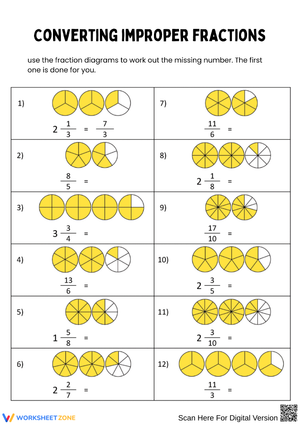
Mixed Numbers to Improper Fractions worksheets for 4th Grade
These mixed numbers to improper fractions worksheets for 4th grade give teachers a ready-to-use set of practice resources that move students through visual fraction models, step-by-step conversion work, and real-context word problems — without additional prep. Each worksheet follows the progression most 4th graders need: build the concept visually, then move to the procedure.
What Each Worksheet Targets
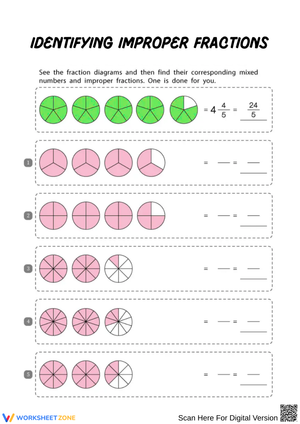
The earlier worksheets in the set use shaded fraction models — tape diagrams and partitioned circles — where students count total parts across all wholes to determine the improper fraction. A student working with 2 3/4, for example, counts across two complete circles and three additional fourths, arriving at 11 total fourths before the multiplication formula is introduced. This sequencing matters. Many 4th graders reach for the algorithm before understanding what it represents, and that premature move is exactly how the most common conversion error gets started.
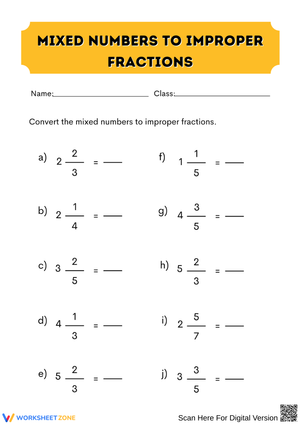
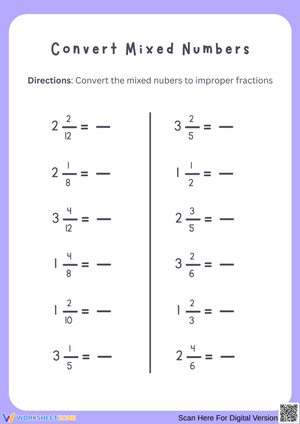
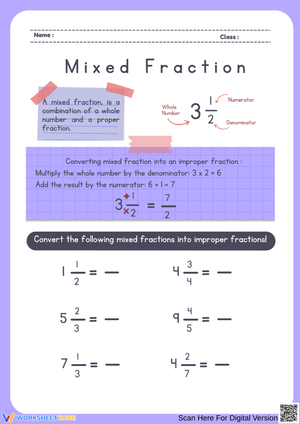
Later worksheets shift to the standard conversion procedure: multiply the whole number by the denominator, add the numerator, and place that total over the original denominator. Several worksheets present this as a fill-in format with labeled steps, so students see the work broken into its parts rather than writing one collapsed, error-prone line. The set also includes word problems — converting mixed-number distances and recipe measurements — that give students a genuine reason to convert rather than treating the skill as an isolated drill.
Mistakes Students Make That These Worksheets Help You Catch
The most consistent error in 4th grade is adding the whole number to the numerator instead of multiplying: a student converts 2 3/4 as 5/4 rather than 11/4. This mistake appears in nearly every class during the first week of instruction. Students who make it are treating the whole number and numerator as two quantities to combine, rather than understanding that each whole contains multiple unit fractions. The visual-model worksheets confront that gap directly — before students write a single line of algorithm, they count parts.
A second error pattern involves the denominator itself. Students change it mid-conversion, arriving at an answer with a different denominator than the problem started with, as if the bottom number were also being transformed. Worksheets that ask students to circle the denominator before beginning — and carry it unchanged through each step — reduce this mistake significantly. A third error, less frequent but stubborn when it appears, is multiplying the whole number by the numerator rather than the denominator. This comes from memorizing a half-understood procedure. Error-analysis problems, where students examine a fictional student's work and identify what went wrong, surface all three of these patterns quickly and give you concrete formative information about who still needs support with the underlying concept.
Standard Alignment
CCSS.MATH.CONTENT.4.NF.B.3 asks students to understand a fraction as a sum of unit fractions and to work flexibly with fractions greater than 1. In practical terms, this standard lands mid-year in most 4th grade pacing guides, after students have spent time on fraction equivalence and ordering. Converting between mixed numbers and improper fractions sits at the intersection of conceptual understanding — what does 2 3/4 actually represent? — and procedural fluency. The visual-model worksheets address the conceptual side; the algorithm-practice worksheets move students toward fluency. Teachers working through the 4.NF.B.3 instructional window have both needs covered in a single set.
Fitting These Worksheets Into Your Fraction Unit
The most efficient approach with the mixed numbers to improper fractions worksheets for 4th grade in this set is to sequence them by where students are in the concept-to-procedure progression, not simply by date. Start the visual-model worksheets alongside fraction tiles or physical circle manipulatives: students build the mixed number with tiles, count the total parts, and record the improper fraction. That physical counting and written recording reinforce each other in a way that looking at a printed model alone does not.
For daily warm-ups, a brief five-problem conversion worksheet takes students about three minutes at the start of class. Run it for two consecutive weeks and the procedure becomes automatic enough to transfer into fraction addition and subtraction — which is the real payoff for this instruction. The cut-and-paste matching worksheets work well during small-group rotations: students match each mixed number to its equivalent improper fraction and receive immediate confirmation when the pairs assemble correctly, without waiting on teacher feedback.
Worth noting: the error-analysis worksheets work best after students have already attempted conversion independently and made the common mistakes themselves. Using them before students have any procedural experience produces confusion rather than insight. Save those for the second half of the instructional sequence.
Differentiating This Set Across Student Readiness Levels
For students who are still building fraction number sense, stay on the visual-model worksheets longer than feels necessary. Students who have genuinely internalized the visual — not just seen it once — pick up the algorithm faster, and that saves reteaching time later. Restricting these students to denominators of halves, thirds, and fourths keeps the arithmetic simple enough that the conversion process stays in focus rather than getting lost in calculation.
Students who move through the algorithm quickly benefit from mixed numbers to improper fractions worksheets for 4th grade that use larger whole numbers — 8 and above — and denominators like sevenths or ninths. The procedure is identical; the arithmetic demands more. You can also ask these students to write their own word problems using mixed numbers drawn from real measurements, which deepens the reasoning without requiring a separate enrichment resource.
For students who struggle to hold multiple steps in working memory, the labeled fill-in worksheets do the organizational work that a blank line cannot. Presenting the three steps — multiply, add, write — as separate labeled boxes removes a procedural bottleneck and lets students focus on the arithmetic rather than the sequence. That is not simplifying the math; it is reducing the cognitive load enough that the actual conversion work gets practiced.
Frequently Asked Questions
How do you introduce the conversion using visual models?
Use fraction circles or tape diagrams and have students count all the shaded parts across every whole. With 1 3/5, they count five fifths in the complete circle plus three more in the partial circle — eight total — and record 8/5. Running this counting routine on three or four examples before introducing the algorithm gives students a mental reference they can return to when the procedure stops making sense.
What is the standard conversion procedure?
Multiply the whole number by the denominator, add the numerator, and place the result over the original denominator. For 3 2/7: 3 times 7 equals 21, add 2 to get 23, write 23/7. A short verbal cue — "multiply, add, keep" — helps students hold the sequence without re-deriving it each time.
Do the worksheets include answer keys?
Each worksheet includes an answer key. Having the key available during class means you can circulate and work with students who are stuck while others self-check, rather than spending instructional time confirming answers that correct students already finished. For homework use, the key enables a productive review rather than students sitting with unresolved errors.
When in the year should this skill be introduced?
Most 4th grade pacing guides place fraction conversion mid-year, after students have worked with equivalence and comparison. Introducing mixed numbers to improper fractions worksheets for 4th grade before students have a stable sense of what a unit fraction represents tends to produce the procedural errors described above — particularly the add-instead-of-multiply mistake. The concept takes hold more reliably when students already understand that 3/4 means three equal parts of a whole divided into four, not just a number sitting above another number.
Clear All