


























Views
Downloads
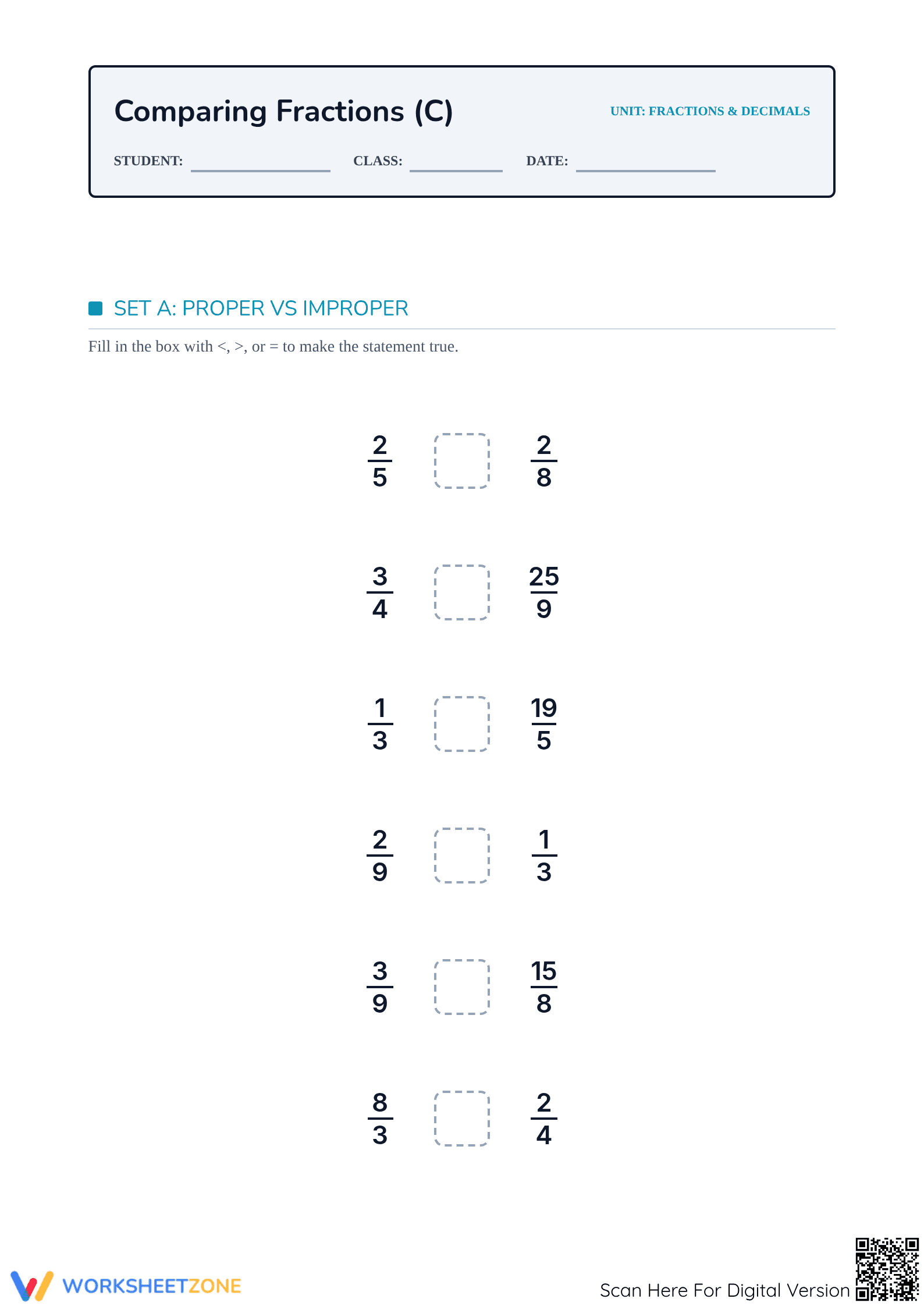
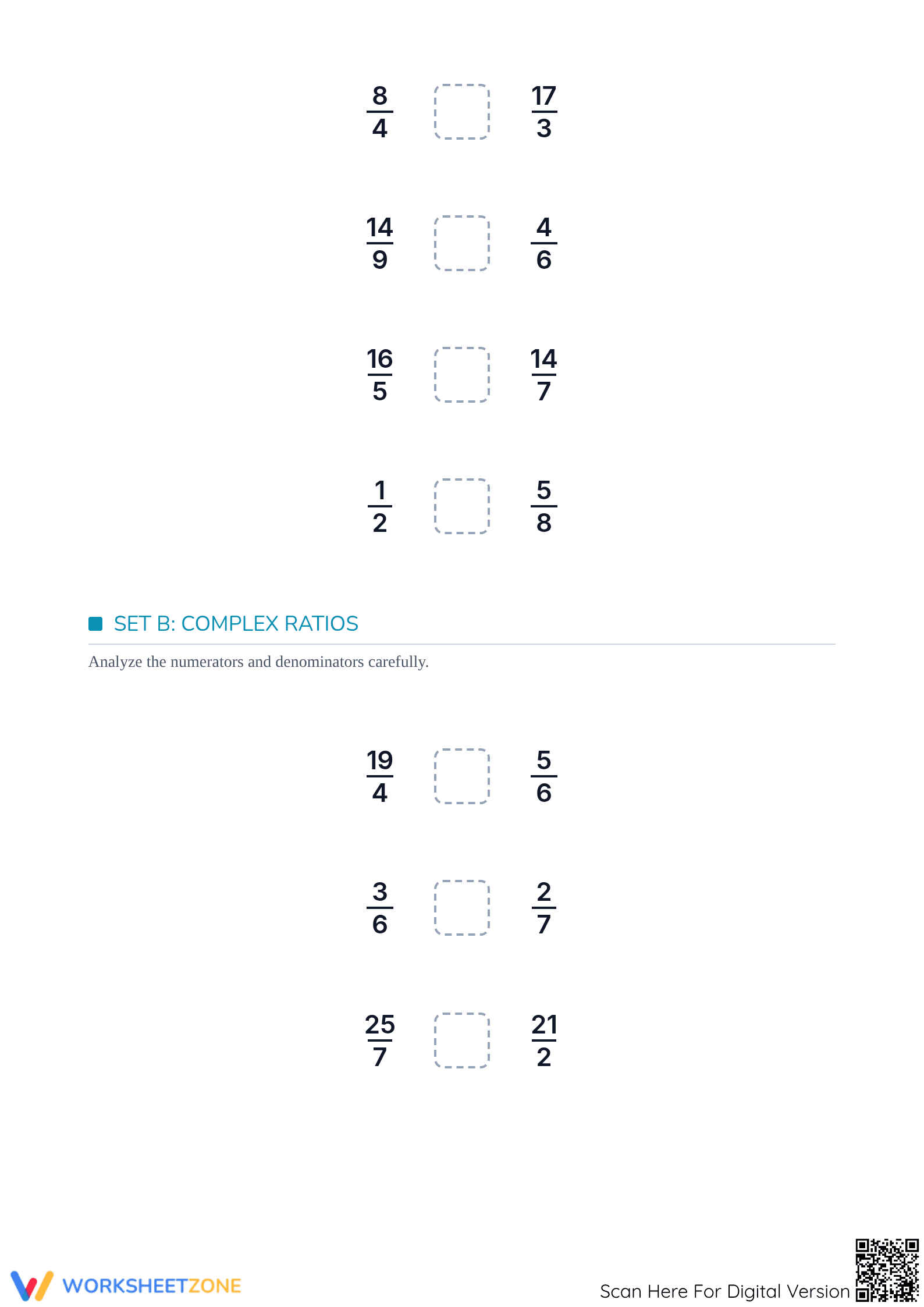
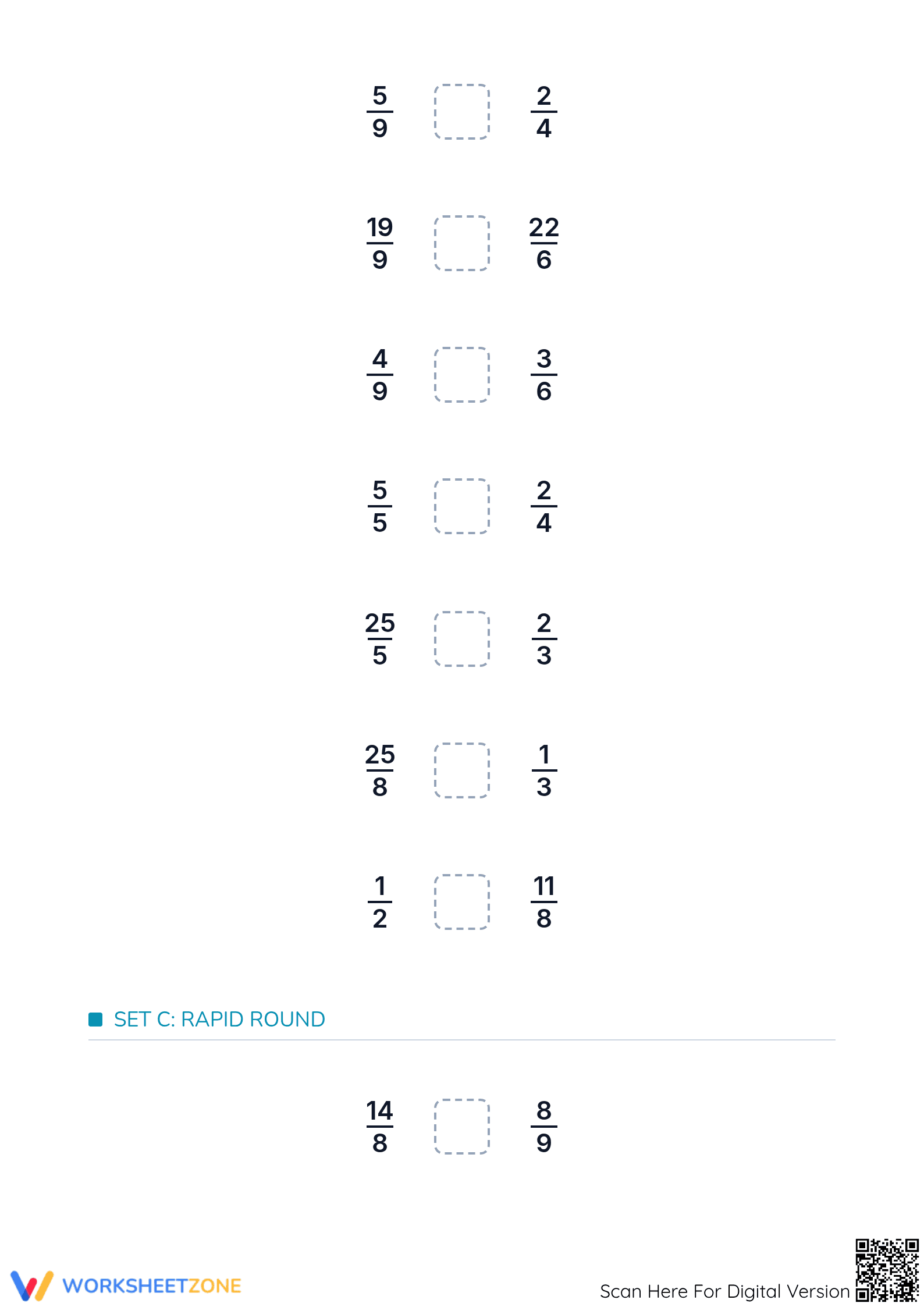


Printable Comparing Simple and Improper Fractions Worksheet
Paste this activity's link or code into your existing LMS (Google Classroom, Canvas, Teams, Schoology, Moodle, etc.).
Students can open and work on the activity right away, with no student login required.
You'll still be able to track student progress and results from your teacher account.
Mastering fraction comparison is foundational in elementary mathematics. This worksheet provides structured practice for comparing proper and improper fractions. Students develop mental models to evaluate fraction values across formats, ensuring they confidently determine relative size in any context.
At a Glance
- Grade: 4 · Subject: Math
- Standard:
CCSS.MATH.CONTENT.4.NF.A.2— Compare two fractions with different numerators and denominators by creating common denominators- Skill Focus: Comparing proper and improper fractions
- Format: 5 pages · 37 problems · Answer key included · PDF
- Best For: Independent practice and fraction mastery assessment
- Time: 25–40 minutes
What's Inside
This five-page PDF includes 37 targeted comparison problems organized into four distinct difficulty sets. The resource features clear formatting with dedicated workspace for each calculation. It covers comparisons between proper fractions, improper fractions, and complex ratios. A full answer key is provided for rapid grading or student self-check, making it a complete solution for classroom or home use.
Skill Progression
- Guided Practice (Set A): 10 introductory problems focusing on proper versus improper fractions to establish basic conceptual understanding.
- Supported Practice (Set B & C): 19 problems involving complex ratios and rapid-fire comparisons to build fluency and mental processing speed.
- Independent Practice (Set D): 8 master-level challenges designed to test student accuracy with larger numerators and denominators.
This gradual-release model transitions students from visual comparisons to higher-order numerical analysis.
Standards Alignment
The primary standard addressed is CCSS.MATH.CONTENT.4.NF.A.2: "Compare two fractions with different numerators and different denominators, e.g., by creating common denominators or numerators, or by comparing to a benchmark fraction such as 1/2." This resource also supports Grade 5 fraction operations. Both standard codes can be copied directly into lesson plans, IEP goals, or district curriculum mapping tools.
How to Use It
Assign this worksheet during the "You Do" phase of a lesson after students have learned about improper fractions and common denominators. Use the first set as a formative assessment to identify students who struggle with the concept of fractions greater than one. The "Rapid Round" can be timed to encourage fluency. Expected completion time ranges from 25 to 40 minutes depending on student level.
Who It's For
This resource is designed for Grade 4 and Grade 5 students mastering fraction comparison. It is particularly effective for students requiring extra practice with improper fractions or those preparing for standardized assessments. Differentiation is built-in through the tiered sets, allowing teachers to assign specific pages based on individual student needs. It pairs naturally with fraction bars or visual area models.
The ability to compare fractions with different denominators is a critical milestone in numerical literacy. Research from RAND AIRS 2024 highlights that students who master fraction comparisons early are significantly more likely to succeed in middle school algebra and complex problem-solving. This worksheet addresses CCSS.MATH.CONTENT.4.NF.A.2 by requiring students to evaluate the relationship between proper and improper fractions through consistent practice. By providing 37 structured tasks, the resource ensures that learners move beyond simple memorization to a deeper understanding of fractional magnitude. The inclusion of master-level problems aligns with current pedagogical recommendations for providing high-ceiling tasks that challenge all learners within a single instructional framework. Educators can use these metrics to track progress against IEP goals, ensuring students reach necessary proficiency levels. This systematic approach to standard mastery provides the essential scaffolding needed for students to transition from arithmetic to algebraic reasoning. By emphasizing the comparison of fractions greater than one, teachers can effectively bridge the gap between elementary concepts and more advanced secondary math requirements.


