


























Views
Downloads

Printable Comparing Simple and Improper Fractions Worksheet
Paste this activity's link or code into your existing LMS (Google Classroom, Canvas, Teams, Schoology, Moodle, etc.).
Students can open and work on the activity right away, with no student login required.
You'll still be able to track student progress and results from your teacher account.
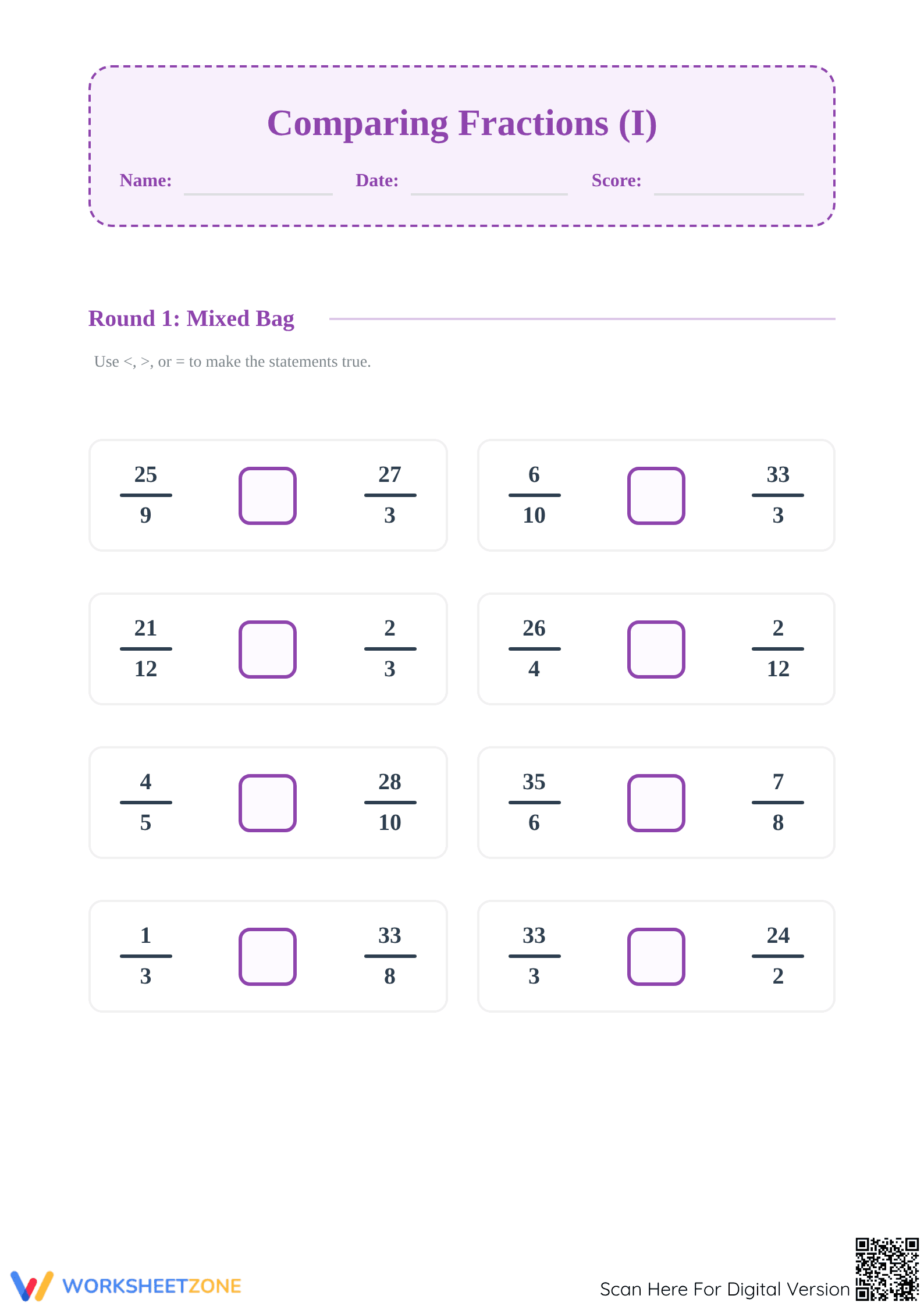
This comprehensive three-page math resource empowers students to master the comparison of simple and improper fractions through a structured four-round progression. By navigating from basic mixed bags to complex "Final Boss" challenges, learners develop a deep conceptual understanding of fractional values greater than one. Students will successfully use inequality symbols to demonstrate their mathematical reasoning across 26 targeted problems.
At a Glance
- Grade: 4 · Subject: Math (Fractions)
- Standard:
CCSS.MATH.CONTENT.4.NF.A.2— Compare two fractions with different numerators and denominators using symbols- Skill Focus: Improper Fraction Comparison
- Format: 3 pages · 26 problems · Answer key included · PDF
- Best For: Upper elementary independent practice and reinforcement
- Time: 25–35 minutes
What's Inside: This set contains three distinct pages of practice organized into four thematic rounds. The worksheet includes 26 comparison tasks, ranging from unit fractions with visual models to complex improper fraction pairs. A complete answer key is provided for immediate feedback, and the clean layout ensures that students have ample space to show their work or draw additional visual aids as needed.
- Guided Practice: Round 1 provides a "Mixed Bag" of 8 problems where students compare basic fractions to improper ones, establishing a baseline for fractional magnitude.
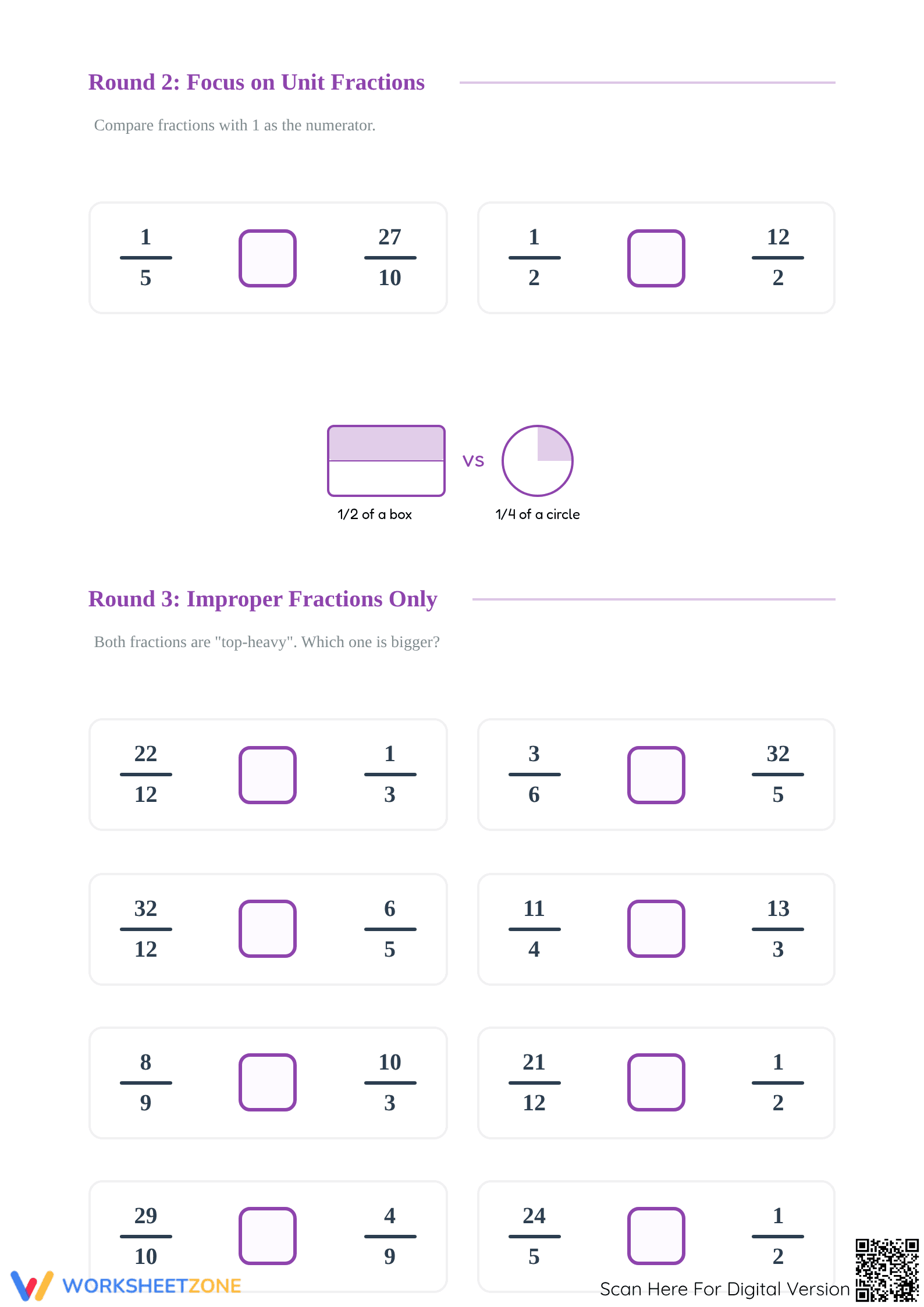
- Supported Practice: Rounds 2 and 3 focus on unit fractions and "top-heavy" improper fractions, utilizing a visual box-vs-circle model to anchor abstract comparisons in concrete imagery.
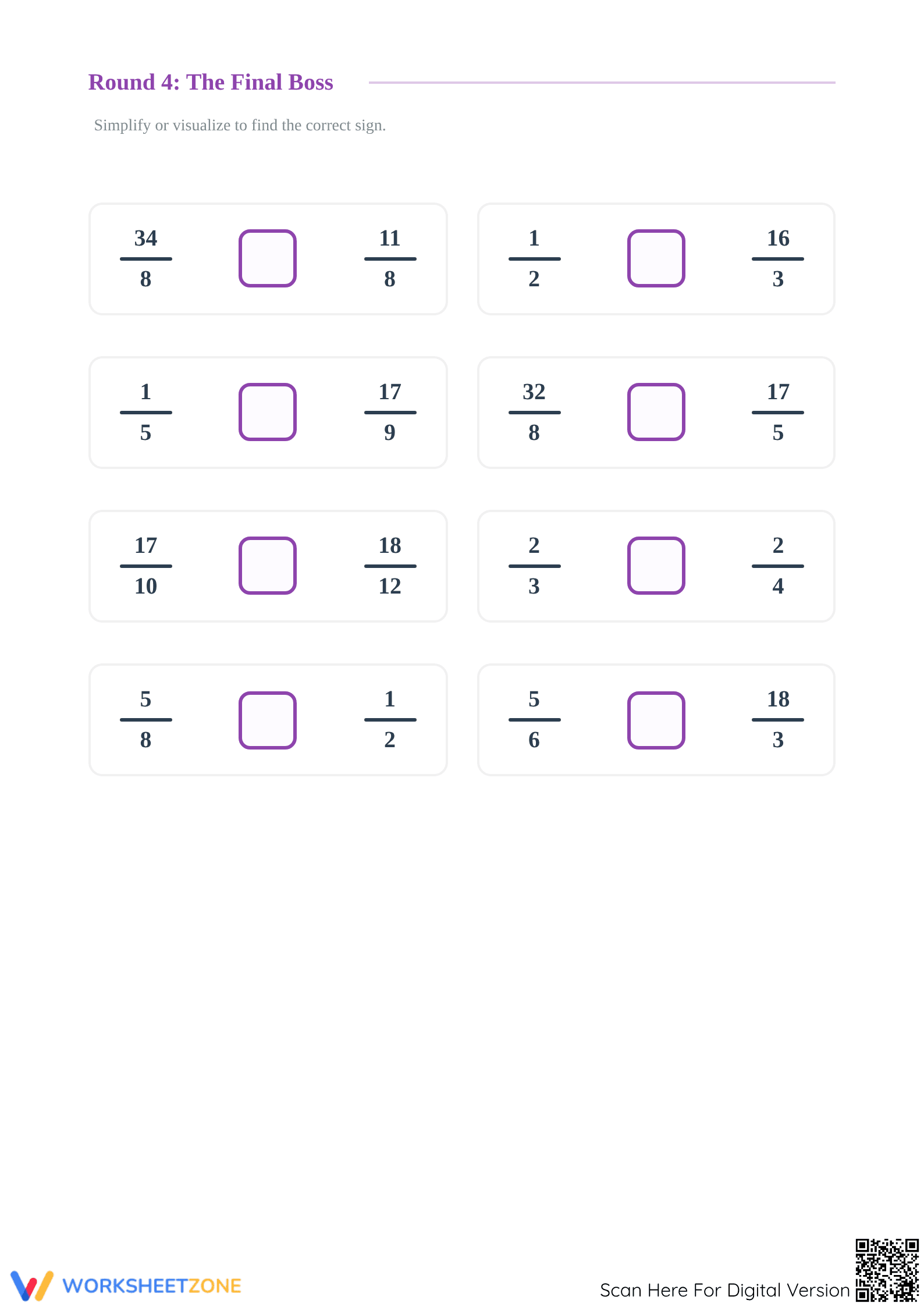
- Independent Practice: The "Final Boss" round presents 8 advanced problems requiring simplification or visualization to determine the correct sign, ensuring students reach independent mastery.
Standards Alignment: This resource is specifically built for `CCSS.MATH.CONTENT.4.NF.A.2`, which requires students to compare two fractions with different numerators and different denominators, e.g., by creating common denominators or numerators, or by comparing to a benchmark fraction such as 1/2. This standard code can be copied directly into lesson plans, IEP goals, or district curriculum mapping tools.
How to Use It: Deploy this worksheet during the independent practice phase of a lesson on non-unit fractions. It serves as an excellent formative assessment; teachers should observe Round 2 to see if students correctly interpret the visual models before they move into the purely numerical challenges of the later rounds. Most students will complete the full 26-task sequence within 30 minutes.
Who It's For: This resource is designed for Grade 4 students but remains highly effective for Grade 5 learners who need a refresher on improper fractions. It is particularly useful for small-group intervention and pairs naturally with fraction tiles or number line anchor charts to support students who require additional tactile or visual scaffolding.
Mathematical fluency in fraction comparison is a critical predictor of success in middle school algebra, according to the ScienceDirect TpT Analysis. This worksheet addresses the specific hurdle of improper fractions by moving students through a cognitive load progression that minimizes frustration. By isolating the comparison of fractions with different denominators and numerators, the tasks align with the `CCSS.MATH.CONTENT.4.NF.A.2` requirement for benchmark reasoning. This structured approach ensures that the 26 problems serve as more than just repetition; they act as a diagnostic tool for identifying misconceptions about fractional parts of a whole. Teachers can rely on this resource as a high-utility component of their curriculum, providing the necessary evidence of student growth in fractional operations for progress monitoring and instructional planning.


