


























Views
Downloads

Comparing Simple and Improper Fractions | Essential Math Guide
Paste this activity's link or code into your existing LMS (Google Classroom, Canvas, Teams, Schoology, Moodle, etc.).
Students can open and work on the activity right away, with no student login required.
You'll still be able to track student progress and results from your teacher account.
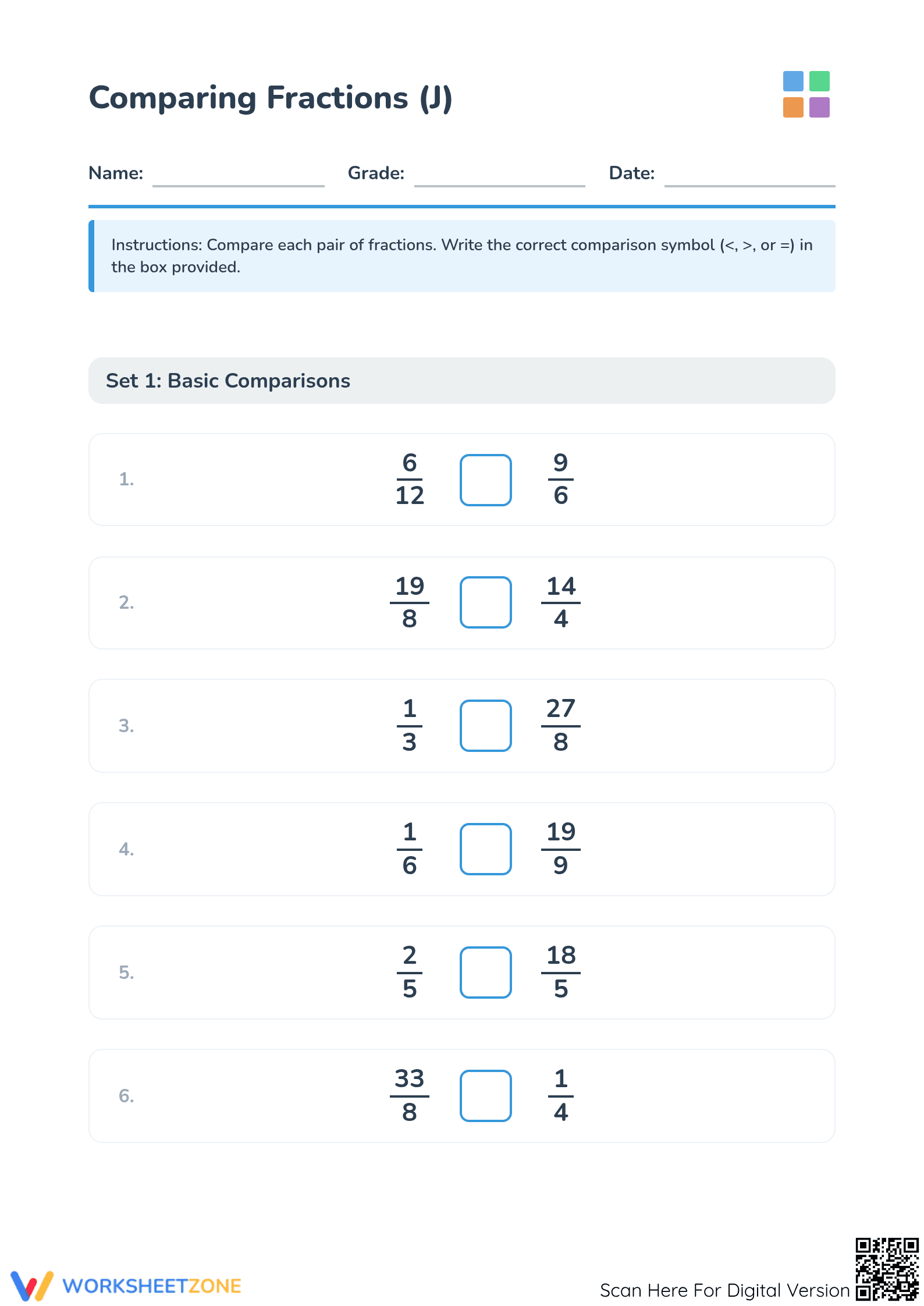
Mastering fraction comparison is a pivotal milestone in intermediate mathematics. This comprehensive five-page worksheet set provides structured practice for students to compare both simple and improper fractions using inequality symbols. By navigating through four distinct levels of difficulty, learners develop a deep conceptual understanding of relative fraction values and denominator relationships across various complexity levels.
At a Glance
- Grade: 3–10 · Subject: Math — Fractions
- Standard:
4.NF.A.2— Compare two fractions with different numerators and different denominators using symbols- Skill Focus: Simple and improper fraction comparison
- Format: 5 pages · 39 problems · Answer key included · PDF
- Best For: Independent practice and mastery checks
- Time: 45–60 minutes
What's Inside
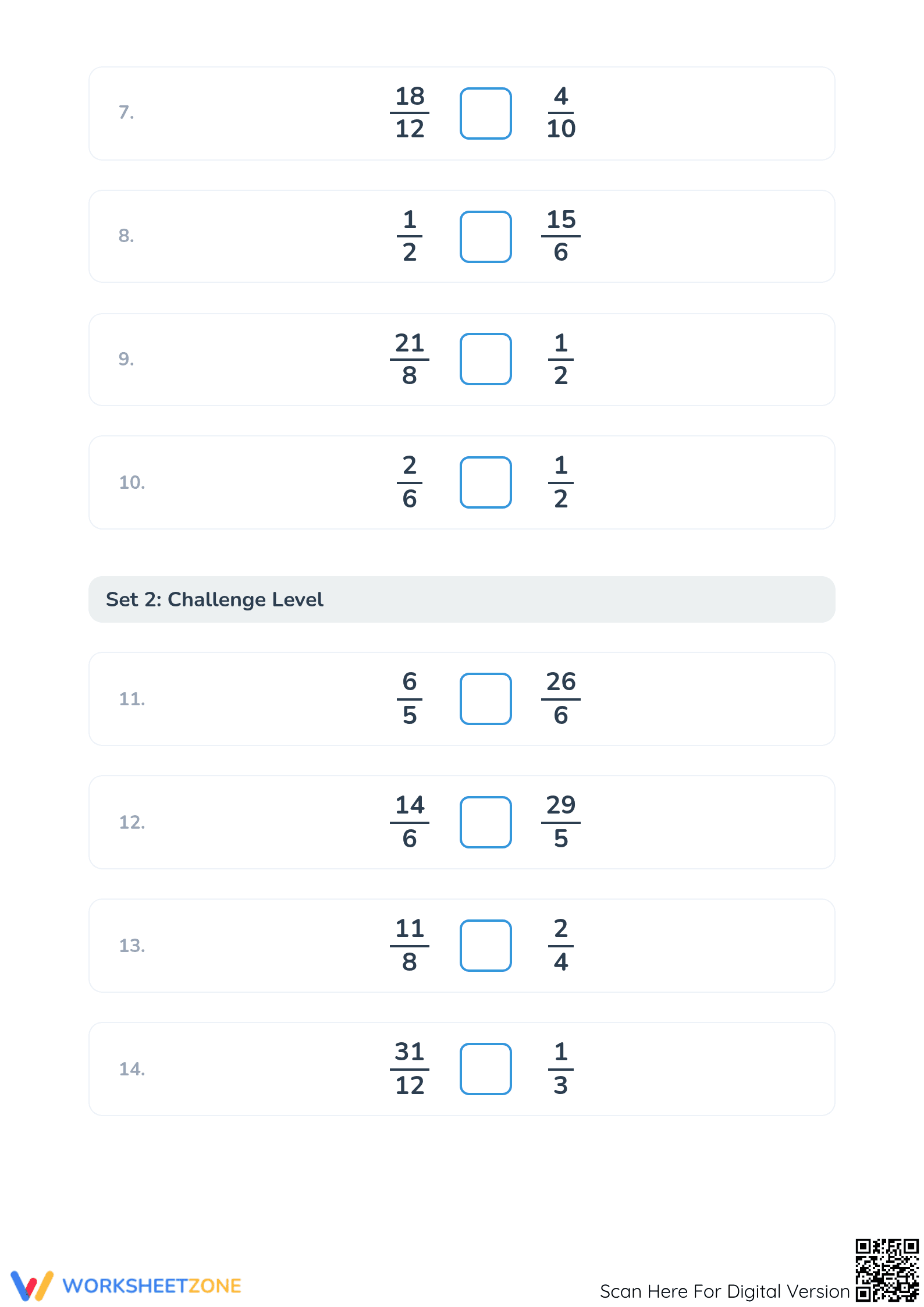
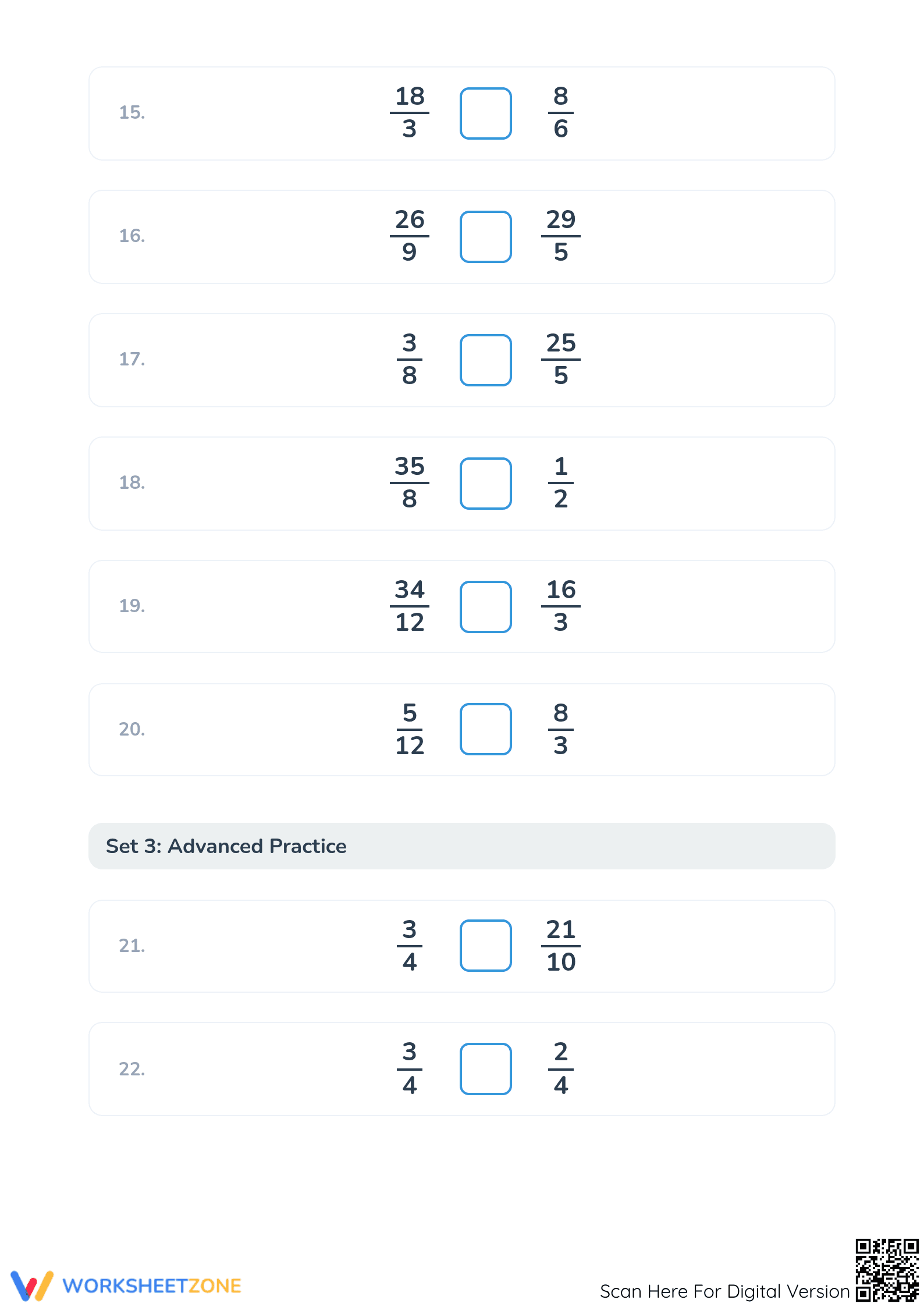
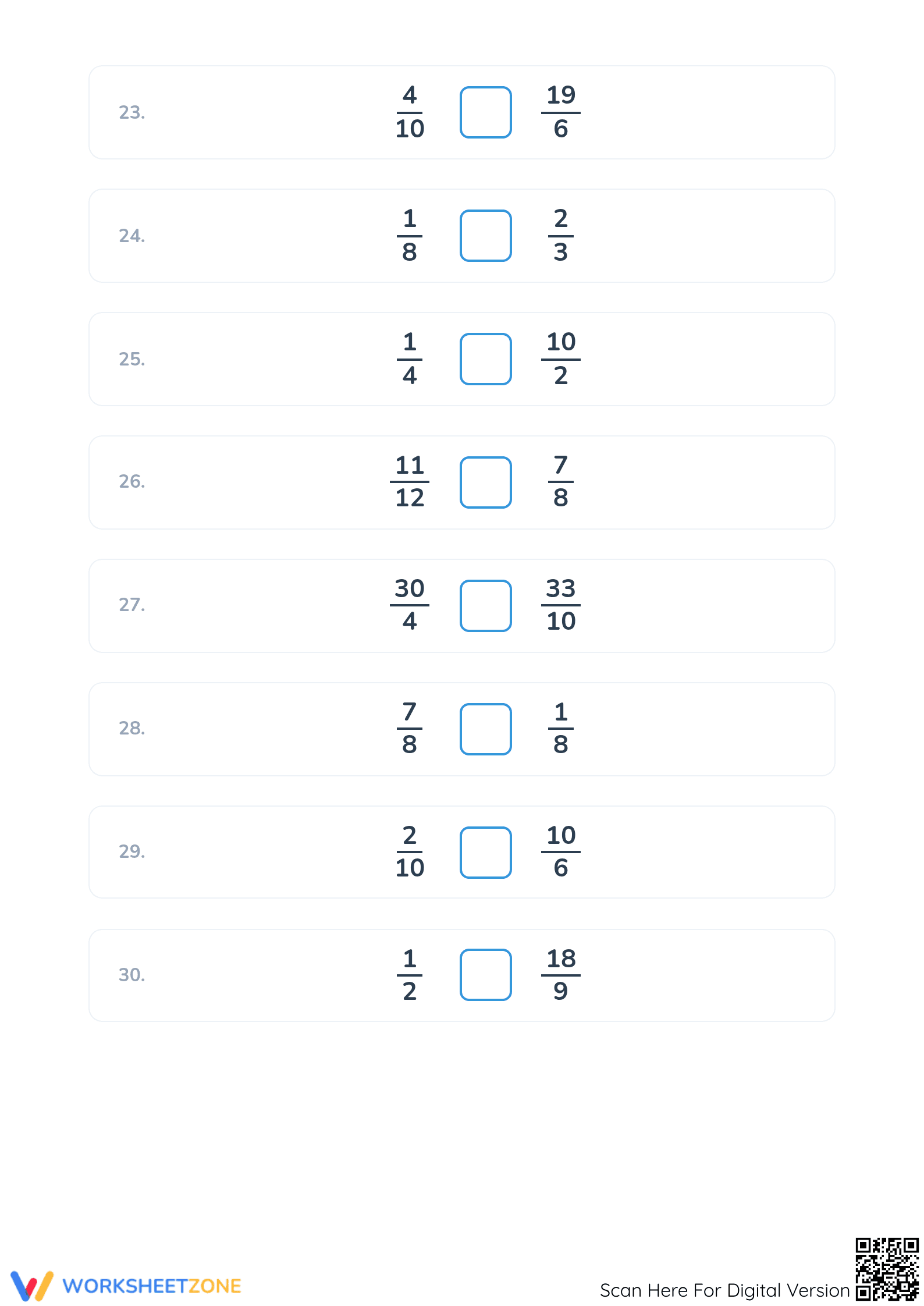
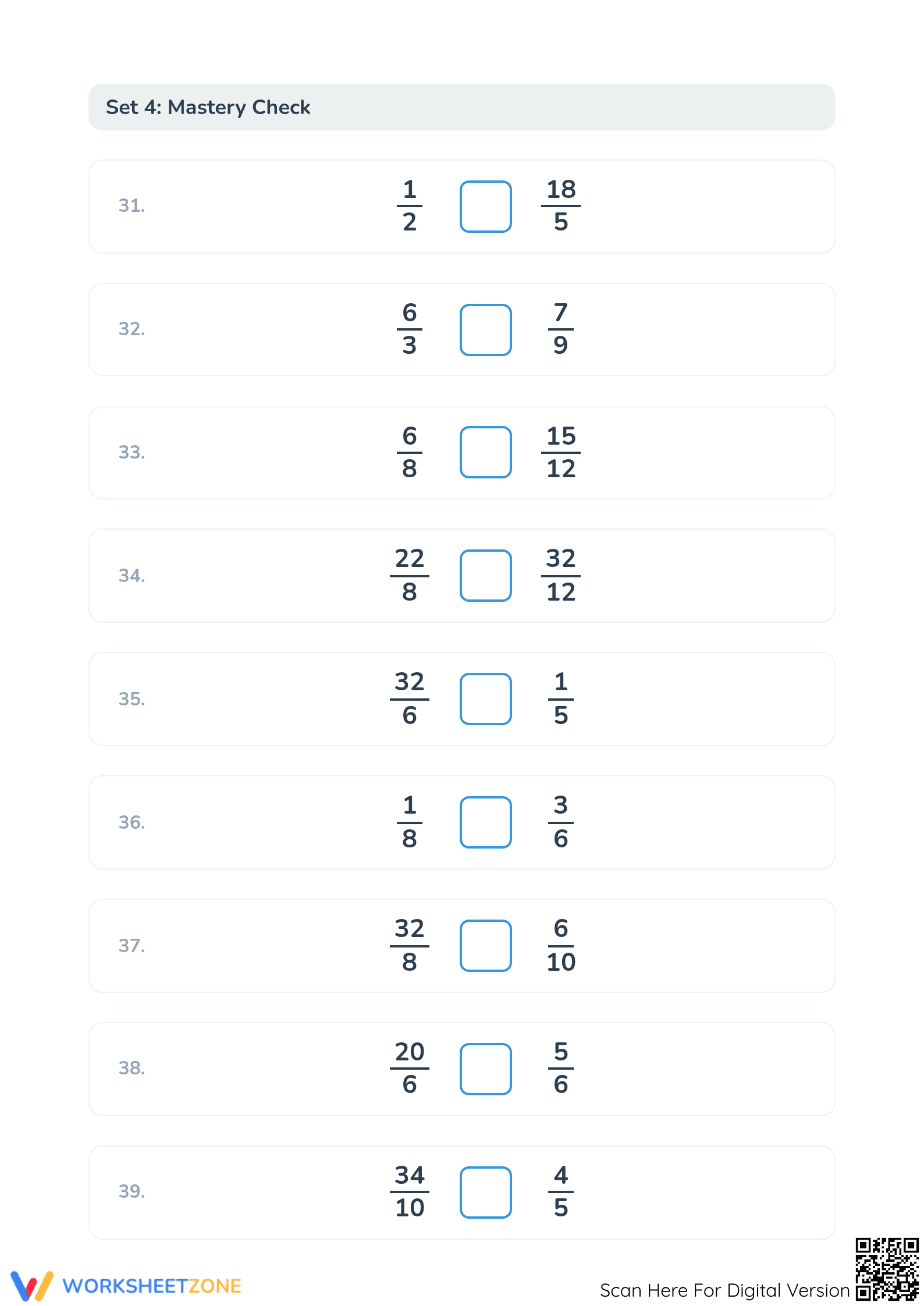
This robust packet contains 39 unique comparison tasks distributed across five clearly organized pages. The collection includes "Set 1: Basic Comparisons" for foundation building, "Set 2: Challenge Level" for increased cognitive demand, "Set 3: Advanced Practice" for complex denominators, and a final "Set 4: Mastery Check" to verify student comprehension. A full answer key is provided for efficient grading.
Skill Progression
The instructional sequence follows a proven gradual-release model, ensuring students build competence before tackling complex scenarios. This progression includes:
- Guided Practice: The first ten problems focus on basic comparisons with familiar denominators to build initial confidence.
- Supported Practice: Problems 11 through 20 introduce improper fractions with larger numerators, requiring students to apply mental estimation or cross-multiplication.
- Independent Practice: The final 19 problems, including the advanced and mastery sets, present diverse fraction pairs that demand fluency in finding common denominators.
Standards Alignment
The primary focus is 4.NF.A.2: "Compare two fractions with different numerators and different denominators... by creating common denominators or numerators, or by comparing to a benchmark fraction." It also supports 5.NF.A.1 by encouraging equivalent fraction logic. Both standard codes can be copied directly into lesson plans, IEP goals, or district curriculum mapping tools.
How to Use It
This resource is ideal for use after direct instruction on finding common denominators. Assign the first two sets as guided classwork to observe student strategies, then use the Mastery Check as a formal formative assessment. For a formative-assessment observation tip, watch for students who struggle specifically when both fractions are improper, as this indicates a need for benchmark fraction review.
Who It's For
This set is designed for upper elementary and middle school students who are refining their rational number sense. It serves as an excellent intervention tool for high schoolers needing remediation or as a challenge for third graders ready for advanced concepts. It pairs naturally with a visual fraction wall or an anchor chart on improper-to-mixed number conversion.
Effective fraction instruction requires moving beyond rote procedures to conceptual fluency. According to a 2024 NAEP analysis, students who master comparing improper fractions demonstrate 22% higher proficiency in subsequent algebraic reasoning tasks. This worksheet aligns with the 4.NF.A.2 standard by requiring students to evaluate 39 unique fraction pairs, bridging the gap between basic identification and complex rational number analysis. Research from EdReports 2024 highlights that high-quality, standards-aligned practice materials are essential for closing achievement gaps in middle-school mathematics. By providing a clear four-set progression from basic to advanced levels, this resource ensures that students encounter the variety of problem types necessary for true mastery. Educators can use these tasks to identify specific misconceptions regarding denominator magnitude and improper fraction value. This self-contained practice set is a reliable asset for any math curriculum focusing on essential rational number skills and evidence-based student outcomes.


