


























Views
Downloads
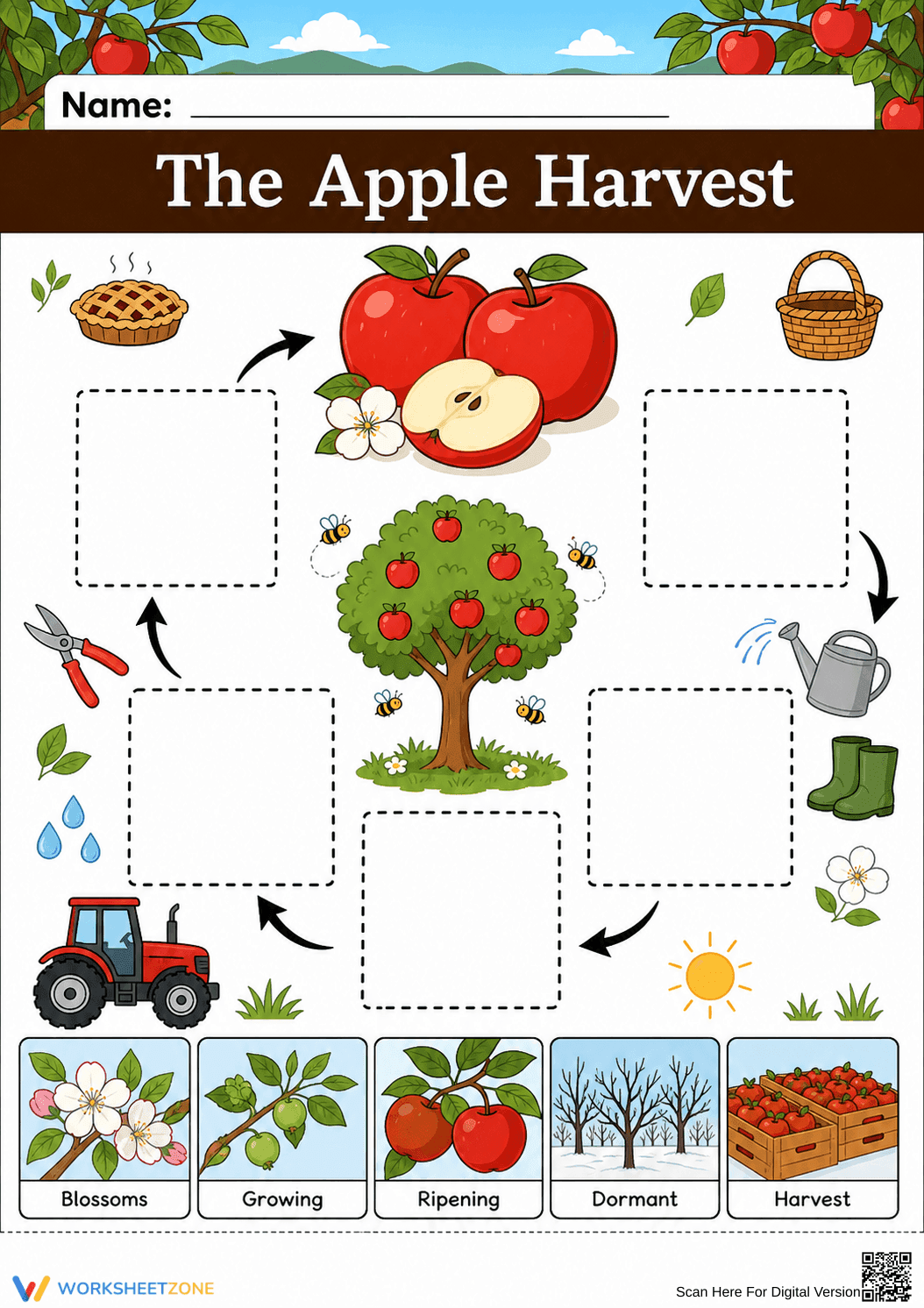

Grade 3 Apple Life Cycle — Printable No-Prep Worksheet
Paste this activity's link or code into your existing LMS (Google Classroom, Canvas, Teams, Schoology, Moodle, etc.).
Students can open and work on the activity right away, with no student login required.
You'll still be able to track student progress and results from your teacher account.
This printable science worksheet helps students master the stages of plant growth by sequencing the apple life cycle. By cutting and pasting five distinct developmental phases—from blossoms to harvest—learners build foundational biology skills and practice chronological ordering in a highly visual, engaging format.
At a Glance
- Grade: 3 · Subject: Science
- Standard:
3-LS1-1— Develop models describing diverse organism life cycles.- Skill Focus: Sequencing plant life cycles
- Format: 1 page · 5 problems · Answer key included · PDF
- Best For: Independent practice and science centers
- Time: 15–20 minutes
This single-page resource features a circular diagram with five dashed boxes connected by directional arrows, representing the continuous nature of a life cycle. At the bottom, students find five labeled illustration cards: Blossoms, Growing, Ripening, Dormant, and Harvest. Students cut out these cards and glue them into the correct sequence. The clear illustrations provide strong visual scaffolding, while the answer key ensures quick grading.
This resource is designed for immediate classroom implementation:
- Print (1 min): Download the PDF and print a class set. Requires only scissors and glue.
- Distribute (1 min): Hand out during your science block or place in a center.
- Review (2 mins): Use the provided key to check sequences or project it for self-correction.
With under two minutes of prep, this activity is excellent for sub plans.
This activity is directly aligned to 3-LS1-1: Develop models to describe that organisms have unique and diverse life cycles but all have in common birth, growth, reproduction, and death. By organizing the stages of an apple tree's development, students create a functional model of a plant's reproductive cycle. Both standard codes can be copied directly into lesson plans, IEP goals, or district curriculum mapping tools.
Deploy this worksheet after direct instruction on plant biology to reinforce cyclical growth. It serves as an excellent independent practice activity. Alternatively, use it as a formative assessment at the end of a botany unit. As students work, observe whether they correctly identify the "Dormant" stage's placement, which requires understanding seasonal cycles. Expected completion time is 15 to 20 minutes.
This resource is ideal for third-grade general education students, though its heavy reliance on visual cues makes it highly accessible for English Language Learners and students receiving special education services. The clear labels support vocabulary development alongside scientific reasoning. Pair this activity with a read-aloud about Johnny Appleseed or a non-fiction text detailing seasonal changes in deciduous forests to create a comprehensive cross-curricular lesson.
Understanding biological sequences is a critical component of early elementary science education. Aligned with 3-LS1-1, this resource requires students to develop models describing diverse organism life cycles. According to a 2024 report by EdReports, instructional materials that integrate visual modeling with hands-on sequencing tasks significantly improve student retention of complex scientific processes. When learners physically manipulate the stages of an apple's growth—moving from blossom to harvest—they transition from passive observers to active participants in their learning. This tactile engagement reinforces the continuous, cyclical nature of life, providing a concrete foundation for more advanced biological concepts in later grades. By combining clear vocabulary with sequential logic, educators can effectively assess student comprehension of plant reproduction and seasonal dormancy while supporting broader literacy goals.


