


























Views
Downloads
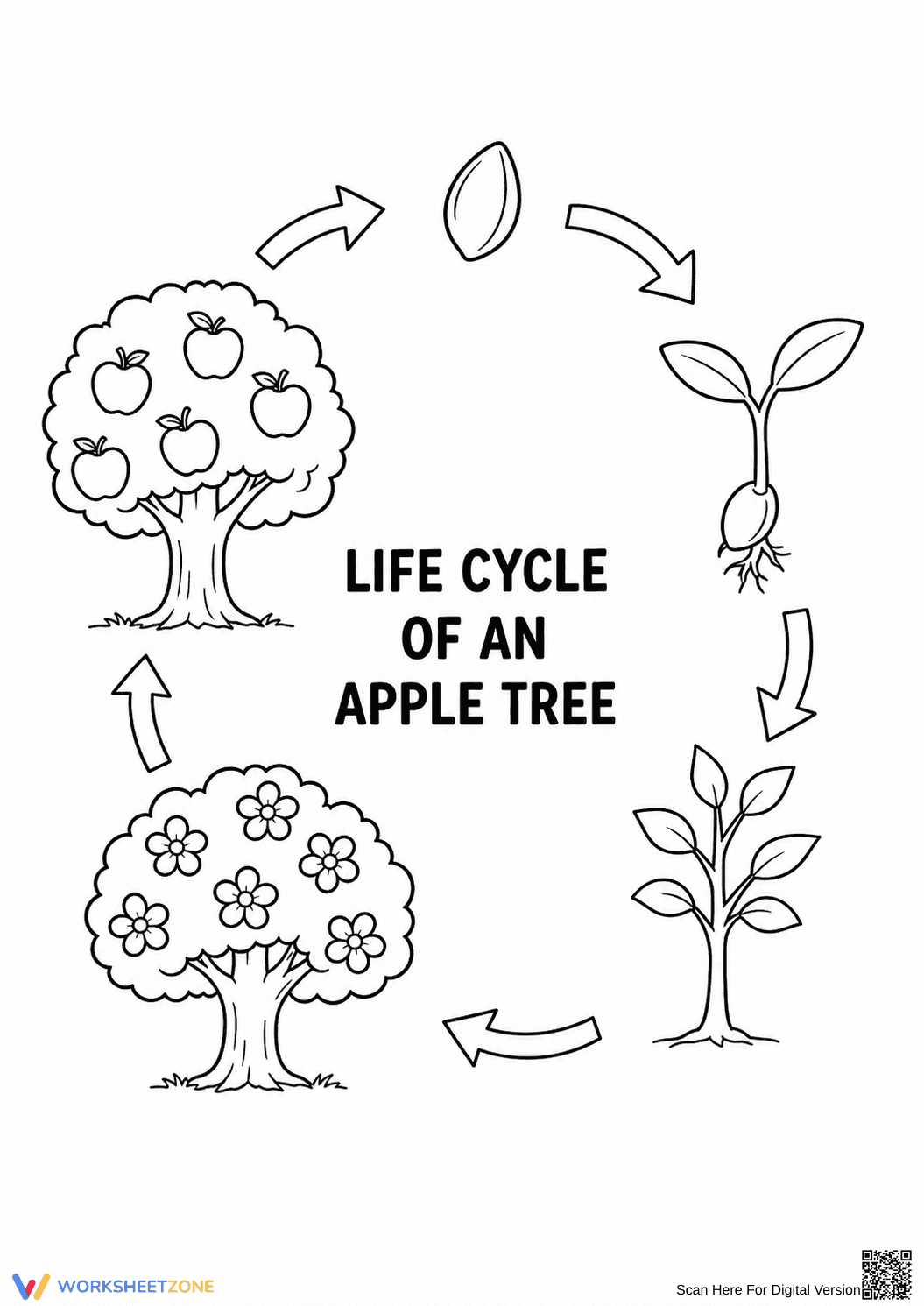

Grade 3 Apple Tree Life Cycle — Printable No-Prep Worksheet
Paste this activity's link or code into your existing LMS (Google Classroom, Canvas, Teams, Schoology, Moodle, etc.).
Students can open and work on the activity right away, with no student login required.
You'll still be able to track student progress and results from your teacher account.
This printable apple tree life cycle worksheet helps students visualize how plants grow from seeds to mature, fruit-bearing trees. By examining five distinct stages of development, young learners build a foundational understanding of biological reproduction. The clear diagram format makes complex scientific concepts accessible and engaging for elementary students.
At a Glance
- Grade: 3 · Subject: Science
- Standard:
3-LS1-1— Develop models to describe organism life cycles- Skill Focus: Plant life cycles
- Format: 1 page · 5 stages · No answer key needed · PDF
- Best For: Independent practice or science centers
- Time: 15–20 minutes
This single-page resource features a clear, circular diagram illustrating the continuous life cycle of an apple tree. Students will find five distinct visual stages: the seed, the sprouting seedling, the growing sapling, the mature tree in full bloom, and the final fruit-bearing tree. Bold directional arrows guide the learner's eye through the chronological progression. The black-and-white line art doubles as an engaging coloring activity, allowing students to personalize their science notes.
Zero-Prep Workflow
Designed for immediate classroom implementation.
- Print (1 minute): Download the PDF and print a class set.
- Distribute (1 minute): Hand out diagrams with crayons. No complex instructions needed.
- Review (3 minutes): Walk the class through the five stages, noting the connecting arrows.
With total teacher prep time under two minutes, this is ideal for an emergency sub plan.
Standards Alignment
This visual model is directly aligned to the Next Generation Science Standards, specifically 3-LS1-1: Develop models to describe that organisms have unique and diverse life cycles but all have in common birth, growth, reproduction, and death. By tracing the path from seed to fruit, students observe these universal biological milestones in a concrete way. Both standard codes can be copied directly into lesson plans, IEP goals, or district curriculum mapping tools.
How to Use It
This diagram works beautifully as an introductory activity before direct instruction on plant biology. Have students color the stages while you read a book about apple orchards. Alternatively, use it as a formative assessment during a science center; ask students to verbally explain what happens between each arrow to check for understanding. Expected completion time is 15 to 20 minutes.
Who It's For
This worksheet is primarily designed for third-grade science students learning about plant biology and life cycles. The highly visual nature of the diagram provides excellent differentiation for English Language Learners and visual learners who benefit from seeing concepts illustrated rather than just reading text. It pairs perfectly with an anchor chart on plant parts or a hands-on seed germination experiment.
Understanding biological progressions through visual models is a critical component of early science education. Aligned with 3-LS1-1, this resource helps students develop models to describe organism life cycles. According to a recent ScienceDirect TpT Analysis, elementary science materials that incorporate clear, sequential diagrams significantly improve student retention of cyclical biological processes compared to text-heavy alternatives. When young learners actively engage with a visual model—such as tracing the arrows from a tiny seed to a mature, fruit-bearing tree—they build stronger cognitive frameworks for understanding how living things grow, reproduce, and sustain their species. This foundational knowledge satisfies core science standards and fosters a deeper appreciation for the natural world. Integrating this simple visual tool provides students with a research-backed method for mastering essential life science concepts.


