




























Views
Downloads
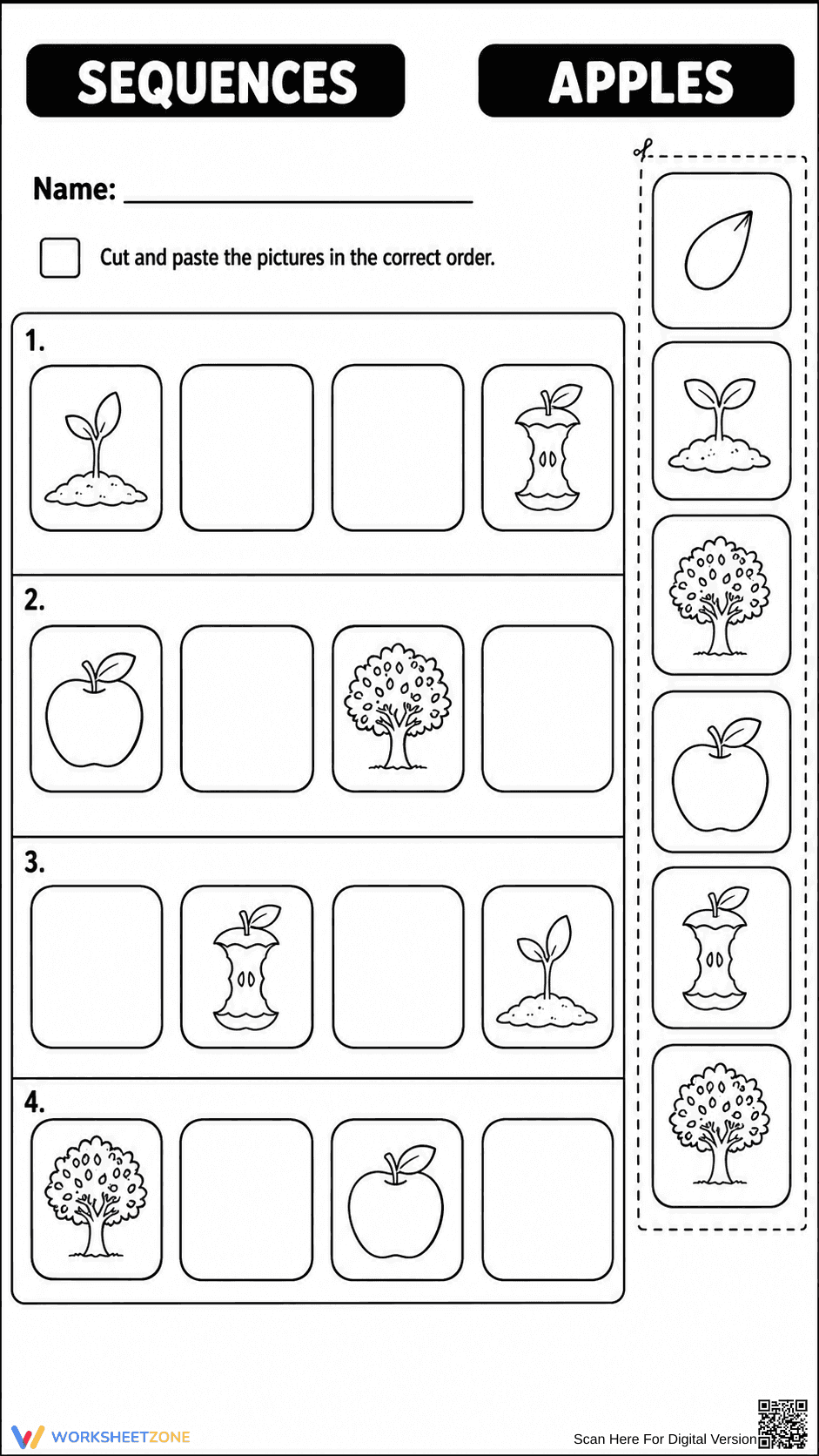

Apple Life Cycle Sequencing | Grade 1 Printable Worksheet

Paste this activity's link or code into your existing LMS (Google Classroom, Canvas, Teams, Schoology, Moodle, etc.).
Students can open and work on the activity right away, with no student login required.
You'll still be able to track student progress and results from your teacher account.
This science worksheet helps early learners master sequencing by exploring the apple life cycle. Students cut and paste images into chronological order, building fine motor skills and a concrete understanding of plant growth.
At a Glance
- Grade: 1 · Subject: Science
- Standard:
3-LS1-1— Model the stages of an organism's life cycle- Skill Focus: Sequencing and Pattern Recognition
- Format: 1 page · 4 problems · Answer key included · PDF
- Best For: Independent practice or science centers
- Time: 15–20 minutes
This single-page resource features four sequencing rows, each missing two stages of the apple life cycle. A cut-and-paste bank provides six illustrated stages, including a seed, seedling, tree, and apple core. The visual format removes reading barriers, allowing students to focus on logical progression. A complete answer key is provided.
Designed for immediate classroom implementation, this activity requires zero teacher preparation.
- Print (1 min): Generate copies and grab the answer key.
- Distribute (1 min): Hand out pages, scissors, and glue.
- Review (3 min): Model the first sequence on the board.
With setup under two minutes, this worksheet serves as an ideal emergency sub plan or independent center activity.
This activity aligns with 3-LS1-1, requiring students to develop models describing that organisms have unique life cycles. While targeted at third grade, this visual task provides the foundational framework for early elementary students. Both standard codes can be copied directly into lesson plans, IEP goals, or district curriculum mapping tools.
Deploy this worksheet immediately after a whole-class read-aloud about plant growth or a seasonal fall unit on apples. It works beautifully as an independent science center where students can physically manipulate the stages before gluing them down. As a formative assessment tip, observe students before they apply glue; ask them to verbally explain why they placed the seedling before the mature tree to check their chronological reasoning. Expect most students to complete the cutting, sorting, and pasting within 15 to 20 minutes.
This resource is specifically designed for kindergarten and first-grade students developing early science and logic skills. To support students who struggle with fine motor tasks, teachers can pre-cut the image bank pieces ahead of time. Advanced learners can be challenged to flip the page over and draw the continuous circular life cycle from memory. Pair this activity with a classroom anchor chart showing a generic plant life cycle to help students bridge the concept from apples to all living plants.
Understanding the chronological progression of living things is a critical milestone in early childhood science education. By aligning with 3-LS1-1, this activity ensures students can accurately model the stages of an organism's life cycle through hands-on sequencing. According to EdReports 2024, integrating physical manipulatives like cut-and-paste tasks into science instruction significantly increases retention of abstract concepts such as biological growth and time progression. When young learners physically move the image of a seed to precede a seedling, they build cognitive maps that translate to stronger reading comprehension and mathematical patterning skills later on. This foundational practice bridges the gap between simple observation and complex scientific modeling, providing a rigorous yet accessible entry point for early elementary life science curricula. Teachers utilizing this method consistently report higher engagement and deeper conceptual mastery among their youngest learners.


