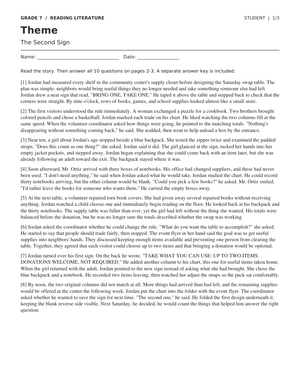
A well-built theme worksheets does something that whole-class discussion alone rarely accomplishes: it forces students to commit their interpretation to paper, where the distance between "I sort of know the theme" and "I can actually name and defend it" becomes immediately visible. This set covers grades 3 through 8 and addresses the full range of skills involved in identifying, articulating, and supporting literary theme — from distinguishing a topic word from a theme statement, to backing up a claim with specific textual evidence.
The Specific Skills These Worksheets Target
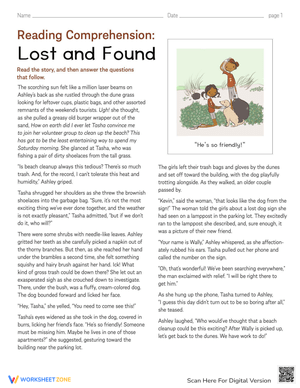
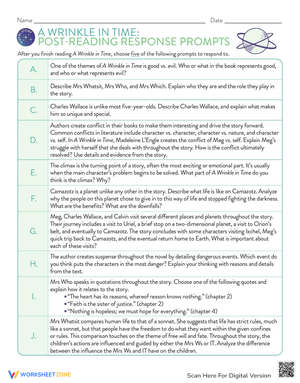
The sharpest challenge in theme instruction is not reading comprehension in the traditional sense — students who can retell a plot in detail often produce responses like "the theme is friendship" without recognizing that "friendship" names a topic, not a theme. Moving from topic to statement is the first skill this set builds. Students practice expanding one-word observations ("courage," "loss," "honesty") into complete sentences that carry a claim: "Courage means doing what's right even when no one will notice." That shift — from label to assertion — is where real literary analysis begins.
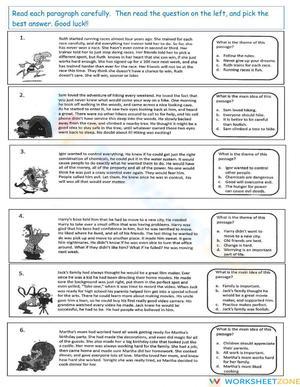
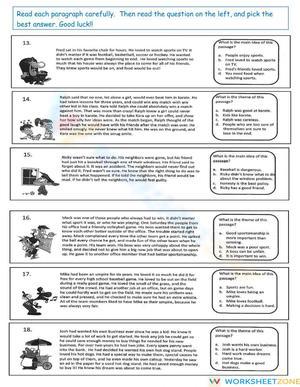
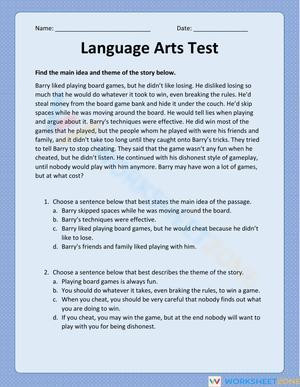
Beyond theme statements, the set asks students to distinguish theme from main idea, which trips up even strong readers. The main idea is specific to one story: it lives inside the text. The theme, by contrast, travels — it applies to experiences the characters never had. Each worksheet in this section presents a short passage and asks for both responses side by side, so students can see the contrast directly rather than keep the distinction abstract.
Additional skills across the set:
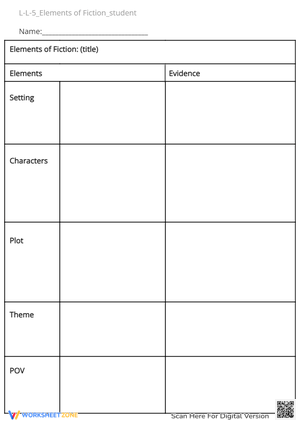
- Identifying the central conflict and connecting it to the lesson a character learns
- Tracing character change across a story arc as evidence for a theme statement
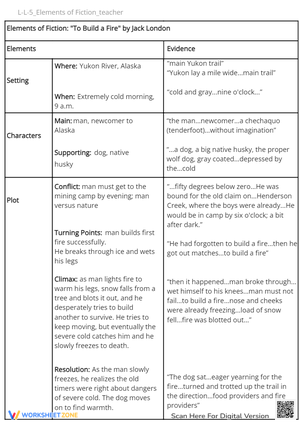
- Selecting and quoting specific text details that support an interpretation
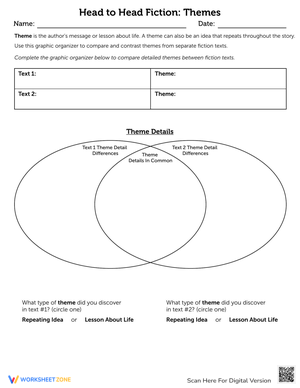
- Recognizing that a longer work can carry more than one theme — and that both can be valid if evidence supports them
- Differentiating moral (a right-or-wrong judgment) from theme (a broader observation about human experience)
Mistakes Students Make That These Worksheets Help You Catch
The one-word theme is the most consistent error across grade levels, and it does not fix itself with more reading. A student who writes "the theme is perseverance" on every assignment is not being lazy — they have not been taught to ask what the author is actually saying about perseverance. That question is the engine of theme analysis, and each worksheet in this set returns to it through different prompts and passage types.
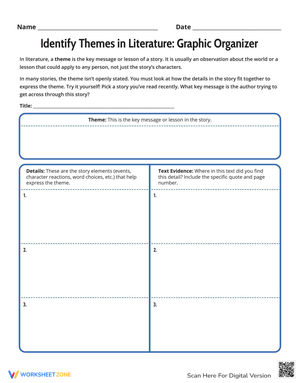
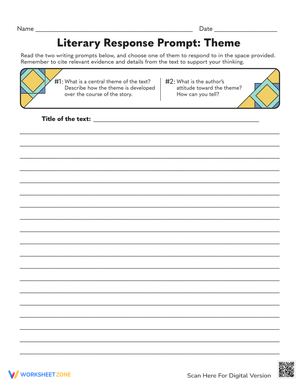
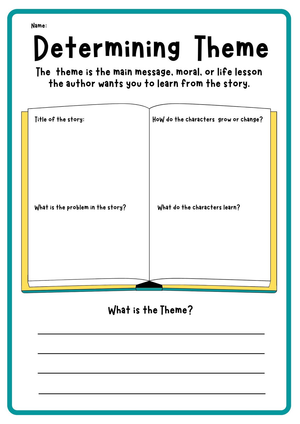
A related problem: students who summarize instead of analyze. When asked to identify the theme, they write "the character worked hard and eventually won the race" — accurate plot summary, but not a theme. This happens because theme is genuinely abstract, and summary feels like a safe answer. The worksheets address this by separating the two tasks into distinct response boxes on the same worksheet, so students cannot blur one into the other. When the boxes are labeled differently and placed side by side, students see that they've answered the same question twice and realize one response needs to do different work.
One more pattern worth naming: students who identify a valid theme but choose the weakest possible evidence. They will write "True kindness asks nothing in return" and then cite a single line of dialogue from early in the story — before the character has shown any growth. Teaching students to look for evidence in the story's resolution, not just its opening conflict, makes a noticeable difference in the quality of written responses. These worksheets flag this tendency by asking students to locate evidence at more than one point in the text before finalizing their theme statement.
How to Build These Worksheets Into Your Lesson Plans
Theme is a skill that benefits from short, repeated contact rather than one extended unit. Using this theme worksheets during the ten minutes before a class read-aloud — as a prediction activity — gives students a framework to notice theme evidence while the text is being read, rather than hunting backward for it afterward. This approach works especially well at grades 4 and 5, where students are just beginning to hold the full arc of a story in mind while tracking individual scenes.
For middle school ELA, the evidence-based worksheets in this set work well in the days following a novel chapter or short story discussion, when students have already formed an opinion about the theme but haven't written it out. Small-group work on a shared passage, followed by individual responses on separate worksheets, makes differences in interpretation visible and gives the class a concrete reason to discuss why textual evidence matters. Save the more complex worksheets — the ones asking students to trace multiple themes across a longer excerpt — for after the class has practiced reliably with shorter, single-theme passages.
Standard Alignment
These resources align to CCSS.ELA-Literacy.RL.4.2 (determining the theme of a story, drama, or poem from details in the text, and summarizing) and CCSS.ELA-Literacy.RL.5.2 (determining theme and explaining how it is supported by key details). At the middle school level, the evidence-tracking worksheets address RL.6.2 and RL.7.2, which require students to analyze how theme is developed across a text — not just identified. In classroom terms, this means the bar shifts significantly between fifth and sixth grade: students move from naming a theme to explaining how the author builds it through character, conflict, and resolution. That gap is precisely where this set focuses its most targeted practice.
Adjusting These Worksheets for a Range of Learners
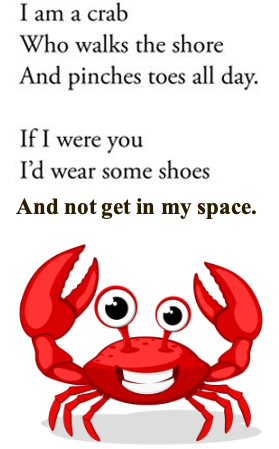
For students who still confuse theme with plot at the start of instruction, begin with the fable-based worksheets in this set. Fables give students a single visible arc — a character faces a problem, makes a choice, experiences a consequence — and often state the moral outright. Once students can write a complete theme statement after reading a fable, move them to implied-theme passages, where the lesson is embedded in character behavior rather than delivered in a final line. The move from explicit to implied is the critical developmental step, and the set sequences it deliberately.
Advanced readers frequently identify the theme quickly but treat the evidence-gathering step as unnecessary. For these students, ask them to locate a second valid theme for the same passage and support it with different evidence — evidence that cannot be used to support the first theme. This requires a second close reading from a different angle and builds the interpretive flexibility that high school literary analysis demands. The worksheets in this set that include multiple short passages lend themselves well to that kind of extension without requiring additional materials.
Frequently Asked Questions
Is this set appropriate for both elementary and middle school students?
Yes. The set spans grades 3 through 8, and both the passages and the prompts increase in complexity across that range. Elementary worksheets use shorter texts and provide more structured response prompts with sentence starters. Middle school worksheets ask students to work with longer excerpts and produce multi-sentence, evidence-backed theme statements without that support. Teachers in departmentalized settings often pull from both levels within the same class when ability ranges are wide.
My students can already define theme — will these worksheets still push their thinking?
Knowing the definition and applying it accurately under pressure are two different things. Students who can define "theme" correctly in October will still write one-word topic responses in November when they encounter an unfamiliar passage. Using this theme worksheets regularly keeps the skill active rather than theoretically understood. It also surfaces specific gaps — weak evidence selection, plot-summary responses, confusion between moral and theme — that a vocabulary quiz will never catch.
How long does each worksheet take to complete?
Most worksheets in this set take between 15 and 25 minutes for independent completion, depending on passage length. The fable-based worksheets run closer to 10 minutes and work well as warm-up activities. The multi-passage and evidence-tracking worksheets are better suited to a full class period or a homework assignment where students have time to reread the text before responding.
Can I use these alongside a novel the class is currently reading?
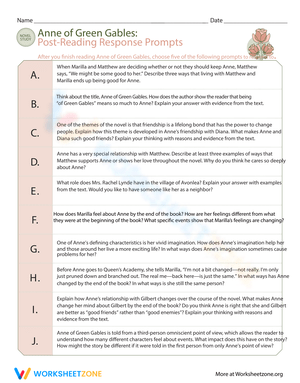
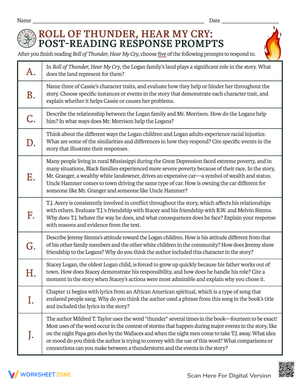
That is one of the strongest uses for this theme worksheets. Pulling an excerpt from a novel the class is mid-way through, then asking students to identify theme evidence on a structured worksheet, connects the analytical skill directly to a text they already have opinions about. Several worksheets in the set include blank passage fields specifically for this purpose — teachers paste in their own excerpt and students complete the analysis using the printed prompts.