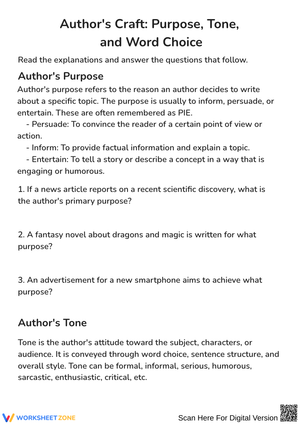
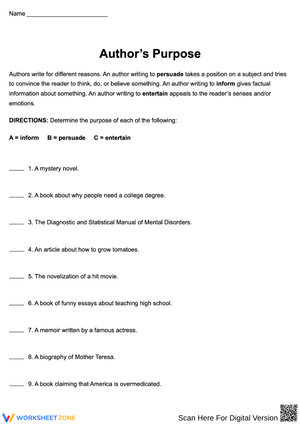
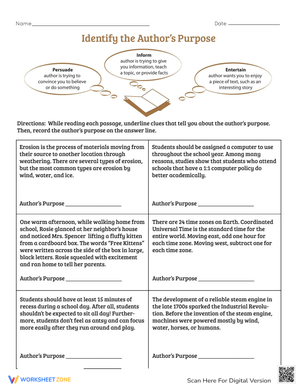
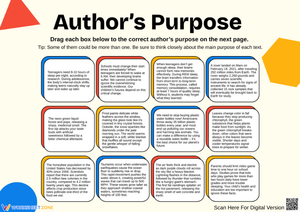
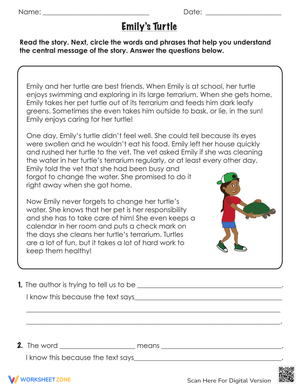
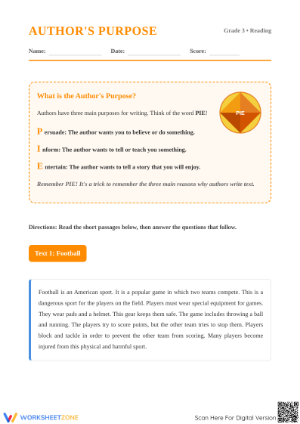
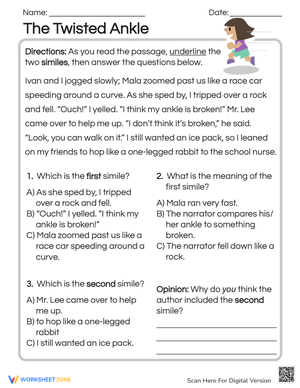
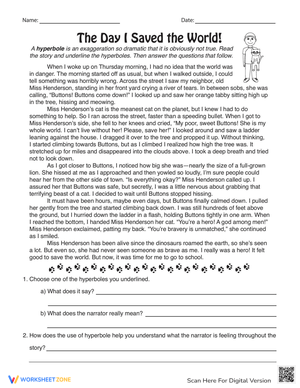
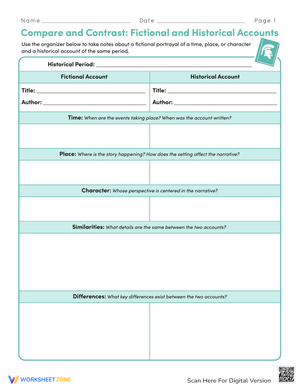
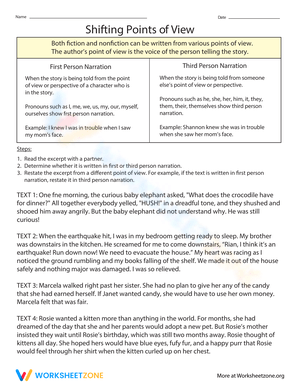
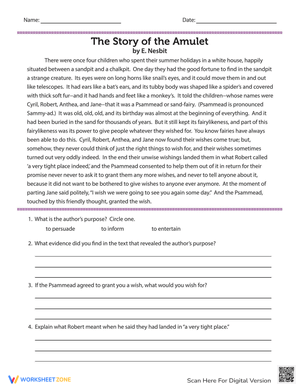
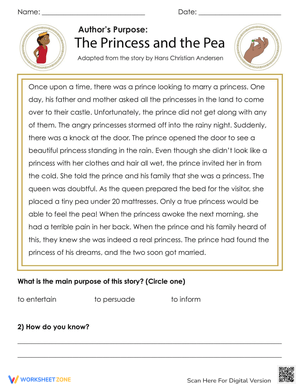
These author's purpose worksheets resources give grades 3–6 students directed practice identifying why a writer produced a given text — from the entry-level task of labeling a passage as persuade, inform, or entertain to the more demanding work of naming a primary purpose when a secondary one is also visible. Each worksheet includes a short passage and a structured response that requires students to cite a specific word or phrase as evidence for their choice, a step that slows down guessing and makes the reasoning process visible for teacher review. The set draws on a range of text types: opinion columns, encyclopedia entries, short fiction excerpts, advertisements, and first-person accounts.
The Specific Skills Each Worksheet Targets
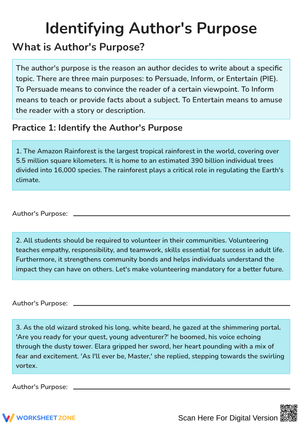
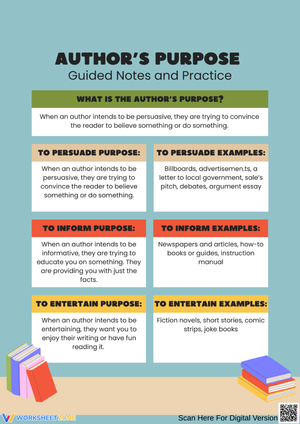
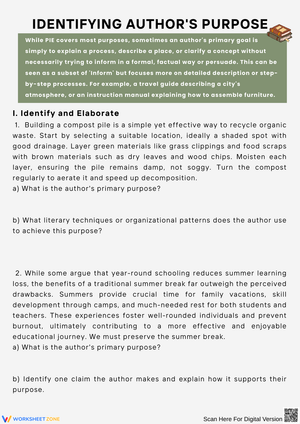
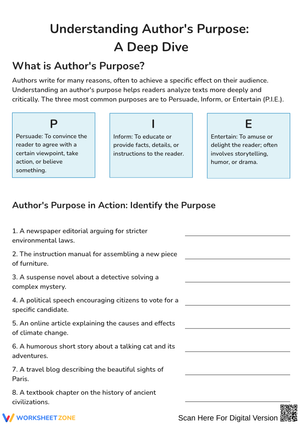
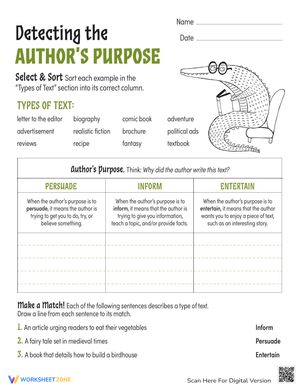
Three levels of tasks are distributed across the set. On the foundational worksheets, students read a passage and identify the author's purpose from the three PIE categories — Persuade, Inform, Entertain — with no evidence requirement. The task is pure recognition, which is the right starting point for students encountering PIE for the first time. Middle-tier worksheets add an underline-and-explain step: students mark the phrase or sentence that most clearly signals intent, then write one sentence justifying their choice. The advanced worksheets present texts where a surface-level purpose and an underlying purpose diverge — a science explanation that closes with a call to reduce plastic use, for instance — and students must identify which purpose is dominant and explain how they know.
Working through these author's purpose worksheets consistently over a unit builds the habit of reading with a question active before reaching the last sentence of a passage. That forward-leaning orientation is what separates a reader who decodes competently from one who thinks critically about what a writer is actually doing.
Where Students Go Wrong With Author's Purpose Tasks
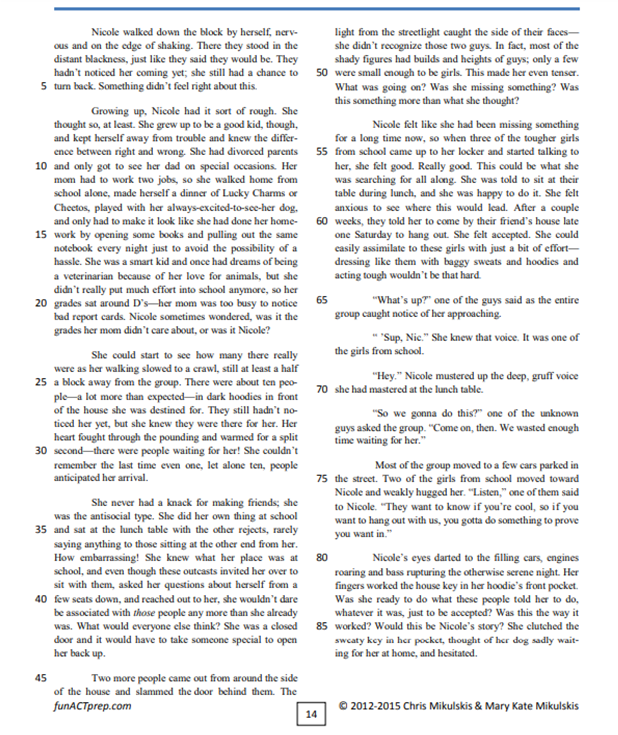
The most consistent error — visible in student work from third grade through sixth — is labeling anything with a narrator "entertain." Students read a first-person account of a scientist's fieldwork, note that there is a character and sensory details, and circle E. The real question they should be asking is whether the primary goal of the text is to tell a story or to transmit information using narrative as a delivery vehicle. That distinction does not come naturally to students who have been taught "stories equal entertain," and the worksheets that use narrative nonfiction are the ones that surface the confusion most clearly.
The second consistent error involves opinion pieces. Students who associate persuasion with slogans and exclamation points sometimes miss the intent in a measured op-ed because it sounds calm and cites statistics — and they mark it "inform." The evidence-citation requirement on the middle and advanced worksheets addresses this directly. When students have to write down the specific sentence that signals the author's intent, they cannot fall back on overall tone as a proxy for purpose.
Fitting These Worksheets Into Your Week
The foundational worksheets work as warm-ups during the first five to eight minutes of an ELA block. Put the passage on the projector, give students two minutes to mark their answer and underline their evidence, then discuss before moving into the lesson. Classes that start this way on Monday settle into a shared vocabulary for author's purpose that pays off when the standard comes up again in unit texts later in the week.
For a full gradual-release sequence, use one worksheet as a whole-class think-aloud, a second as paired practice, and a third as an individual formative check. Because each worksheet is standalone, you are not locked into that order — if a class has already mastered basic PIE sorting, you move directly to the evidence-based worksheets without working through the foundational tier first. These author's purpose worksheets resources also fit naturally into literacy center rotations: the bounded format — one passage, one task — lets students start and finish during a single rotation without needing to carry context from a previous session.
Tiering the Practice Across Your Class
For students still building reading fluency, the foundational worksheets can be used with an anchor chart that defines the three PIE categories. Having the definitions visible does not undermine the skill — students still have to read the passage and make a judgment call. It reduces the memory demand and frees up cognitive space for the actual reasoning work.
Students who have already internalized PIE need the evidence requirement to stay challenged. Push those readers further: after completing the worksheet, ask them to write a second sentence explaining who the likely audience is and how that audience might have influenced the author's choices. That follow-up question is not printed on the worksheet, but it takes five additional minutes and shifts the task from categorization into genuine rhetorical analysis.
For students who decode below grade level, a fluent reading partner or a brief read-aloud of the passage keeps the analytical work accessible without removing the intellectual task.
Standard Alignment
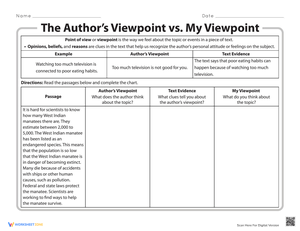
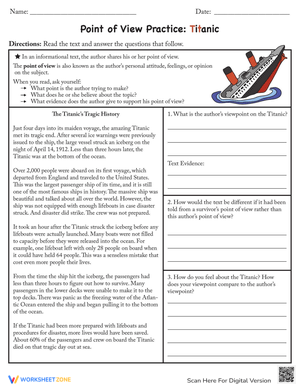
The worksheets align most directly to CCSS.ELA-LITERACY.RI.3.6, which asks students to distinguish their own point of view from the author's, and CCSS.ELA-LITERACY.RI.4.6, where the standard shifts toward comparing firsthand and secondhand accounts. The PIE vocabulary these worksheets build is what students need before they can meaningfully work through either standard. The craft and structure strand at grades 4–6 — particularly RI.5.6, which focuses on how an author uses evidence to support particular points — maps directly onto the middle and advanced worksheets in the set.
State standards following the CCSS structure typically introduce author's purpose as a focal skill in grades 3 and 4, with increasing analytical complexity through grade 6. Grade 3 teachers will find the foundational and middle worksheets cover the expected level of task demand. Grade 5 and 6 teachers should start with the advanced worksheets, where the dual-purpose passages and written justification steps align to the higher-order expectations those standards require.
Frequently Asked Questions
What grade levels are these worksheets appropriate for?
The set targets grades 3 through 6. Foundational worksheets with shorter passages and clear single-purpose texts are appropriate for third grade; advanced worksheets with dual-purpose passages and written evidence requirements match fifth- and sixth-grade expectations. Some second-grade teachers have used the foundational worksheets successfully with students who have solid nonfiction reading exposure and strong decoding skills.
Do texts ever serve more than one author's purpose?
Yes, and the advanced worksheets address this directly. A first-person historical account might primarily inform while also using narrative techniques that engage the reader. On those worksheets, students identify which purpose is dominant and point to the textual evidence that makes the case. This level of analysis reflects what upper-elementary and middle-school assessments expect — and what students who read widely will encounter constantly in actual texts.
How much time does each worksheet require?
Foundational worksheets typically run five to eight minutes for most students. Those requiring written evidence and a secondary analytical step take ten to fifteen minutes. That range makes individual worksheets workable as warm-ups, center tasks, or short formative checks without needing a full class period.
Can I pull individual worksheets into an existing reading program?
These author's purpose worksheets resources are standalone practice materials that do not require a specific basal program or reading series. Teachers using Into Reading, Journeys, or other anthology-based curricula have inserted individual worksheets as targeted skill practice when author's purpose appears as a unit focus, without following a preset sequence from the set.












 Interactive Worksheet Maker
 Quiz Maker
 Word Search Maker
 Crossword Puzzle Maker
 Word Scramble Generator
 Sentence Scramble Generator
 Handwriting Worksheet Generator
 Name Tracing Generator
 Fill In The Blank Generator