Understanding the Five Essential Text Structures
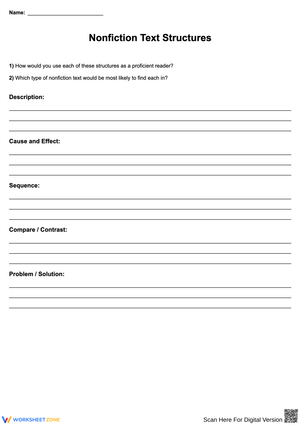
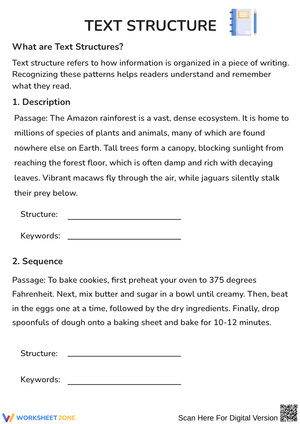
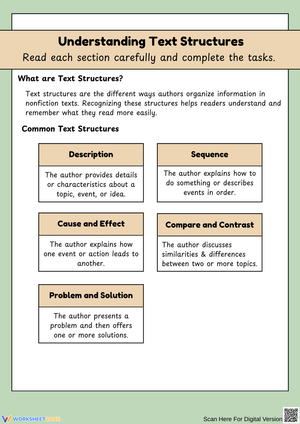
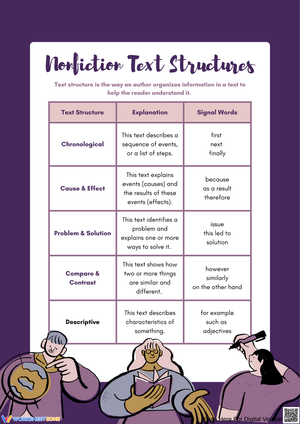
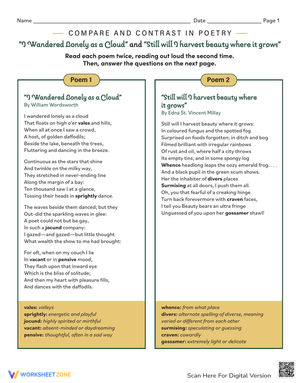
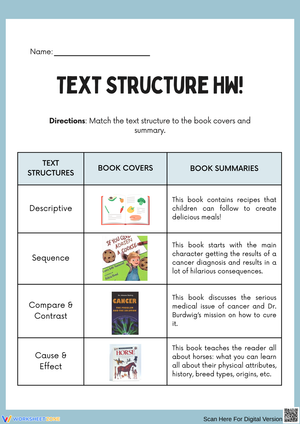
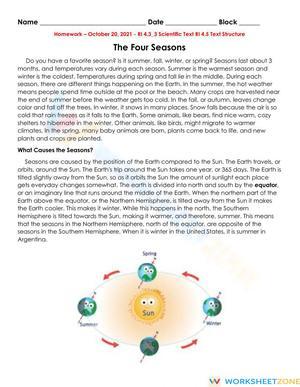
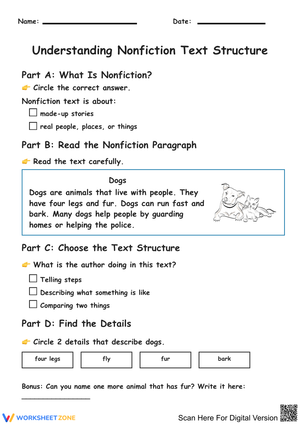
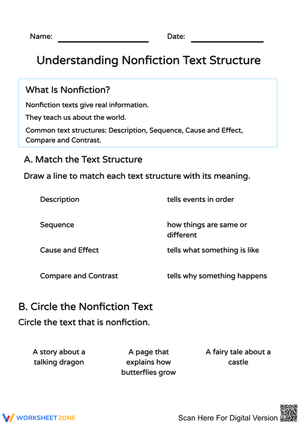
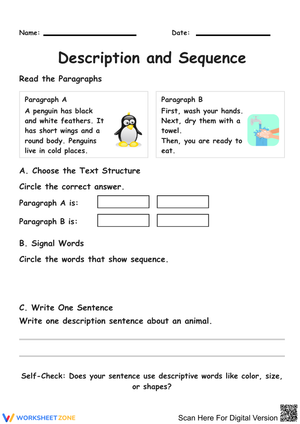
When students learn to identify how an author has organized information, they gain a powerful tool for decoding complex ideas. For teachers, utilizing analyzing text structure printable worksheets resources allows for targeted practice that simplifies this cognitive task. There are five primary structures that appear frequently in informational writing: description, sequence, cause and effect, compare and contrast, and problem and solution. Each structure serves a specific purpose in conveying information and requires students to employ different mental processing strategies. Description involves providing details for a mental picture, while sequence organizes information in a timeline.
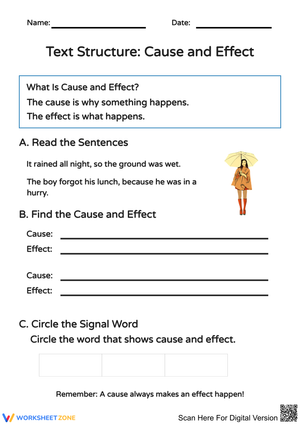
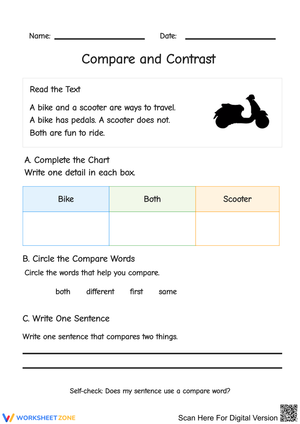
Cause and effect explores relationships, compare and contrast examines similarities, and problem and solution identifies challenges and proposes resolutions. By using printable worksheets, teachers can provide short, manageable passages that highlight these structures, allowing for focused analysis without the overwhelm of lengthy chapters. Systematic instruction ensures that students develop the ability to see the underlying logic that connects ideas across all subject areas, from science to social studies.
Why Analyzing Text Structure Improves Reading Comprehension
Reading comprehension is the result of overlapping cognitive processes, and recognizing text structure is a significant contributor to deep understanding. When a reader identifies the structure of a text, they create a mental framework into which they can slot new information. This organizational schema reduces the effort required to remember details because they are linked by a logical thread. For instance, if a student knows they are reading a compare and contrast passage, their brain is already primed to look for similarities and differences, making the reading process more efficient and effective for long-term retention.
Research in educational psychology suggests that students who are explicitly taught text structure strategies perform better on recall tasks. By using analyzing text structure printable worksheets activities, teachers can provide the repetition necessary for this skill to become automatic. Instead of reading a text as a series of disconnected sentences, students begin to see the bigger picture, transitioning from passive reading to active analysis, which is a key milestone in literacy development and academic success.
Identifying Signal Words with Printable Worksheets
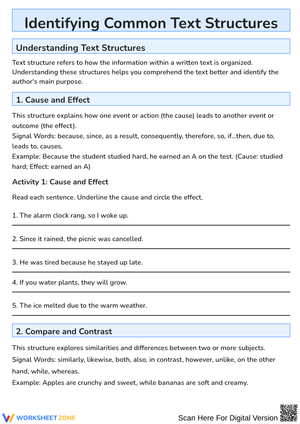
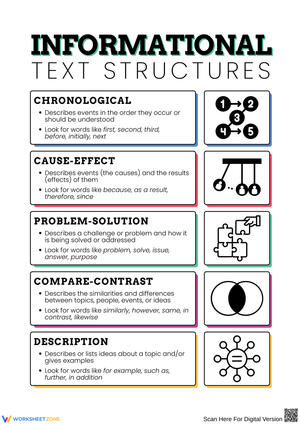
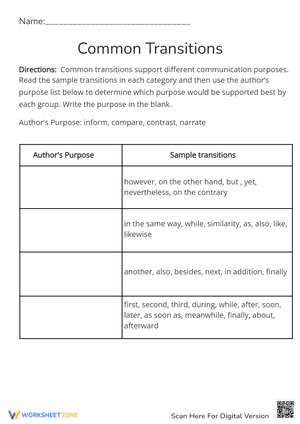
One of the most effective ways to teach text structure is through the identification of signal words. These linguistic markers alert the reader to the organization of the text. For example, 'first' and 'next' signal sequence, while 'because' and 'therefore' indicate cause and effect. Using analyzing text structure printable worksheets materials that focus on these words helps students develop a keen eye for organizational clues. Teachers can use these worksheets to conduct word hunts or have students highlight signal words before reading for content, turning a passive task into an active investigation that builds foundational literacy skills.
According to research highlighted in Understanding Text Structure from Reading Rockets, explicitly teaching students to recognize organizational patterns can lead to a 20-30% increase in information recall from complex expository texts. This allows learners to build mental models of the information effectively by utilizing the author's inherent logic to organize their own internal understanding of the subject matter. Initially, teachers might focus on one structure at a time, providing common words and short paragraphs where those words are used prominently. As students become more comfortable, the worksheets can become more challenging, featuring passages with fewer signal words or more subtle indicators. This scaffolding ensures that students are not just memorizing a list but are learning to use words as a gateway to deep comprehension.
Scaffolding Text Structure Analysis for Different Learners
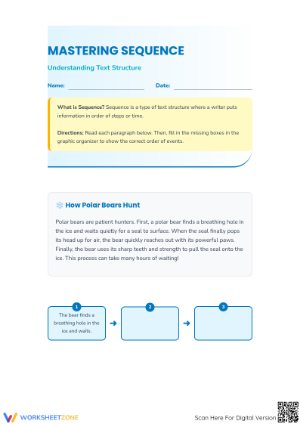
Scaffolding is essential to ensure every student masters text structure analysis. For younger students or those who are struggling, teachers can start with highly structured worksheets that include graphic organizers. These visual tools allow students to map out information as they read, providing a concrete representation of an abstract concept. For example, a Venn diagram is perfect for compare and contrast, while a flowchart is ideal for sequence or cause and effect. Using analyzing text structure printable worksheets versions with pre-drawn organizers simplifies the initial learning phase and builds confidence. As students gain confidence, these scaffolds can be gradually removed. A middle-tier worksheet might provide the text and a blank graphic organizer, requiring the student to decide which type of map is appropriate. Advanced students might identify the structure and write a summary reflecting that structure. This differentiation is easily managed with printable files, as teachers can select versions based on student readiness, ensuring every learner is appropriately challenged.
Teacher Tips for Effective Classroom Implementation
Integrating text structure instruction into a busy schedule requires a strategic approach. One effective method is using mentor texts—short, high-quality examples of each structure studied in detail. Teachers can find these in textbooks or use specific analyzing text structure printable worksheets passages. Spending a week on each structure allows students to fully immerse themselves in the associated patterns and signal words, preventing confusion and building a strong foundation. Another tip is to make text structure a regular part of classroom conversation. When discussing any article, ask students, 'How is the author organizing this information?' Finally, utilize formative assessment to track student progress. Brief, printable exit tickets can check if students can identify the structure of a short paragraph or list signal words for a specific pattern. These quick checks allow teachers to identify which students may need extra support, ensuring the literacy program remains responsive to individual student needs.
Mapping Text Logic with Graphic Organizers
Graphic organizers are powerful tools for teaching text structure, providing a visual bridge between words and logic. Seeing information laid out in a diagram makes it significantly easier for visual learners to understand and remember. A well-designed organizer forces the student to look for specific types of information, encouraging active engagement. Using analyzing text structure printable worksheets versions of these organizers ensures that every student has the necessary tool at their fingertips. This clarity is essential for developing the critical thinking skills required to evaluate the vast amount of information students encounter daily in both digital and physical formats.
Explicitly teaching text structure is not just about identifying patterns; it is about cognitive offloading where the student uses the structure as a mental scaffold to reduce the working memory load during reading. By providing students with these mental maps, teachers give them a high-definition lens through which to view information. This skill empowers students to both understand and communicate complex ideas with clarity and confidence, preparing them for the rigors of academic research and professional communication.
Frequently Asked Questions Section
1. What are the main types of text structures students should learn?
Students should primarily focus on five main structures: description, sequence, cause and effect, compare and contrast, and problem and solution. Mastering these allows them to navigate the majority of informational texts they will encounter in school. Each structure has its own unique set of signal words and organizational logic that helps readers follow the author's message more effectively. Our analyzing text structure printable worksheets series covers all five to ensure comprehensive literacy development across various grade levels and subjects.
2. How can printable worksheets improve student comprehension of text structure?
Printable worksheets provide students with the opportunity for focused, repetitive practice in identifying organizational patterns. By working with short, targeted passages, students can build their skills without becoming overwhelmed by length. These resources often include graphic organizers, which provide a vital visual aid for mapping out the relationship between ideas. This structured approach helps transition students from basic word recognition to deep logical analysis of complex informational texts, making them more proficient readers and thinkers.
3. What are some common signal words for different types of text organization?
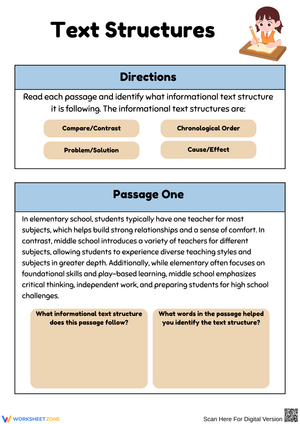
Common signal words include 'first' and 'finally' for sequence; 'similarly' and 'on the other hand' for compare and contrast; 'because' and 'consequently' for cause and effect; and 'challenge' or 'solution' for problem and solution. Identifying these words is a key strategy taught through analyzing text structure printable worksheets activities. Teaching students to spot these linguistic markers allows them to predict the flow of information and better organize the details they encounter while reading, significantly improving their ability to summarize and recall content.
4. When should teachers start teaching text structure?
Text structure instruction can begin as early as first grade with simple structures like sequence and description using familiar stories. As students move into upper elementary grades, they can be introduced to more complex patterns like cause and effect and problem and solution in expository texts. The use of printable worksheets allows teachers to adjust the difficulty level of the texts to suit the developmental stage of their students, ensuring that the cognitive load is appropriate for their age and existing reading proficiency level.
5. How do I know if my students are effectively analyzing text structure?
Effective analysis is demonstrated when students can correctly identify the organizational pattern of a new text and explain their choice using signal words as evidence. Additionally, if students can successfully fill out a graphic organizer based on a reading passage, it indicates they have grasped the logical connections between ideas. Regular use of analyzing text structure printable worksheets assessments allows teachers to track this progress and identify students who may need additional scaffolding or intervention.












 Interactive Worksheet Maker
 Quiz Maker
 Word Search Maker
 Crossword Puzzle Maker
 Word Scramble Generator
 Sentence Scramble Generator
 Handwriting Worksheet Generator
 Name Tracing Generator
 Fill In The Blank Generator