


























Views
Downloads

Determining Theme Worksheet | Grade 4 Essential
Paste this activity's link or code into your existing LMS (Google Classroom, Canvas, Teams, Schoology, Moodle, etc.).
Students can open and work on the activity right away, with no student login required.
You'll still be able to track student progress and results from your teacher account.
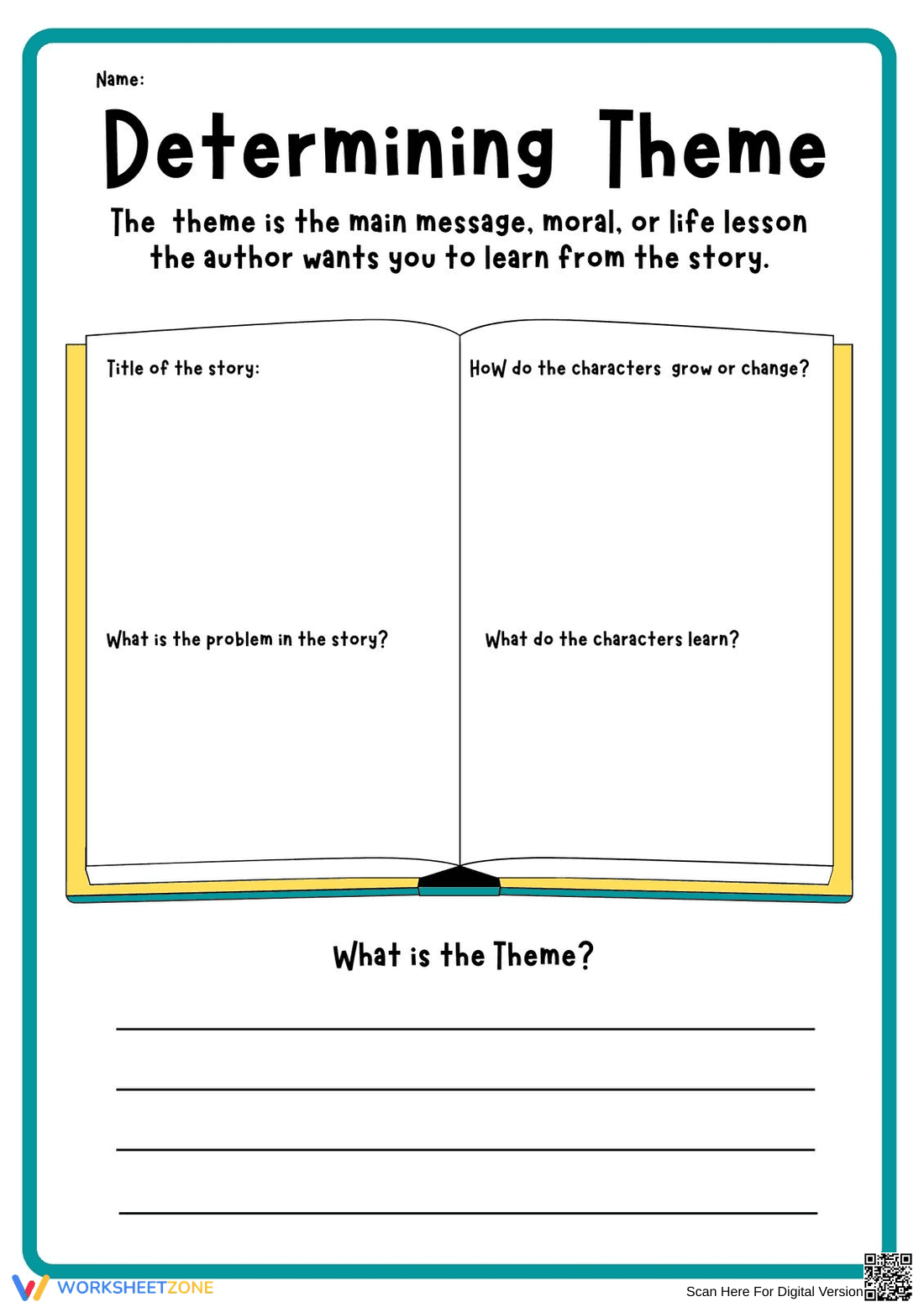
This Grade 4 determining theme worksheet helps students identify the central message or moral of any literary text. By analyzing character growth, plot problems, and lessons learned, learners move from surface-level reading to deep comprehension. It provides a structured graphic organizer to guide students through the critical thinking process required for literary analysis.
At a Glance
At a Glance
- Grade: 4 · Subject: ELA
- Standard:
CCSS.ELA-LITERACY.RL.4.2— Determine a theme of a story from details in the text- Skill Focus: Identifying theme and character growth
- Format: 1 page · 5 problems · Answer key included · PDF
- Best For: Independent reading response or small groups
- Time: 15–20 minutes
What's Inside
Inside this resource, you will find a single-page graphic organizer designed for any short story or novel chapter. It features a clear definition of theme at the top to ground student understanding. The page includes four specific analysis quadrants—title, character change, conflict identification, and lessons learned—followed by a final synthesis section for the theme statement.
Zero-Prep Workflow
The zero-prep workflow is designed for maximum efficiency. First, print the single-page PDF (30 seconds). Next, distribute the sheets to students during your reading block or as a homework assignment (1 minute). Finally, review the completed organizers using the provided sample answer key to check for logical connections between plot details and the identified theme (30 seconds).
Standards Alignment
This resource is aligned to CCSS.ELA-LITERACY.RL.4.2, which requires students to determine a theme of a story, drama, or poem from details in the text. It also supports RL.4.3 by focusing on how characters respond to challenges. Both standard codes can be copied directly into lesson plans, IEP goals, or district curriculum mapping tools.
How to Use It
Use this worksheet during the independent practice phase of a gradual release model. After modeling theme identification with a picture book, assign this sheet for students to use with their independent reading books. It also serves as an excellent formative assessment tool; observe if students can link the character change box directly to their final theme statement. Expected completion time is 15 to 20 minutes.
Who It's For
This worksheet is ideal for general education fourth graders, but the visual layout also supports English Language Learners and students with IEPs who need scaffolded prompts. It pairs naturally with any short story anthology or as a response-to-reading activity following a teacher-led read-aloud session. It is also suitable for emergency sub plans.
According to the Fisher & Frey (2014) framework for gradual release of responsibility, structured graphic organizers are vital for transitioning students from teacher-led modeling to independent mastery of complex literary concepts. This worksheet targets CCSS.ELA-LITERACY.RL.4.2 by requiring students to synthesize specific textual details—such as character growth and conflict resolution—into a cohesive theme statement. Research from the NAEP indicates that students who can successfully identify the moral or lesson of a text demonstrate significantly higher overall reading comprehension scores. By providing explicit prompts for character change and lessons learned, this resource reduces the cognitive load associated with abstract reasoning, allowing Grade 4 learners to focus on evidence-based analysis. The 1-page format ensures that the task remains focused and manageable within a standard 20-minute instructional block, making it a reliable tool for both formative assessment and routine literacy practice in diverse classroom settings.


