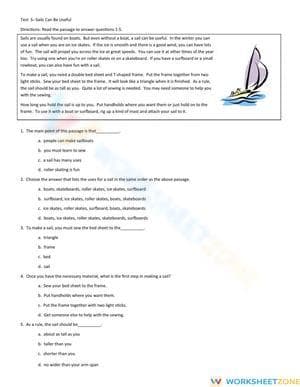
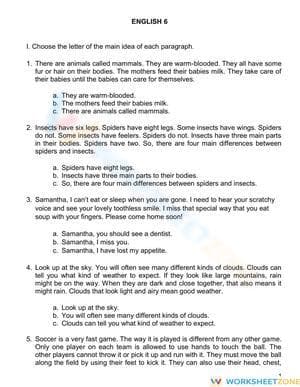
These main idea and supporting details worksheets give 3rd through 6th grade ELA teachers a structured, printable way to move students from passive reading toward active analysis of a text's central argument. Each worksheet pairs a short passage — drawn from both informational and narrative text types — with prompts that ask students to state the central idea, underline or list supporting evidence, and explain why a tempting but incorrect answer describes only a single detail rather than the whole text. The evidence-marking format means teachers can see exactly where student thinking breaks down, which makes the set as useful for quick formative checks as it is for direct instruction.
The Specific Skills Targeted in Each Worksheet
The core task throughout the set is identifying what a passage is mostly about — not what it mentions, not what a single sentence says, but what the author is arguing or explaining from start to finish. That distinction drives every question format in the collection.
- Main idea identification: Students state the central idea in their own words rather than selecting a sentence lifted directly from the passage.
- Supporting detail location: Students return to the text and underline or list two to three details that prove or develop the main idea.
- Detail ranking: Students mark which detail most directly supports the central idea, which adds secondary explanation, and which is present but least essential. This step separates students who can locate details from students who understand why details carry different weight.
- Topic vs. main idea sorting: Several worksheets present the topic as a single noun phrase — for example, honeybee navigation — alongside two or three full-sentence candidates, and students explain why the topic label is too narrow to function as a main idea.
- Graphic organizer completion: Box-and-branches and web formats help students map the relationship between a central claim and its evidence before moving to written responses.
Passages range from single paragraphs — useful during initial instruction and targeted reteaching — to multi-paragraph texts where students must synthesize across several sections before committing to an answer.
Common Misconceptions to Watch For and Correct
The most consistent error pattern is treating the topic as the main idea. A student who reads a paragraph about monarch butterfly migration will often write monarch butterflies as the main idea — which names the topic. The main idea is the full claim the author is making: that monarchs use environmental and magnetic cues to navigate thousands of miles each fall. The worksheets address this directly by requiring students to write complete sentences and then verify that the sentence covers the whole passage, not just its subject.
The second pattern is first-sentence bias. Students in 3rd and early 4th grade tend to copy the opening sentence as the main idea, even when the passage builds to its central point in the final lines. This habit develops because explicit instruction has correctly taught them that topic sentences often appear first — but hasn't yet shown them that some writers withhold the main point until the end. Several worksheets in the set use a delayed-main-idea structure specifically to surface and disrupt that habit before it becomes automatic.
A third error appears during detail selection: students pick the most interesting detail rather than the most representative one. In a passage about rainforest layers, a student might choose the detail about poison dart frogs because it's vivid — but that detail describes only one element of the forest floor. The ranking task forces students to articulate why one detail is more central than another, and it typically resolves this confusion faster than reteaching the definition of a supporting detail ever does.
How to Work These Worksheets Into Your Planning Without Overcomplicating the Block
The gradual release model fits this skill well. On the first day with a new passage type, project the worksheet and think aloud through the main idea decision before students mark anything. On day two, guide students through the same steps with a new passage, letting them discuss with a partner before committing written answers. By day three, students work independently, and the teacher pulls a small group to address the topic-vs.-main-idea confusion that typically persists in three or four students per class even after whole-group instruction.
These worksheets also fit cleanly into the seven or eight minutes before a transition. A short-paragraph task works as a focused warm-up at the start of the reading block, a quick exit ticket at the end, or a targeted station during the independent rotation in a reading workshop structure. Because the format stays consistent across the set, students stop spending attention on interpreting directions and start spending it on the actual reading — which is where that effort belongs.
For sub plans, a main idea and supporting details worksheets with an answer key needs almost no additional prep. The format is self-directing, the passages are short, and a substitute can redirect students using the built-in prompts without needing any content knowledge about the current reading unit.
Differentiating These Worksheets Across Ability Levels
Using a main idea and supporting details worksheets with students at different readiness levels requires only minor adjustments to how the same passage gets presented — not a full redesign of the task.
Students who struggle with fluency often perform below their actual comprehension level on these tasks because decoding the passage consumes most of their available working memory. Reading the passage aloud before independent work removes that barrier and reveals whether the comprehension skill itself needs more instruction or whether fluency is the more pressing issue. Pairing a shorter paragraph with sentence stems — The main idea is ___ because the passage says ___ — gives those students enough structure to demonstrate understanding without turning the worksheet into an exercise in staring at a blank line.
On-level students work with passages of three to five sentences, two or three written detail responses, the ranking step included, and no sentence stems. For students reading above grade level, the most productive extension isn't a longer passage — it's a comparative task: two worksheets on related topics with the added prompt of writing one sentence that captures a main idea shared across both texts. That task replicates the synthesis work students will face on standardized assessments and in upper-grade content reading, using existing worksheet materials without building anything new.
Standard Alignment
These worksheets address CCSS.ELA-LITERACY.RI.4.2: "Determine the main idea of a text and explain how it is supported by key details; summarize the text." This standard sits at the structural center of 4th grade informational reading, but the skill progression runs from RI.2.2 — where students identify the main topic and retell key details — through RI.5.2 and RI.6.2, where students determine two or more main ideas and support their analysis with textual evidence. The worksheets serve as grade-level practice at 4th grade, reinforcement at 5th, or targeted reteaching at 6th for students who haven't yet resolved the topic-vs.-main-idea confusion. Teachers working with 3rd grade students will find direct alignment with CCSS.ELA-LITERACY.RI.3.2, which introduces the expectation that students determine the main idea and explain how key details support it.
Frequently Asked Questions
At what grade level does this skill typically enter formal instruction?
The main idea and supporting details distinction enters formal instruction in 2nd grade under the Common Core framework, but it deepens substantially in 3rd and 4th grade when students begin reading longer informational texts with multiple paragraphs and layered evidence. Most teachers find they need to reteach the topic-vs.-main-idea distinction at the start of each school year, even with students who demonstrated mastery the previous spring, because the error patterns reliably reappear in new reading contexts.
How many worksheets per week makes sense when first introducing this skill?
Two to three short-passage worksheets per week during the first two weeks of instruction is a sustainable pace. After initial instruction, one worksheet every few days — used as a warm-up or exit ticket — maintains the skill without turning it into overdrilled routine. Spaced practice across several weeks produces more durable retention than a concentrated run of daily packets.
Do these work with literary passages, or only informational text?
The skill transfers across text types, but informational passages work better during initial instruction because their topic sentences tend to be more explicit and their evidentiary structure more visible. Once students are secure with informational main idea identification, literary passages — a scene from a story, a fable, a descriptive paragraph — add useful complexity because the central idea often has to be inferred rather than located in a single sentence. Rotating between text types also helps students understand that identifying a main idea is a property of how authors construct arguments, not a feature limited to one genre.
Do these worksheets replace a full reading unit?
A strong main idea and supporting details worksheets set provides repeated, focused practice with the identification and evidence-location components of the skill — and that's exactly what it should do. The modeling discussions, extended writing tasks, read-alouds, and transfer to full-length texts all require lesson structures that printable worksheets support but cannot replicate on their own. Each worksheet functions as one deliberate component of a lesson, not the lesson itself.