Why Claim and Evidence Worksheets Are Taught in the ELA Lessons
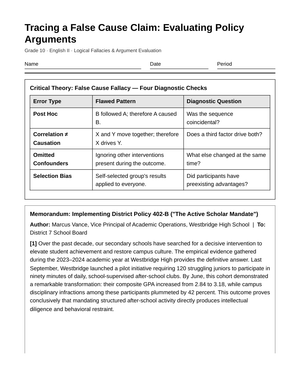
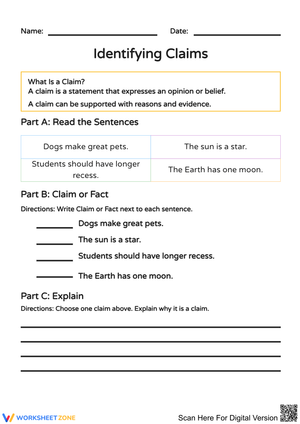
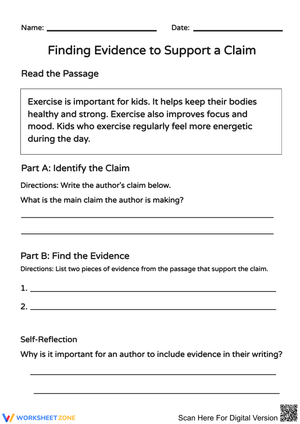
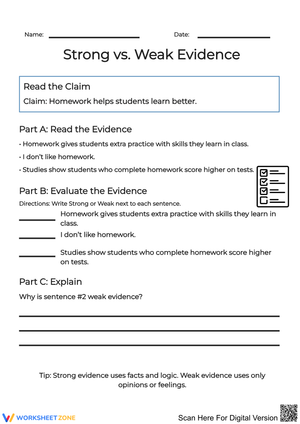
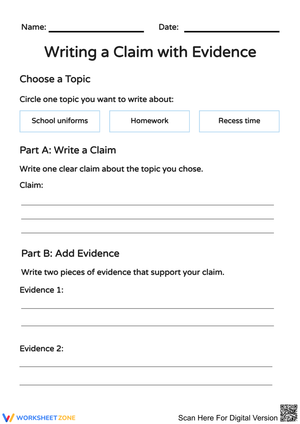
If you teach grades 4-8 ELA, you already know the gap between a student who can summarize a passage and one who can defend a position with textual support. Claim and evidence worksheets close that gap by isolating a single skill: identifying what a writer or speaker is arguing, then finding the specific lines of text that back it up. This is not the same task as general reading comprehension, where students answer literal or inferential questions about a passage. Claim and evidence work asks students to separate an assertion from the proof behind it, then judge whether that proof actually supports the assertion.
For teachers planning a unit that leads to a full argument essay, these worksheets function as a low-stakes rehearsal space. Students practice the exact cognitive move they will need later: read a claim, scan a text, pull out relevant lines, and explain the connection. Doing this in short, worksheet-sized chunks before asking for a five-paragraph essay reduces the number of students who freeze when asked to write an argument from scratch.
Standards Alignment Across Grade Bands
Claim and evidence instruction is not a one-time lesson. It is a skill that builds across grade levels, and worksheets should reflect that progression rather than treating every grade the same way. CCSS.ELA-Literacy.W.6.1 asks students to write arguments that support claims with clear reasons and relevant evidence, which is the foundational version of this skill. By the time students reach the standard described in Common Core State Standards - Writing Grade 8, they are expected to clarify relationships among claims, counterclaims, reasons, and evidence using words, phrases, and clauses that signal those connections.
That jump matters for how you sequence worksheets. A sixth-grade worksheet can reasonably ask students to match one claim to one piece of supporting evidence. An eighth-grade worksheet should push further, asking students to use transition language such as however or as a result to show how a reason connects to a claim, per the expectations in Common Core State Standards - Writing Grade 8. High school teachers referencing Common Core State Standards - Writing Grade 9-10 will recognize the next step: students must use valid reasoning and sufficient evidence while also learning to distinguish a claim from an opposing claim, a skill detailed in CCSS.ELA-Literacy.W.9-10.1a - Introduce precise claims and distinguish from opposing claims.
The practical takeaway for lesson planning is this: claim and evidence worksheets should not stay static across a school year. A worksheet bank that only offers single-claim, single-evidence matching will underprepare seventh and eighth graders who need to juggle counterclaims, and it will overwhelm fourth and fifth graders who are still learning to separate a fact from an opinion.
Pairing Worksheets With Close Reading Passages
Claim and evidence worksheets are most effective when tied to a passage students have already read closely, rather than presented as an abstract skill drill. Reading standards require students to cite specific textual evidence when offering an oral or written interpretation of a text, and that citation habit only develops through repeated practice with real passages, not generic sentence stems.
When you pair a worksheet with a close reading passage, ask students to underline or highlight the exact sentence they are citing before they transfer it to the worksheet. This extra step slows students down just enough to prevent the common shortcut of paraphrasing the whole paragraph instead of pulling a precise quote. Over time, this builds the habit of returning to the text rather than relying on memory or general impressions when constructing an argument.
Classroom Implementation
Start a claim and evidence unit with a single, well-chosen mentor passage rather than a stack of worksheets. Model the thinking aloud: read the claim, scan for evidence, explain why a chosen sentence fits. Then release students to try the same passage independently before introducing a new one.
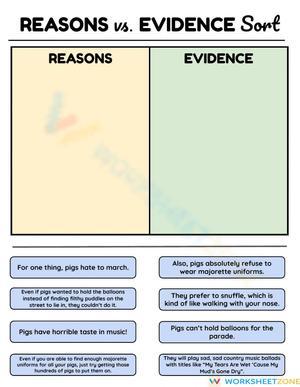
- Use sorting worksheets early in the unit as a low-pressure entry point.
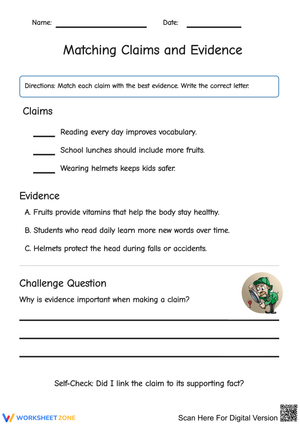
- Reserve matching and ranking worksheets for the middle of the unit, once students grasp the basic distinction between claim and evidence.
- Save counterclaim-focused worksheets for students working toward grade 8 or 9-10 standards, since that skill builds on, rather than replaces, basic claim-evidence matching.
- Collect worksheets as exit tickets to decide the next days grouping before moving to full essay drafting.
Keep a running anchor chart in the room that lists sentence starters for connecting claims and evidence, since students will lean on this scaffold well after the worksheet phase ends and into independent essay writing.
Frequently Asked Questions
1. What grade levels should introduce claim and evidence worksheets
Most ELA teachers begin explicit claim and evidence instruction around grade 4 or 5 with simple matching tasks, then build toward the more complex reasoning required by grade 6 argument writing standards and the counterclaim work expected by grade 8 and grade 9-10.
2. How are claim and evidence worksheets different from general reading comprehension worksheets
General comprehension worksheets often ask students to recall or infer information from a text. Claim and evidence worksheets specifically isolate the skill of separating an arguable assertion from the textual proof that supports it, which is a narrower and more targeted task.
3. How can teachers use claim and evidence worksheets to prep for argument essays
Use worksheets as rehearsal for the exact moves students need in a full essay: identifying a claim, locating supporting evidence, and explaining the connection between them. Sorting and matching tasks work well as formative checks before students attempt an independent draft.
4. What is the difference between a claim, a reason, and evidence for students
A claim is the arguable position being made. A reason explains why the claim is true in general terms. Evidence is the specific, text-based detail, such as a quote or data point, that supports the reason and, in turn, the claim.