


























Views
Downloads

Essential Leg Muscle Anatomy Worksheet | Grade 10-11
Paste this activity's link or code into your existing LMS (Google Classroom, Canvas, Teams, Schoology, Moodle, etc.).
Students can open and work on the activity right away, with no student login required.
You'll still be able to track student progress and results from your teacher account.
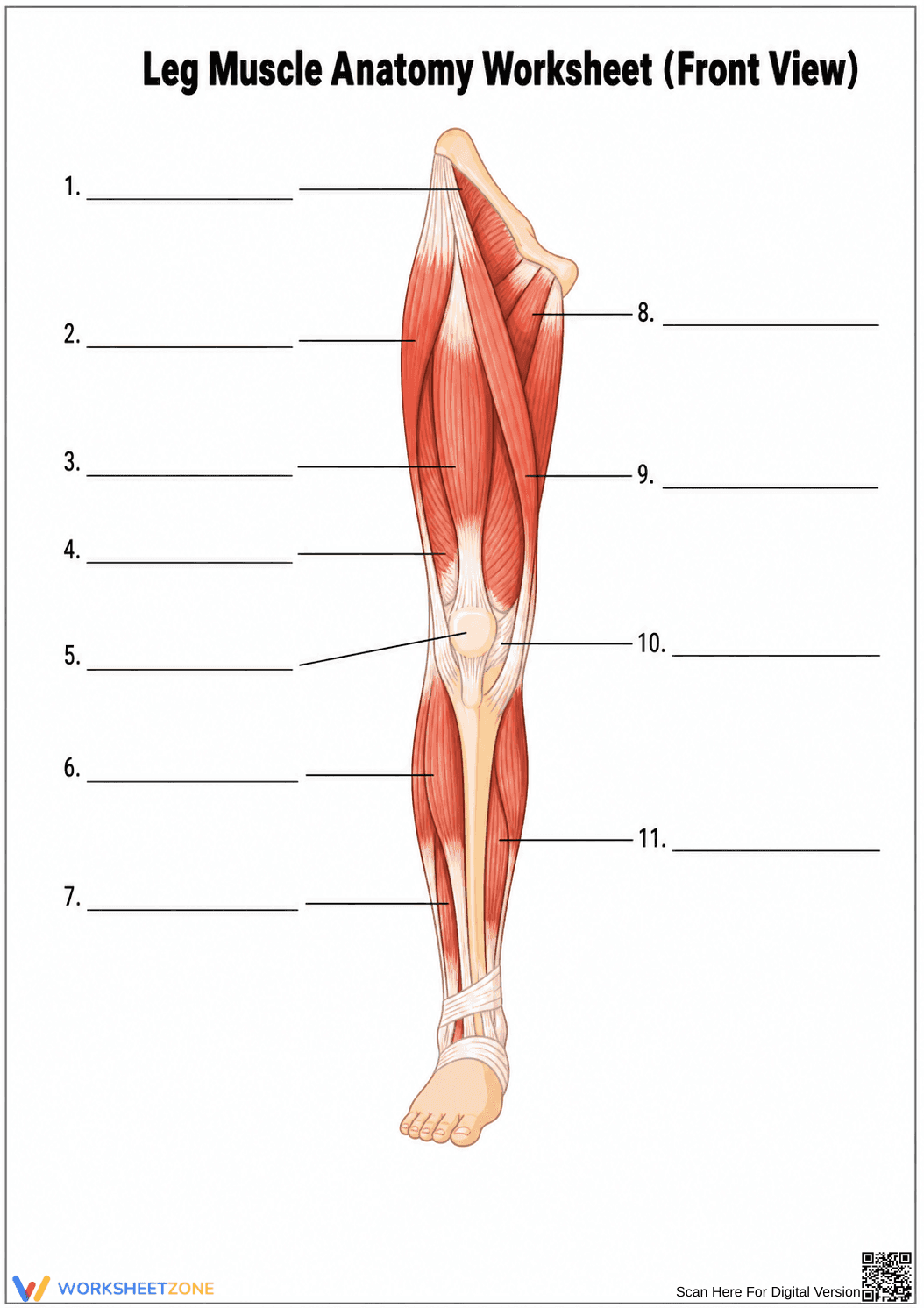
This Grade 10-11 anatomy worksheet provides a focused anatomical study of the human leg from the anterior perspective. Students identify and label 11 distinct muscular structures, facilitating a deeper understanding of how the muscular system supports movement and stability. It is designed to bridge the gap between theoretical lectures and practical identification through visual reinforcement.
At a Glance
- Grade: 10-11 · Subject: Anatomy & Biology
- Standard:
HS-LS1-2— Develop and use a model to illustrate hierarchical organization of interacting systems- Skill Focus: Anterior leg muscle identification
- Format: 1 page · 11 problems · Answer key included · PDF
- Best For: Lab practical prep and formative assessment
- Time: 15–20 minutes
The resource features a high-resolution medical illustration of the human leg's front view. It includes 11 numbered callouts pointing to major muscle groups such as the quadriceps, tibialis anterior, and sartorius. The layout is clean, providing ample space for students to write names clearly without overcrowding the diagram. A comprehensive answer key is provided to ensure immediate feedback and grading accuracy for the instructor.
This worksheet is optimized for a zero-prep classroom workflow. Teachers can print the single-page PDF in less than 30 seconds. Distribution takes approximately 1 minute during the transition to independent work. Reviewing the 11 labels as a whole-class activity requires only 5 minutes, bringing total teacher management time to under 7 minutes. It serves as an ideal emergency sub plan or a quick check for understanding during a busy unit.
Aligned to `HS-LS1-2`, this worksheet requires students to model the hierarchical organization of the muscular system. By identifying specific muscles, students visualize how individual tissues form organs that contribute to the larger locomotor system. This alignment ensures that the activity supports broader curricular goals regarding body system interactions. Both standard codes can be copied directly into lesson plans, IEP goals, or district curriculum mapping tools.
Use this worksheet as a "bell-ringer" activity following a lecture on the lower body to gauge retention. Alternatively, it functions effectively as a pre-lab guide before students interact with anatomical models or cadaveric images. For formative assessment, observe if students can distinguish between the different heads of the quadriceps femoris during the labeling process. Expected completion typically ranges from 15 to 20 minutes depending on prior knowledge.
This resource is tailored for high school biology and anatomy students, as well as introductory kinesiology learners. It provides the necessary visual scaffolding for students who struggle with spatial orientation in text-heavy textbooks. It pairs naturally with a muscular system anchor chart or a 3D skeletal model to provide a multi-sensory learning experience that accommodates diverse learning styles.
According to Fisher & Frey (2014), the use of visual non-linguistic representations, such as anatomical labeling diagrams, significantly enhances the retention of complex biological terminology. This worksheet leverages that research by requiring students to map specific vocabulary to spatial locations on the human body. By engaging with the HS-LS1-2 standard through direct identification, students move beyond rote memorization toward a structural understanding of human physiology. The 11-point task structure provides enough complexity to challenge Grade 11 students while remaining accessible for Grade 10 introductory courses. Research from the NAEP indicates that students who engage in regular diagrammatic practice show higher proficiency in science literacy and system-based thinking. This worksheet serves as a reliable tool for building that proficiency within the muscular system unit, ensuring students are prepared for higher-level medical or health science coursework.


