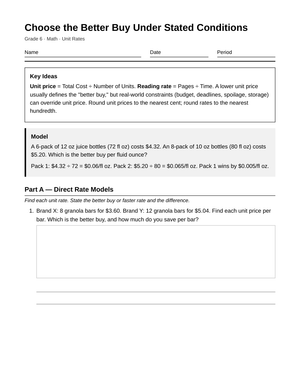
Why What's the Better Buy Worksheets Belong in Your Ratios Unit
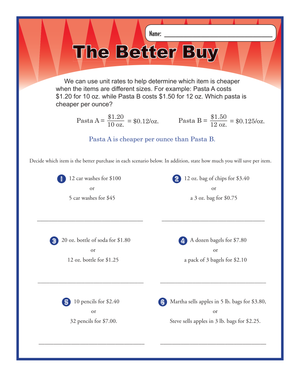
When students compare a 12-ounce box of cereal at $3.60 against a 20-ounce box at $5.40, they're doing exactly the proportional reasoning your sixth and seventh graders need to master. What's the better buy worksheets turn that everyday shopping question into repeatable unit rate practice. Instead of abstract ratio drills, students calculate price per ounce, per item, or per serving and defend which option actually saves money. That grounding in real purchases is why this format shows up across so many teacher resource libraries, and why it transfers so well to the decisions students see at home.
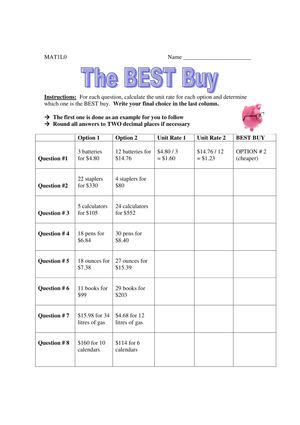
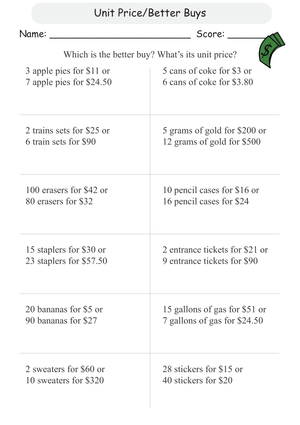
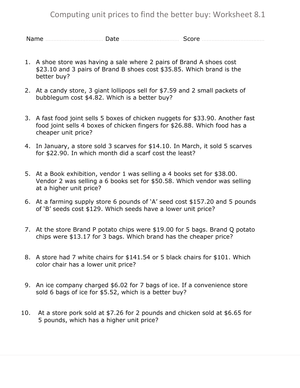
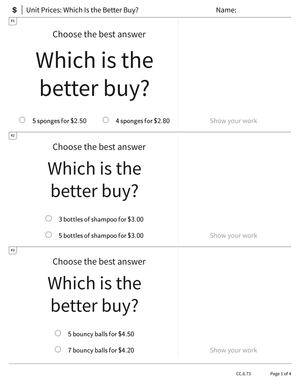
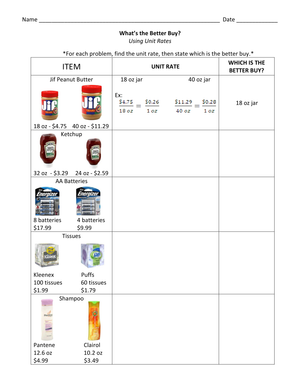
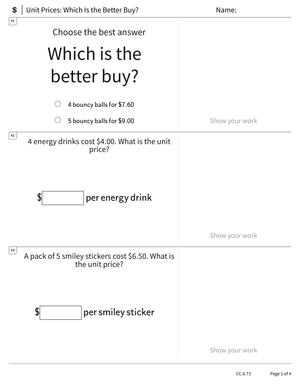
Most versions present two or more products with different package sizes and prices, then ask students to find the unit price for each and circle the better deal. A typical page runs about nine problems, enough for a focused practice session without overwhelming a class still building fluency with division and decimals. The predictable structure also makes the pages easy to differentiate and quick to grade.
Standards Alignment for Grades 6-7 Math
Better buy problems map cleanly onto the ratio and proportional relationship strand. In sixth grade they support CCSS.6.RP.A.2, where students understand the concept of a unit rate associated with a ratio, and CCSS.6.RP.A.3.B, which asks students to solve unit rate problems including those involving unit pricing. By seventh grade, CCSS.7.RP.A.1 raises the difficulty by pulling complex fractions into unit rate calculations, so a better buy problem might involve fractional ounces or a price given per three-quarters of a pound.
Framing the worksheet against these standards helps you place it in a unit map. Introduce it after students can compute a basic unit rate, then use it as the applied bridge between naked-number rate practice and the multistep proportion word problems that come later in the unit. Many teachers also use it as a spiral review item weeks later, since a quick better buy problem re-surfaces unit rate reasoning without a full reteach.
Introducing Unit Price Before You Assign the Page
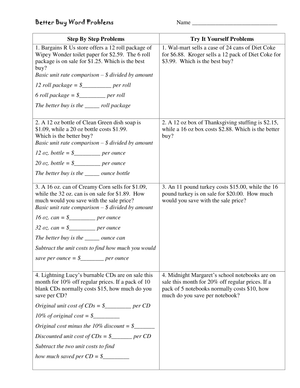
Students stumble on better buy problems when they treat total price as the thing to compare instead of price per unit. Spend a few minutes modeling the setup before handing out the worksheet. Write two options on the board, label the package size and price, and think aloud as you divide price by quantity to get a per-unit cost. Emphasize that the smaller unit price wins, which pushes back on the assumption that a bigger number always means a better deal.
A quick anchor chart with the phrase price divided by amount equals unit price gives struggling students something to reference. Ask students to keep three decimal places during division so rounding doesn't accidentally flip which item looks cheaper, a small habit that prevents a surprising number of wrong answers.
Classroom Implementation
Better buy worksheets flex across several instructional formats. As a warm-up, assign two problems to reactivate unit rate thinking from the day before. As independent practice, the full nine-problem page fits a single class period with time to review. For small-group intervention, pull students who reversed the comparison and rework two problems together using a place-value chart to line up the decimals.
For partner work, have one student compute the unit price of option A while the other handles option B, then both agree on the better buy and write a sentence justifying it. That justification sentence matters: it forces students to name the unit and the reasoning, which is exactly where CCSS.6.RP.A.3.B expects them to land.
According to Unit Rates ~ What's the Better Buy?, a Common Core 6.RP and 7.RP resource on Teachers Pay Teachers, better buy tasks ask students to compute unit prices across two or more package sizes and select the lowest cost per unit; a single practice set of roughly nine problems reinforces unit pricing as the shopper's core comparison tool.
Frequently Asked Questions
1. What grade level covers better buy and unit rate worksheets?
Better buy problems typically appear in grades 6 and 7 within the ratios and proportional relationships strand. Sixth graders meet them once they can compute a basic unit rate, and seventh graders revisit them with complex fractions and slightly harder numbers.
2. Which CCSS standards do better buy worksheets align to?
They align to CCSS.6.RP.A.2 for understanding unit rate, CCSS.6.RP.A.3.B for solving unit rate and unit pricing problems, and CCSS.7.RP.A.1 for unit rates involving complex fractions. That progression lets the same format grow with students across two grade levels.
3. How should teachers introduce unit price before assigning these problems?
Model one comparison first. Put two products with their sizes and prices on the board, divide price by quantity for each, and show that the lower unit price is the better buy. An anchor chart reading price divided by amount equals unit price keeps the procedure visible during independent work.
4. What real-world scenarios work best for better buy practice?
Grocery items students recognize work best: cereal, juice, granola bars, and bottled water. Themed sets around a taco night, a class party, or a school store add engagement, and mixing package sizes so the bigger option isn't always cheaper keeps students calculating instead of guessing.
5. How can better buy worksheets support intervention or enrichment?
For intervention, shrink the set to two or three problems and work them in a small group with a place-value chart to align decimals. For enrichment, add a third product option, use awkward quantities that demand careful division, and ask students to justify each choice in a full sentence.