These money worksheets cover coin identification, counting mixed sets, making change, and multi-step word problems across kindergarten through grade 3 — a full instructional arc in one downloadable set. Each worksheet targets a specific skill at a specific point in the progression, so you're pulling exactly what a lesson needs rather than working around content that doesn't fit yet.
Skills These Worksheets Build
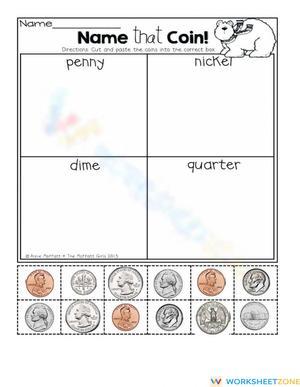
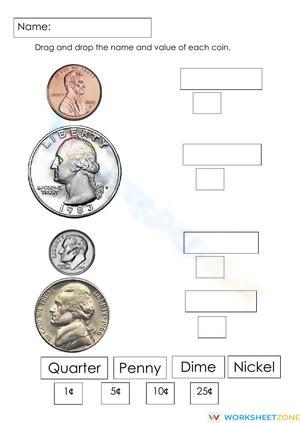
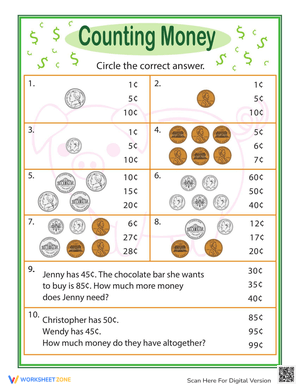
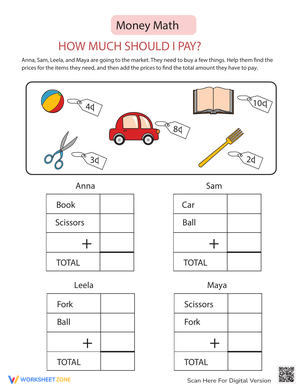
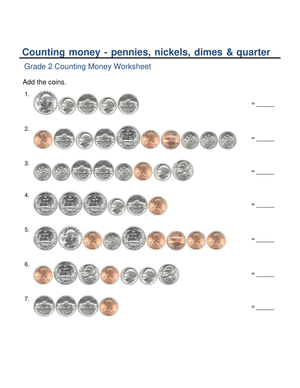
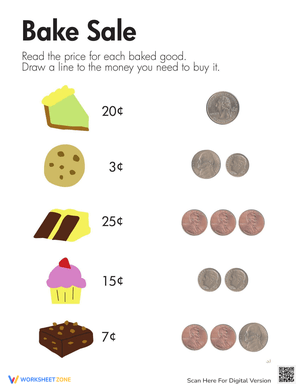
The set moves in the same direction money instruction moves in a real classroom. Early worksheets ask students to identify individual coins using realistic images — not simplified line drawings — because students need to recognize a dime by its size and ridged edge, not by a cartoon labeled "10¢." Matching and labeling tasks establish that foundation before any counting begins.
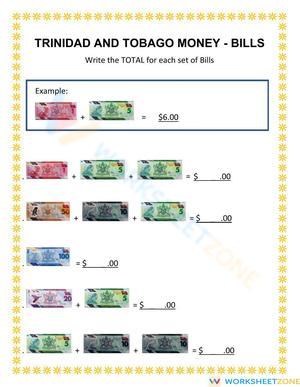
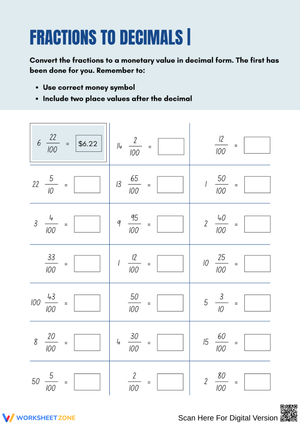
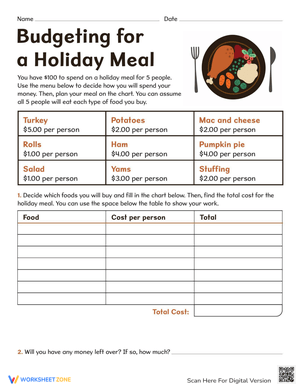
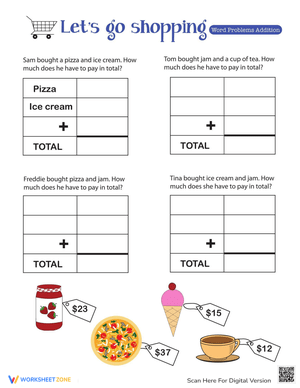
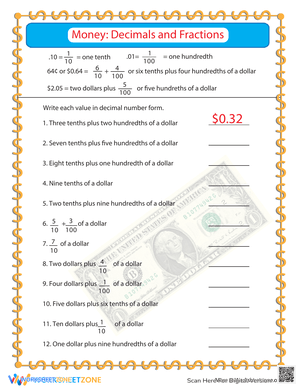
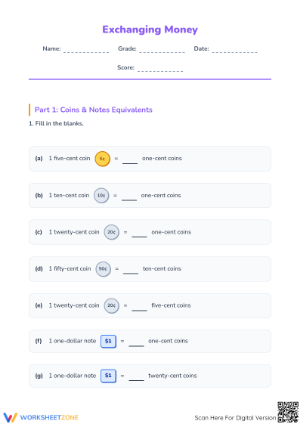
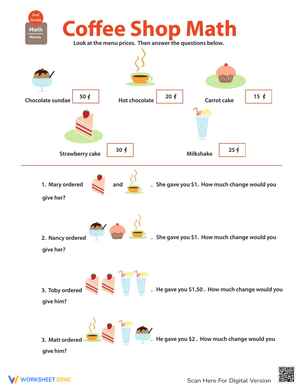
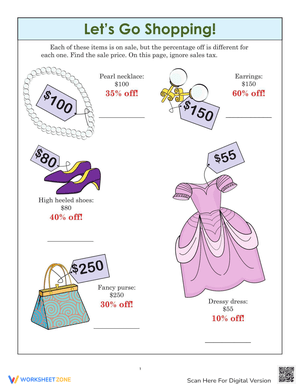
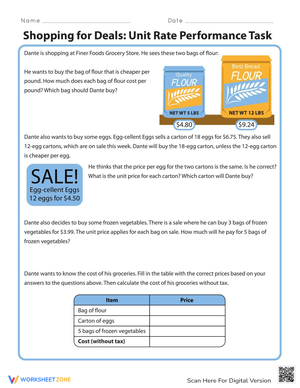
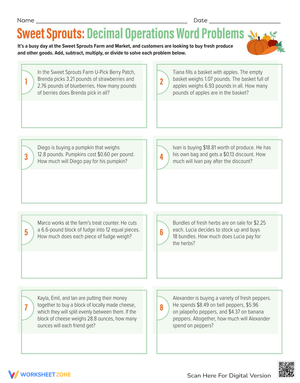
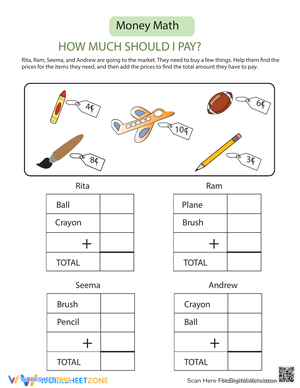
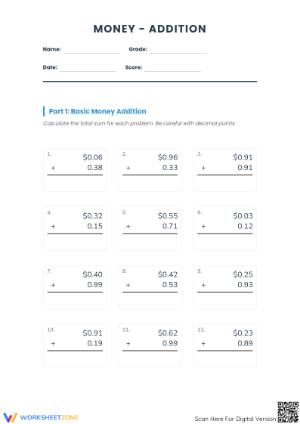
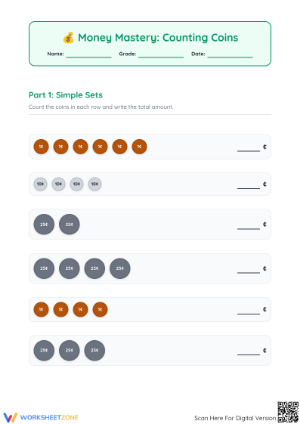
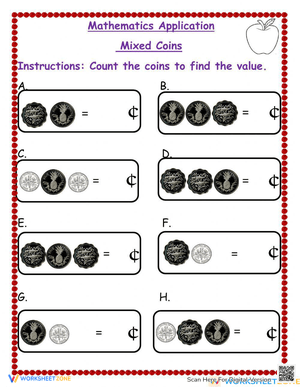
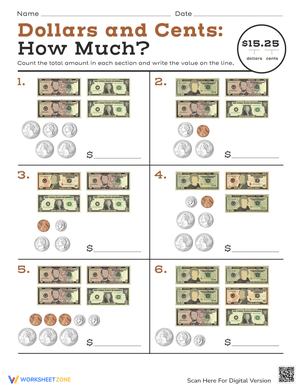
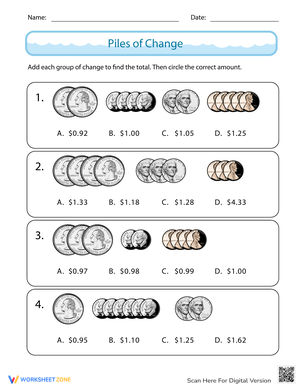
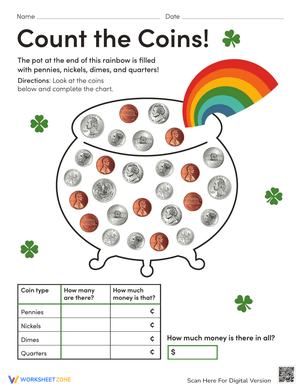
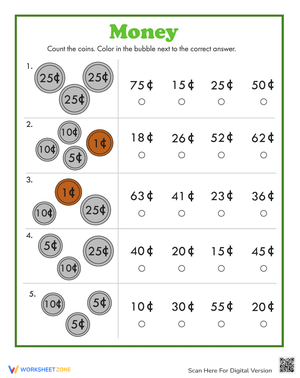
From there, worksheets shift to counting mixed coin sets using skip-counting sequences (5s, 10s, 25s), then to combining coins and bills. Later worksheets introduce the $ and ¢ symbols in context, ask students to compare two money amounts using inequality symbols, and present shopping scenarios where students calculate change. The final worksheets in the set express money as decimals — $1.35, $2.50 — which gives students a foothold in place value before formal decimal instruction starts.
Standard Alignment
The second-grade worksheets align directly to 2.MD.C.8, which asks students to solve word problems involving dollar bills, quarters, dimes, nickels, and pennies, and to use the $ and ¢ symbols correctly. This is the only Common Core standard that addresses money explicitly, and it sits in the Measurement and Data domain rather than Operations and Algebraic Thinking — a placement that reflects how money connects to real-world problem-solving rather than to abstract number work alone. Supporting standards across grades K-3 include the addition, subtraction, and place-value standards that money practice reinforces in context: K.CC (counting), 1.NBT (place value and two-digit addition), 2.NBT (multi-digit computation), and 3.NF / 3.NBT for the decimal-adjacent work in grade 3.
Where Students Stumble Most
The dime causes more confusion than any other coin at the K-1 level. Students who have memorized "bigger coin, bigger value" will consistently assign the dime less value than the nickel because it's smaller in size. Worksheets that isolate the dime-nickel comparison, and then embed it in a mixed set immediately after, address this directly rather than letting the misconception calcify.
At the grade 2 level, the most common error in making-change problems isn't arithmetic — it's setup. Students subtract the price from their coin count rather than from the amount paid, or they conflate the two entirely. Worksheets that label both quantities explicitly ("Amount paid: ___ Amount spent: ___ Change: ___") slow students down at exactly the step where that confusion happens.
The grade 3 decimal work surfaces a different problem: students who have been writing money as "35¢" for two years will write "$1.35" as "$1.35¢" — stacking both symbols because both feel right. Seeing it marked wrong on a worksheet, with a corrected model right below, resolves this faster than a whole-class reminder usually does.
Fitting These Worksheets into the Weekly Lesson Plan
The coin identification and counting worksheets work well as Monday warm-ups when you're opening a money unit — five minutes at the start of math block before the lesson proper. The making-change worksheets are better placed after direct instruction, used as a brief independent check at the end of the period. A quick scan of those responses before students leave tells you which students subtracted correctly, which tried but set the problem up wrong, and which need the concept re-explained before the next session.
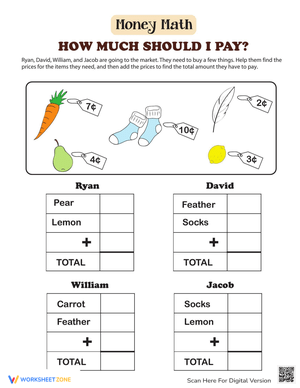
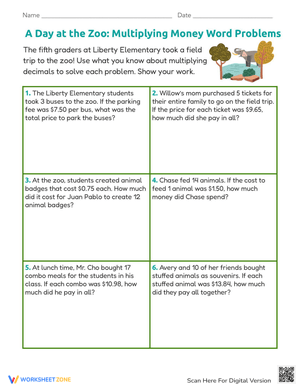
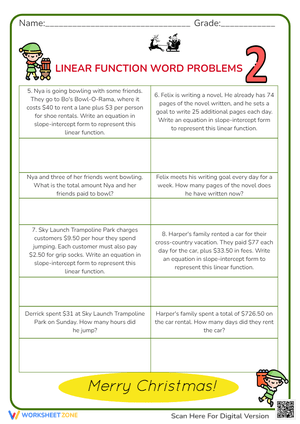
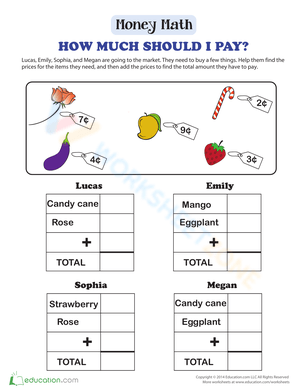
For the word problem worksheets, a brief setup helps. Spend two or three minutes before independent work with a few items and play money at the front of the room — one student pays, one makes change, the class watches. That thirty-second transaction gives students a concrete scene to return to when the word problem's scenario feels abstract. Completion rates and accuracy both improve when students have that visual anchor.
Adapting These Worksheets For Different Levels of Students
Keep two or three tiers available during any money lesson. Students still sorting out coin recognition work on matching and labeling sheets; students who have that down move to counting mixed sets; students ready for a challenge tackle making-change or multi-step word problems. Running all three within the same class period is manageable because the worksheets are visually distinct — a student working on coin identification isn't looking at a watered-down version of what peers are doing, just a different task entirely.
For students who freeze when asked to count a disorganized pile of coins on a worksheet, teach the sort-first strategy explicitly: quarters, then dimes, then nickels, then pennies, always. The worksheets that pre-arrange coins in that order scaffold the approach before students practice it with randomly scattered sets. That sequencing matters — presenting random arrangements before the sorting habit is formed tends to produce guessing rather than counting.
Frequently Asked Questions
These worksheets show US coins — do they work in Canadian or other classrooms?
The coin images and denominations are US-specific: penny, nickel, dime, quarter, and dollar bill. Canadian classrooms use different coins with different values, so these worksheets don't map cleanly onto Canadian currency instruction. The counting and change-making formats are adaptable in principle, but the images and labeled values reflect US currency throughout.
What's the best way to introduce the making-change worksheets?
Do a concrete demonstration first. Use play money at the front of the room, name a price, hand over a bill, and count back the change aloud. Then immediately distribute the worksheet while the sequence is fresh. Students who skip straight to the worksheet without that setup often invert the subtraction — they subtract the amount paid from the price rather than the other way around, and they'll repeat that error across every problem on the sheet if it isn't caught early.
How many worksheets are in the set, and can individual sheets be pulled out?
Each worksheet is a standalone file, so you download and print whichever skills your students need right now. Nothing is locked into a sequence — a second-grade teacher can grab only the making-change worksheets without downloading the full set, and a first-grade teacher reviewing coin values mid-year can pull a single identification sheet for a quick warm-up.
At what point should students be writing money amounts with decimal notation?
The worksheets introduce decimal notation (e.g., $1.75) starting with the grade 3 materials, which aligns with when most state standards expect students to connect money to place value in a more formal way. Using that notation in grades 1-2 before students have a solid understanding of tens and ones tends to produce symbol confusion — the "$1.35¢" error mentioned above is common when decimal money notation is introduced too early without enough place-value grounding.













 Interactive Worksheet Maker
 Quiz Maker
 Word Search Maker
 Crossword Puzzle Maker
 Word Scramble Generator
 Sentence Scramble Generator
 Handwriting Worksheet Generator
 Name Tracing Generator
 Fill In The Blank Generator