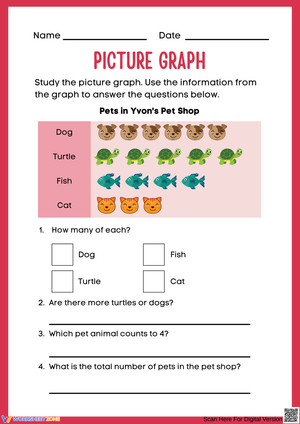
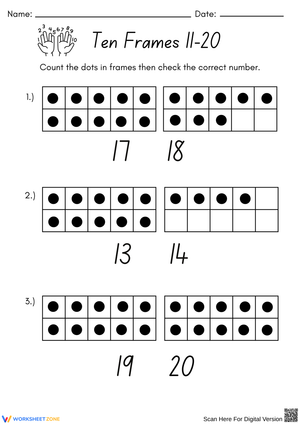
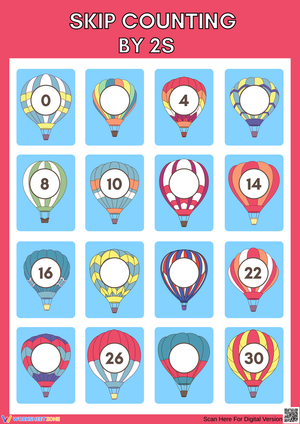
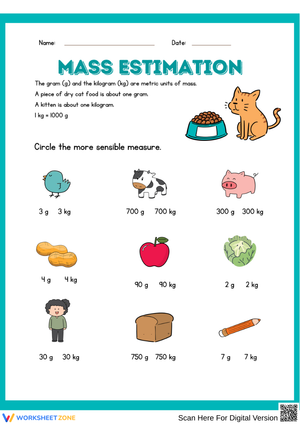
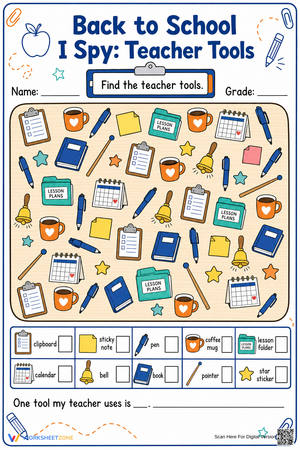
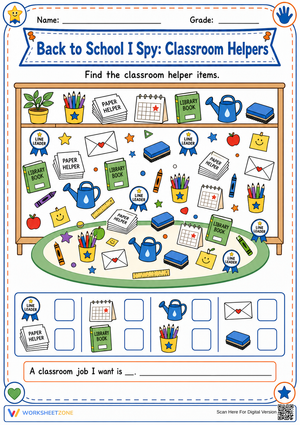
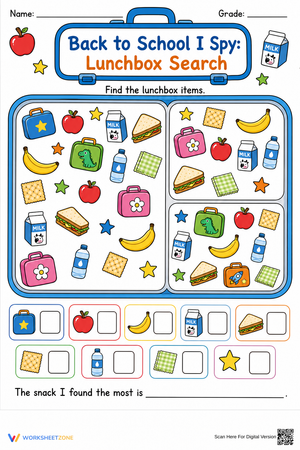
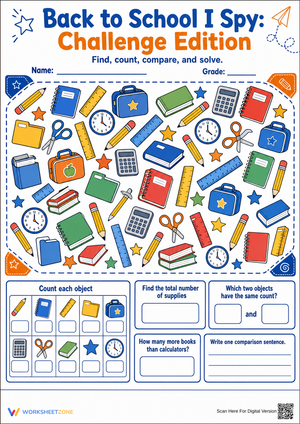
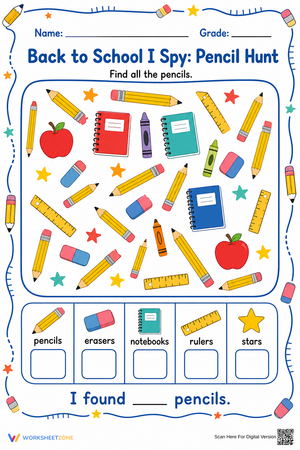
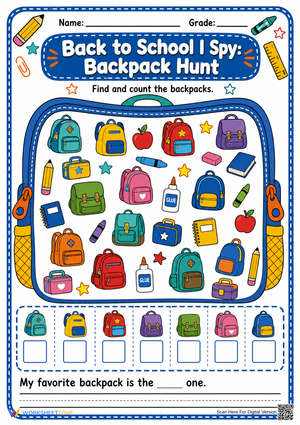
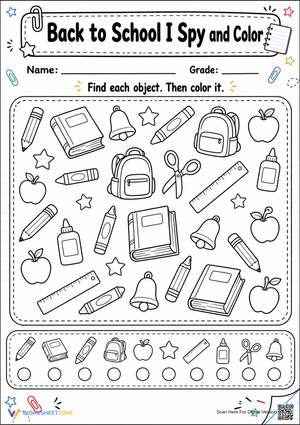
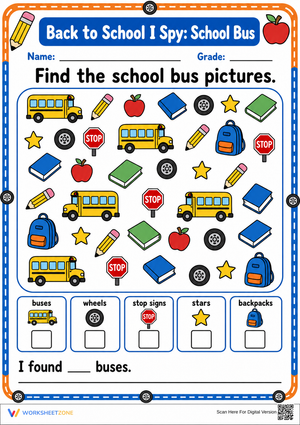
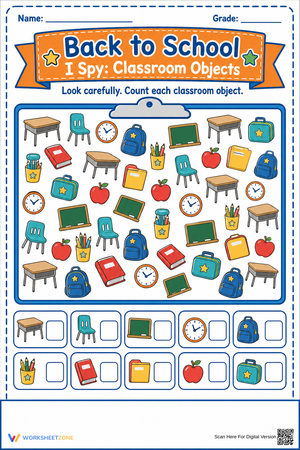
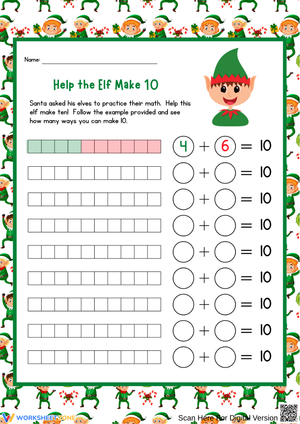
A kindergarten teacher planning morning work rarely starts with abstract equations. Instead, the entry point is almost always a worksheet with dots, cubes, or animals to count. That simple task carries more instructional weight than it looks like on paper. Counting worksheets are the primary vehicle teachers use to move students from reciting numbers in order to actually understanding what those numbers represent.
For US K-2 teachers, especially those working in kindergarten or early intervention settings, counting worksheets are not filler. They are diagnostic tools disguised as practice pages, revealing whether a student has internalized one-to-one correspondence or is simply saying number words without connecting them to quantity.
The CCSS Counting and Cardinality Progression, in Plain Classroom Terms
The Common Core Counting and Cardinality domain (K.CC) organizes this learning into three clusters: knowing number names and the count sequence, counting to tell the number of objects, and comparing numbers. Counting worksheets typically target the first two clusters directly, since they require a student to produce a count and then record or circle the resulting numeral.
K.CC.1 sets a specific fluency target: by the end of kindergarten, students should count to 100 by ones and by tens. That single benchmark explains why so many counting worksheets are structured as spiral review, with short daily counting ranges rather than one large end-of-unit assessment. Teachers who space this practice across the year, rather than compressing it into a single spring unit, tend to see steadier progress toward the count-to-100 goal.
Counting Worksheets and the Cardinality Principle (K.CC.4)
K.CC.4 is where many worksheets earn their keep as diagnostic tools. This standard requires students to connect counting words to quantity through three understandings: pairing each object with one and only one number name, recognizing that the last number counted tells how many objects are in the set, and knowing that each successive number refers to a quantity that is one larger.
A worksheet that simply asks a student to write numbers 1 through 20 does not test any of this. A worksheet that asks a student to count a set of ten scattered stars and then write the total does. The distinction matters when selecting or designing counting worksheets for classroom use, since surface-level number writing tasks can mask a cardinality gap that will surface later during addition and subtraction instruction.
Differentiating by Object Arrangement, Per K.CC.5
K.CC.5 specifies that kindergartners should be able to count up to 20 objects arranged in a line, a rectangular array, or a circle, and up to 10 objects when they are scattered. This is a built-in differentiation ladder that counting worksheets can and should follow.
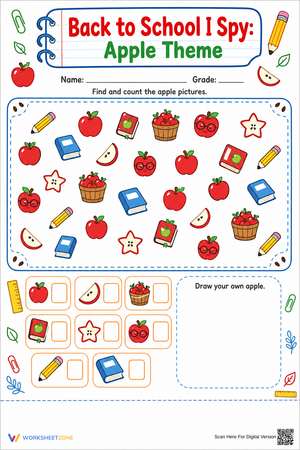
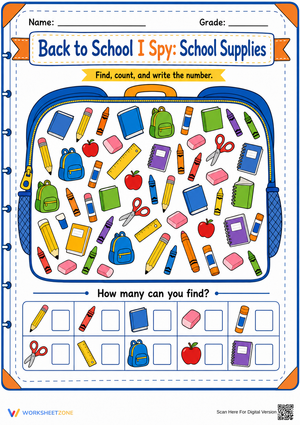
Objects in a line are easiest to track because students can move left to right without losing their place. Circular arrangements remove that fixed starting and ending point, so students must impose their own tracking strategy. Scattered arrangements are the most demanding, since there is no visual structure at all, and students must mark or mentally tag each object as counted. Sequencing counting worksheets in that order, from linear to circular to scattered, gives teachers a natural progression for whole-class instruction and for small-group reteaching.
Classroom Implementation
In practice, counting worksheets show up across several parts of the school day. Morning work often uses a short linear-count worksheet as a warm-up before the math block begins. Math centers can rotate scattered and circular arrangements so students get varied practice without a teacher needing to differentiate materials live in the moment.
During whole-group instruction, a teacher might project a counting worksheet and have students count chorally before completing it independently, which supports students who are still building confidence with the count sequence. In intervention blocks, the same worksheet type can be used one-on-one, with the teacher recording specific error patterns rather than just a score. Keeping a simple tracking sheet of which arrangement type a student struggles with, linear, circular, or scattered, helps target the next small-group session more precisely than a general counting score would.
Building Toward Count-to-100 Fluency
Since K.CC.1 sets counting to 100 by ones and tens as the kindergarten benchmark, counting worksheets used for spiral review often extend well past the 1-20 range once cardinality is secure. These later-year worksheets typically shift format, asking students to fill in missing numbers on a partial hundred chart or continue a count sequence starting from a number other than one.
This shift is intentional. Once one-to-one correspondence and cardinality are established with small sets, the instructional goal moves toward fluency with the count sequence itself, including skip counting by tens, which directly supports the K.CC.1 expectation.
Frequently Asked Questions
1. What grade level are counting worksheets appropriate for?
Counting worksheets are most commonly used in pre-K through grade 2, with the heaviest concentration in kindergarten classrooms where the CCSS Counting and Cardinality domain is a core focus. First and second grade teachers often use them for review or intervention with students who need continued support.
2. How do counting worksheets align with CCSS K.CC standards?
They directly support the three K.CC clusters: knowing number names and the count sequence, counting to tell the number of objects, and comparing numbers. Specific standards like K.CC.1, K.CC.4, and K.CC.5 describe the counting range, cardinality understanding, and object arrangements that well-designed worksheets should reflect.
3. How can teachers use counting worksheets for intervention or reteaching?
Teachers can use them one-on-one to observe a student counting process in real time, identifying whether errors stem from skipped numbers, lost tracking, or a missing understanding that the last number counted names the total. This observation-based use is often more informative than simply grading the completed page.
4. What is the difference between rote counting and cardinality practice on a worksheet?
Rote counting asks a student to recite or write numbers in sequence, while cardinality practice requires the student to count a set of objects and connect that count to a total quantity. K.CC.4 specifically targets the cardinality skill, so worksheets built around counting actual object sets test a deeper understanding than number-writing tasks alone.
5. How many objects should kindergarten counting worksheets include per CCSS guidance?
K.CC.5 specifies counting up to 20 objects when arranged in a line, array, or circle, and up to 10 objects when scattered. Worksheets should scale object counts within these ranges and vary arrangement type to match the full expectation of the standard.













 Interactive Worksheet Maker
 Quiz Maker
 Word Search Maker
 Crossword Puzzle Maker
 Word Scramble Generator
 Sentence Scramble Generator
 Handwriting Worksheet Generator
 Name Tracing Generator
 Fill In The Blank Generator