Teaching Similarity: How to Use Are We Similar Geometry Worksheets
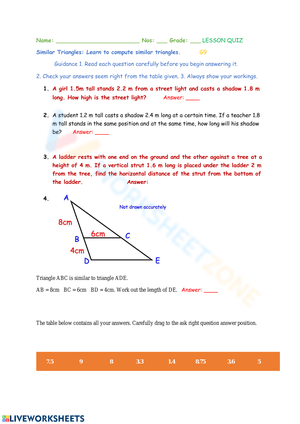
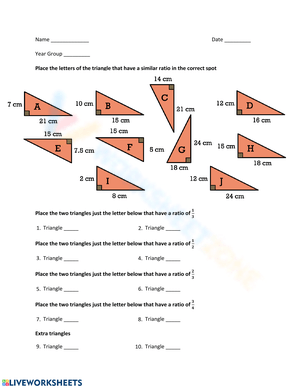
If your similarity unit stalls out on the difference between 'same shape' and 'same size,' the are we similar geometry worksheets give students a fast, decision-driven way to practice. Each problem hands them two figures and asks a single question: are these similar, and how do you know?
What the 'are we similar' worksheet actually asks
The are we similar geometry worksheets put one question in front of students on every problem: given two figures, can one be mapped onto the other, and can you prove it? Instead of memorizing a definition, students look at a pair of shapes and decide whether a sequence of transformations connects them. That framing matches how similarity is introduced in grade 8, where students describe the moves that carry one figure onto another rather than only labeling a picture as similar or not similar.
For teachers planning a similarity unit, this format works well as a warm-up, an exit ticket, or a formative check before triangle proofs. Each item forces a decision and a justification, so you see reasoning, not just an answer bubble. That makes the page useful across grades 7 through 9, whether you are opening the topic or reviewing it right before a high school geometry unit.
Similar vs. congruent: the distinction students miss
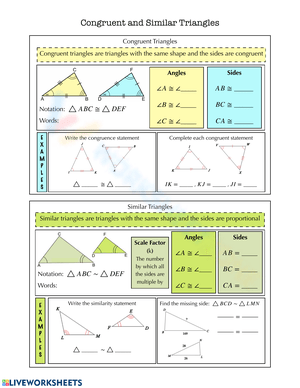
The most common stumbling block is treating 'same shape' as 'same size.' Students who can spot matching angles often assume the two figures must be identical, so they mark congruent pairs as merely similar, or the reverse. The worksheet is built to surface that confusion early, when it is cheap to correct and before it hardens into a habit.
Here is the detail that resolves it: dilation is the single transformation that separates similarity from congruence, because it changes size while preserving shape. A dilation with a scale factor of 1 produces a congruent figure, which means congruence is really the special case of similarity where the scale factor equals 1. Framing congruence as 'similarity at scale factor 1' gives students one mental model instead of two competing ones, and it links 8.G.A.2 directly to 8.G.A.4.
According to the Grade 8 Geometry standards from the Common Core State Standards Initiative, standard 8.G.A.4 states that two figures are similar when one can be obtained from the other through a sequence of rotations, reflections, translations, and dilations. That single sentence defines every are we similar prompt on the page.
Start with corresponding angles and sides
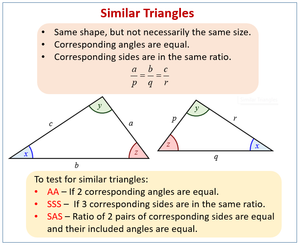
Before anyone calculates a scale factor, students need to identify which parts of the two figures correspond. Similar figures have congruent corresponding angles and proportional corresponding side lengths, so the order in which vertices are listed matters. Teach students to label the matching angles first, then pair the sides that sit between those angles.
A short routine helps here. List the corresponding angle pairs, confirm they are congruent, then write the side pairs as ratios. If the angle pairs do not match, the figures are not similar and there is no reason to compute anything further. This one habit saves students from the common trap of dividing side lengths on figures that were never a match to begin with, and it keeps their justification focused on evidence.
A quick class demonstration reinforces the routine. Project two figures, think aloud as you match one angle pair, and mark it before moving to the next. Students copy your notation, and within a few problems the labeling becomes automatic. That shared shorthand also makes it faster to give feedback, since you can point to a single mismatched angle instead of rewriting an entire explanation.
Calculating scale factor with confidence
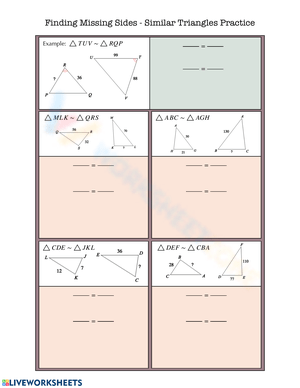
Once corresponding sides are paired, the scale factor is the constant ratio that relates every pair. Students divide a side length in one figure by the matching side length in the other, then check that the same value holds for all corresponding sides. A single consistent ratio confirms similarity; a ratio that changes from one side pair to the next rules it out. Encourage students to test at least two pairs before deciding, since one match can be a coincidence.
This is where vocabulary needs care. The scale factor is the multiplier that carries one figure to the other, while the ratio of similarity expresses the same idea as a comparison. When students see that a scale factor of 2 and a ratio of 2 to 1 describe the identical relationship, the two terms stop competing for space. Illustrative Mathematics tasks for 8.G.A.4 lean on exactly this proportional reasoning, which is why the worksheet mirrors that structure.
Classroom Implementation
Use the worksheet as a five-minute formative check the day before you introduce triangle similarity proofs. Because each item asks for a decision plus a justification, you can sort responses into three quick piles: students who name the transformation sequence, students who compute a scale factor but skip the reasoning, and students who still confuse congruence with similarity. Those three piles become your small groups the next morning.
Pair the page with a hands-on dilation on grid paper or the coordinate plane. Having students dilate a figure by a scale factor of 3 and then measure the result makes the abstract sequence concrete, and it reinforces that angles hold steady while side lengths grow. For intervention, hand a small group the same two figures at a few different scale factors and ask them to predict which pairs are similar before they measure anything.
Keep a running record of which justification level each student reaches, because similarity reasoning compounds over the unit. A student who can only compute a scale factor in week one should be naming a full transformation sequence by the time you reach triangle work. The worksheet gives you a repeatable snapshot, so you can run it again two weeks later and compare, which turns a single check into a short growth record you can share at a data meeting or with a co-teacher.
Differentiating the task for every group
For students who need support, provide sentence starters such as 'These figures are similar because the corresponding angles are ___ and the side ratios all equal ___.' The frame keeps the reasoning visible without demanding polished proof writing. For students who are ready for more, drop the starters and ask for open-ended justifications that name the full transformation sequence, including the order of the moves.
Between those two poles, a middle group benefits from a partial frame: give them the opening clause and let them complete the reasoning on their own. Rotating students across these three levels as the unit progresses keeps the challenge matched to where each learner actually is.
You can also stretch advanced students toward high school geometry. Grade 8 similarity feeds directly into later triangle similarity proofs, where scale factor and proportional reasoning do the heavy lifting. Asking eighth graders to justify with a complete transformation sequence now builds the exact habit those proofs will demand a year or two later.
Frequently asked questions
1. What grade level is this similar figures worksheet for?
It fits grades 7 through 9. The core work aligns with grade 8, where students first describe similarity as a sequence of transformations, but it also serves as review at the start of a high school geometry unit.
2. How do you tell if two figures are similar versus congruent?
Check the corresponding angles and side ratios. If all corresponding angles are congruent and every side ratio equals the same scale factor, the figures are similar. If that scale factor equals 1, the figures are also congruent, meaning identical in both size and shape.
3. What is the difference between scale factor and ratio of similarity?
They describe the same relationship two ways. The scale factor is the multiplier that maps one figure onto the other, while the ratio of similarity states that multiplier as a comparison, such as 2 to 1. A scale factor of 2 and a ratio of 2 to 1 mean the same thing.
4. How can teachers use this worksheet for reteaching or intervention?
Use it as a short formative check, then group students by the kind of error they made. Pair a small group with a hands-on dilation on grid paper so they can watch angles stay fixed while side lengths scale, which targets the congruence-versus-similarity mix-up head on.
5. Does this worksheet align with Common Core geometry standards?
Yes. The tasks reflect standard 8.G.A.4 from the Grade 8 Geometry standards, which asks students to show that two figures are similar by describing a sequence of rotations, reflections, translations, and dilations.
Clear All