A student who can name 0.62 in a math journal but cannot tell you whether it is bigger or smaller than 0.6 does not have a decimal problem so much as a place-value gap. Decimals worksheets are one of the fastest ways to find and close that gap, but only when they are sequenced to match how decimal understanding actually develops across grades 4 through 6. This guide walks through that progression, how to match worksheet type to instructional purpose, and how to use decimal practice for intervention and quick checks for understanding.
Why Sequencing Matters More Than Volume
Handing a struggling sixth grader a page of long-division-style decimal problems will not help if that student never solidified what a decimal actually represents. Decimal fluency is built in stages, and worksheets that skip stages tend to produce students who can execute a procedure without understanding why it works. The most useful decimals worksheets for a US classroom follow the same order the standards do: notation and place value first, then comparison, then operations, then fluency with the standard algorithm.
The CCSS progression documents three distinct grade-level demands for decimals rather than one continuous skill: Grade 4 asks students to use decimal notation for fractions with denominators of 10 or 100 and to compare decimals to hundredths by reasoning about size, not by memorizing rules. Grade 5 shifts to place-value-based operations, including explaining what happens to the decimal point when multiplying or dividing by powers of 10. Grade 6 is where the standard algorithm becomes the expectation for all four operations. Teachers who treat these as one blended skill often see students apply Grade 6 procedures without the Grade 4-5 reasoning underneath them, which shows up as errors like misaligned place value during addition.
Grade 4: Notation, Number Lines, and Comparison (4.NF.C.6-7)
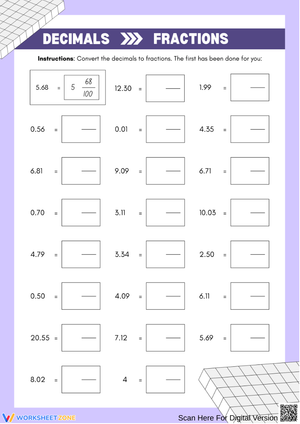
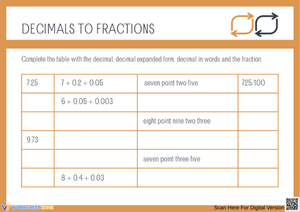
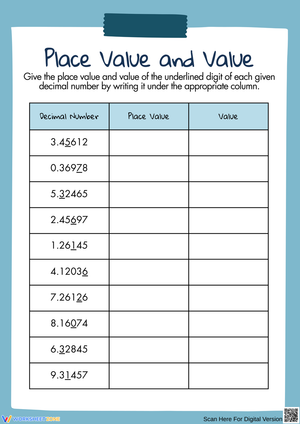
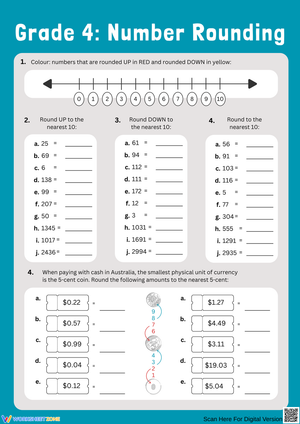
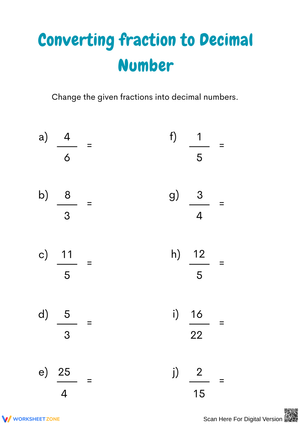
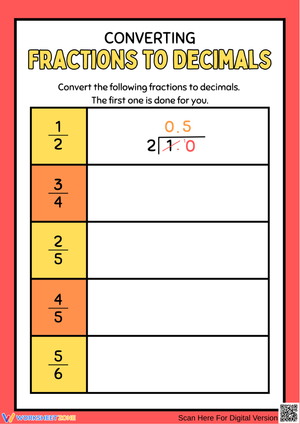
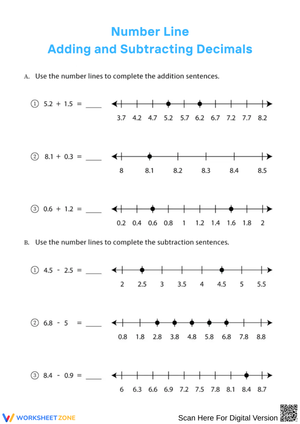
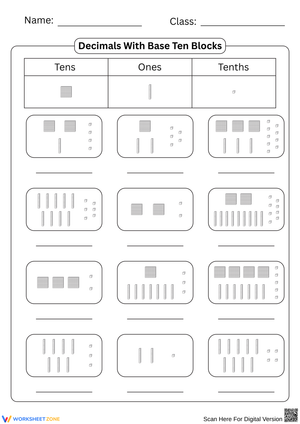
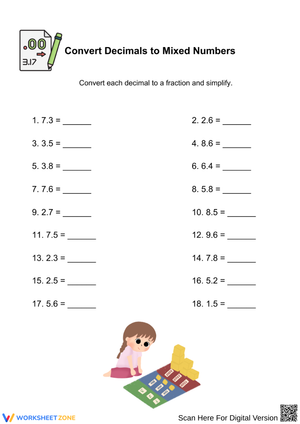
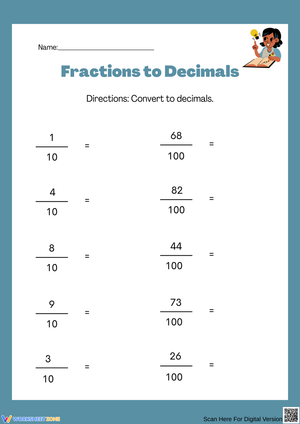
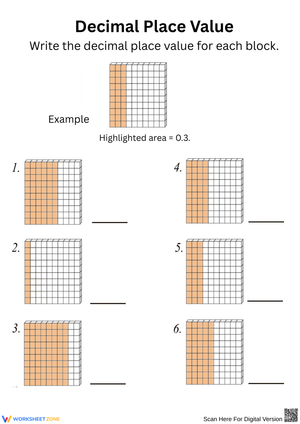
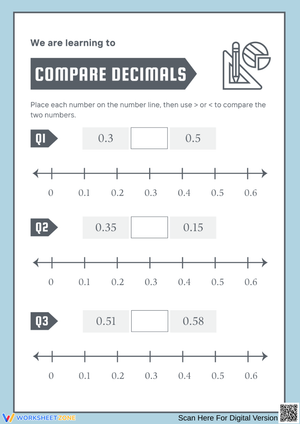
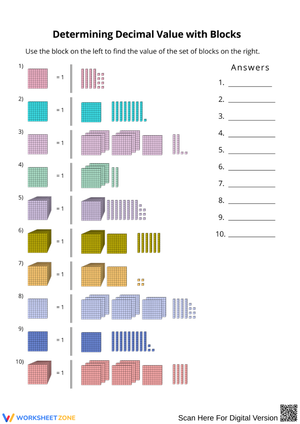
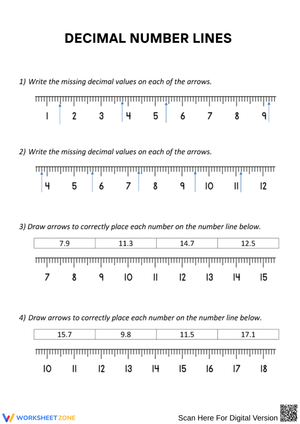
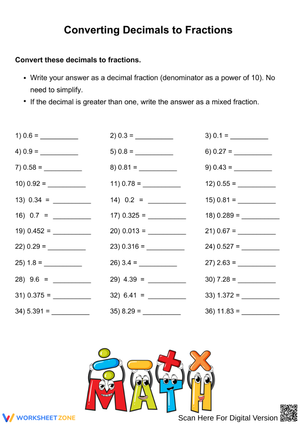
At this stage, decimals worksheets should stay tightly connected to fractions. Students are learning to write a fraction like 6/10 as 0.6, or 25/100 as 0.25, and to place those values on a number line. Worksheets that pair a fraction model, a number line, and a decimal notation task in the same set help students see decimals as another way to represent quantities they already understand, rather than a brand-new topic. Comparison tasks at this level should ask students to reason about size, for example by using models or benchmark fractions, rather than applying a same-number-of-digits shortcut that breaks down once decimals include different numbers of place values.
Grade 5: Place Value and the Four Operations (5.NBT.A.3, 5.NBT.A.7)
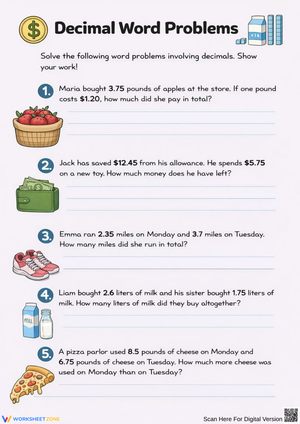
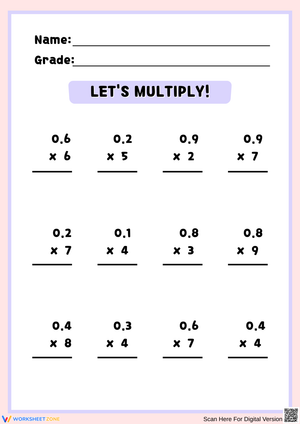
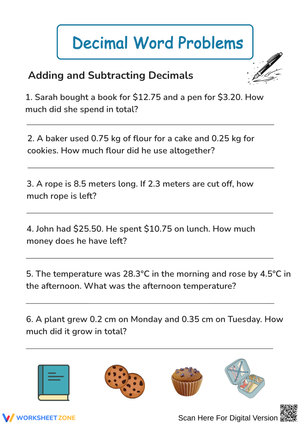
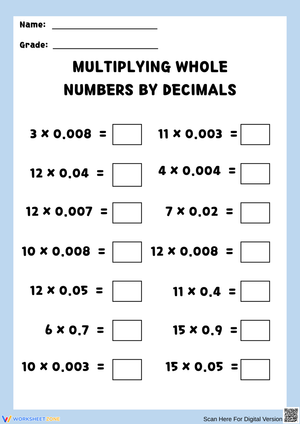
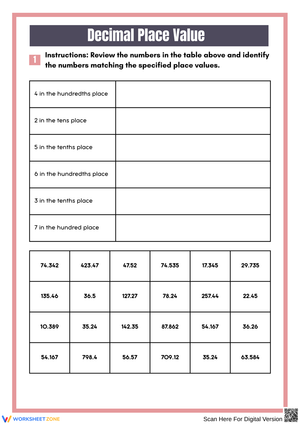
Grade 5 worksheets should extend decimals to thousandths and introduce all four operations, but grounded in place-value strategies and visual models before the standard algorithm takes over. A well-sequenced set includes reading and writing decimals to thousandths, comparing decimals using place-value reasoning, explaining decimal-point shifts when multiplying or dividing by powers of 10, and adding, subtracting, multiplying, and dividing decimals to hundredths using models. This is also the year where worksheet sets benefit most from including a written-explanation prompt, since 5.NBT.A.7 explicitly expects students to explain their reasoning, not just produce an answer.
Grade 6: Standard Algorithm Fluency (6.NS.B.3)
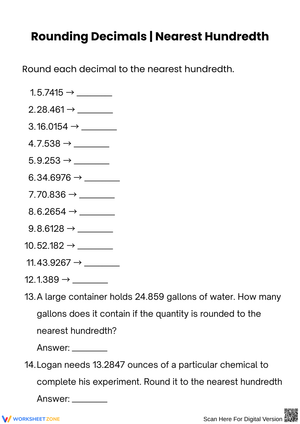
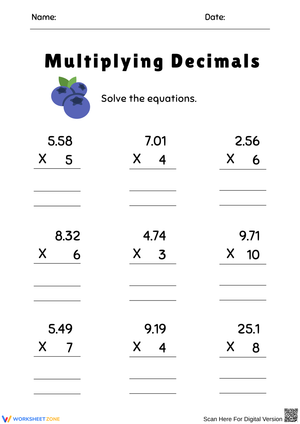
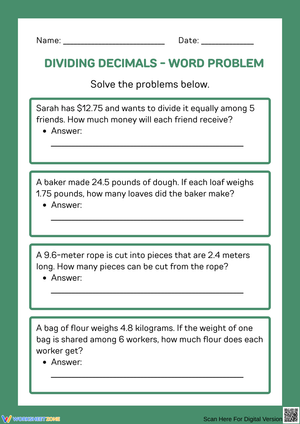
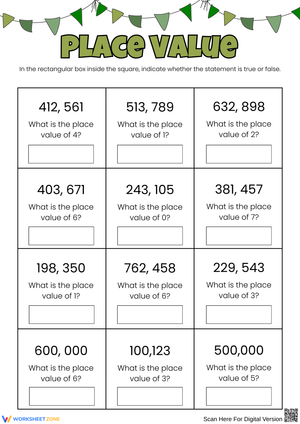
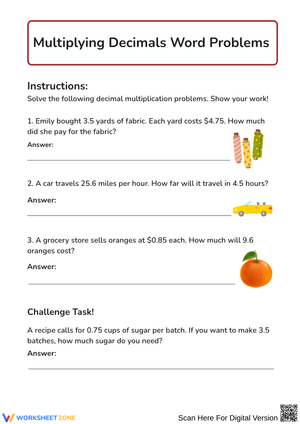
By Grade 6, decimals worksheets shift toward fluency. Students are expected to add, subtract, multiply, and divide multi-digit decimals using the standard algorithm, which means timed or short-cycle practice sets become appropriate here in a way they were not in Grades 4-5. A useful check before assigning Grade 6 fluency worksheets is confirming students already understand place value well enough to align decimal points correctly and can explain what a decimal represents, since fluency practice without that foundation just reinforces procedural errors at speed.
Classroom Implementation
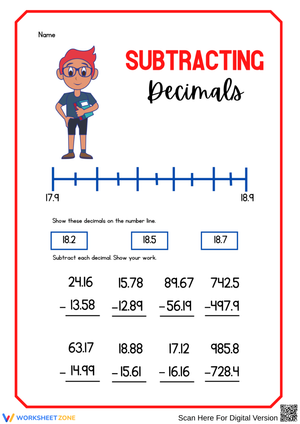
A practical weekly structure for a decimals unit might look like this: open with a short number-line or comparison warm-up worksheet tied to the current grade-level standard, move into a guided worksheet using models for the day's operation, and close with an independent practice set that mirrors the guided work. For a Grade 5 class working on 5.NBT.A.7, that could mean a Monday comparison warm-up, a Tuesday-Wednesday sequence of addition and subtraction worksheets using place-value models, and a Thursday multiplication and division set, with Friday reserved for a short formative check. Keep an intervention-ready notation and comparison worksheet on hand throughout, since it can be pulled for any student who stumbles during the operations sequence.
Common Misconceptions Worksheets Should Target
A few decimal misconceptions show up repeatedly enough that worksheet sets should be built to surface them directly. Students often treat a decimal like 0.62 as though it were the whole number 62, leading to comparison errors when a shorter decimal like 0.7 is actually larger. Others misalign place value when adding or subtracting decimals with different numbers of digits after the decimal point, especially when no visual place-value support is included. Worksheets that pair a comparison or operation task with a required explanation, or that mix decimals of different lengths within the same problem set, tend to surface these misconceptions faster than worksheets using uniform decimal lengths throughout.
Frequently Asked Questions
1. What grade level should introduce decimal worksheets and in what order?
Grade 4 is where decimal notation and comparison worksheets should begin, tied closely to fraction models for tenths and hundredths. Grade 5 extends this into place-value-based operations to thousandths, and Grade 6 shifts to standard-algorithm fluency. Following this order matters more than starting early, since skipping the notation and comparison stage tends to produce procedural errors later.
2. How do decimal worksheets differ for notation and comparison practice versus operations practice?
Notation and comparison worksheets focus on representing decimals correctly, often with number lines or fraction models, and reasoning about relative size. Operations worksheets require applying addition, subtraction, multiplication, or division to decimal values, first with place-value models in Grade 5 and then with the standard algorithm in Grade 6.
3. How can teachers use decimal worksheets for intervention with students below grade level?
Start with a short diagnostic worksheet covering notation and comparison, even for older students, to check whether the underlying place-value understanding is solid. If gaps show up, use Grade 4-level notation and comparison worksheets before returning the student to grade-level operations practice.
4. What decimal skills should Grade 6 students already have fluent before moving to standard-algorithm practice?
Students should be able to read, write, and compare decimals to thousandths and understand place value well enough to align decimal points correctly, per the Grade 5 expectations under 5.NBT.A.3 and 5.NBT.A.7. Without that foundation, standard-algorithm fluency practice in Grade 6 tends to reinforce errors rather than build genuine fluency.
5. How can decimal worksheets be used for quick formative assessment or exit tickets?
A short worksheet with four or five comparison or single-operation items works well as an exit ticket. Reviewing responses for error patterns, such as consistent place-value misalignment, gives more useful information for planning the next lesson than a single overall score.