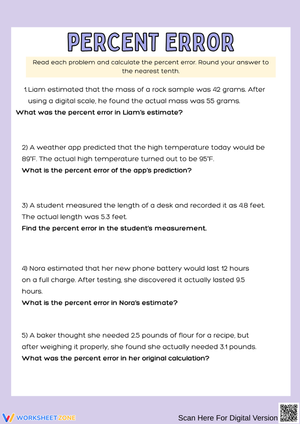
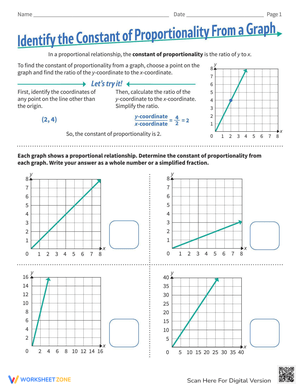
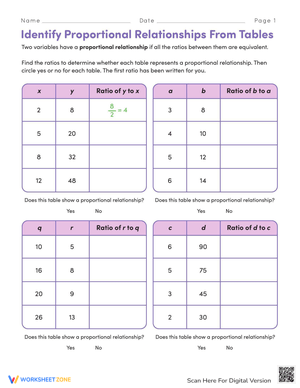
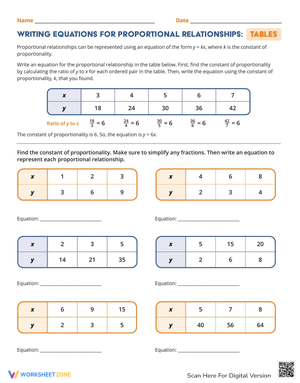
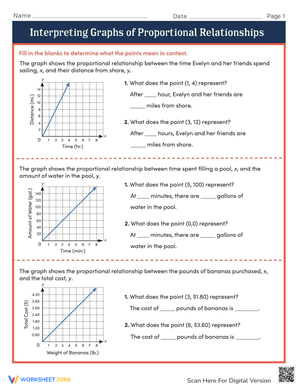
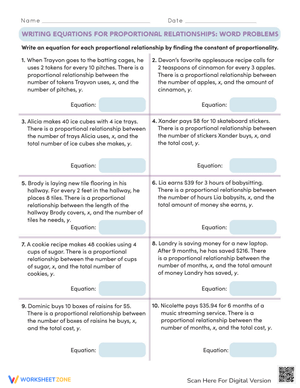
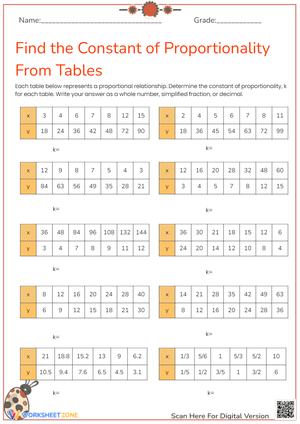
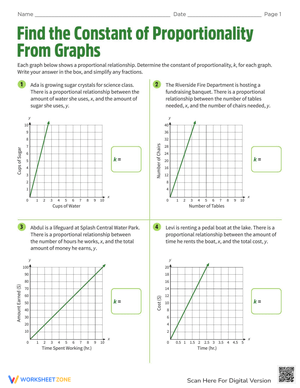
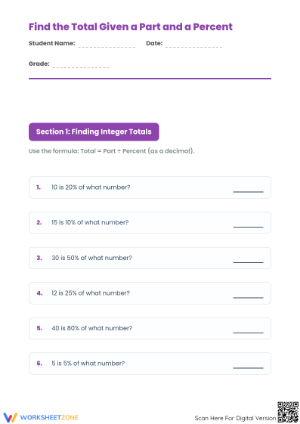
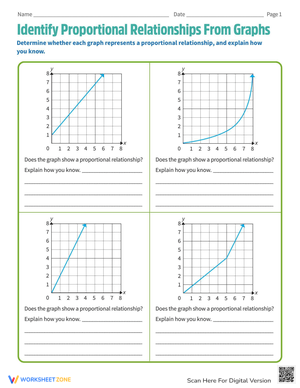
These ratios proportions printable worksheets give teachers in grades 6 and 7 a structured, low-prep entry point into one of middle school math's most consequential topics — the proportional reasoning that connects whole-number arithmetic to the symbolic thinking algebra demands. The set covers ratio language and notation, equivalent ratios, unit rates, and proportion-solving across multiple representations, with each worksheet targeting a specific skill cluster so teachers can place them precisely in an instructional sequence rather than distributing them as undifferentiated review.
Patterns in Student Work That These Worksheets Surface Early
The single most persistent error in ratio work is directionality. A student who correctly writes "the ratio of red tiles to blue tiles is 3:5" will, minutes later, write that same ratio to answer a question asking for the ratio of blue to red. The relationship is understood; the order is not. Worksheets that ask students to express the same comparison in both directions — red to blue, then blue to red — catch this before the error settles into a reliable habit.
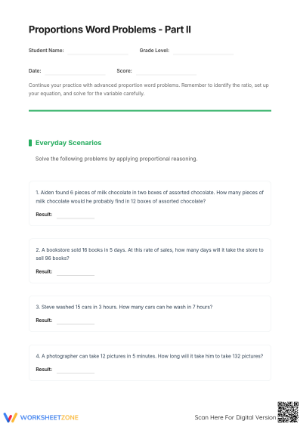
A second pattern emerges when students move from identifying ratios to solving proportions. Students who execute cross-multiplication without hesitation frequently cannot set up the proportion from a word problem. They have the algorithm; they lack the connection between the algorithm and the context. A student who writes 3/5 = x/20 correctly but cannot say what x represents when asked needs more work with ratio tables, not more cross-multiplication repetitions. Worksheets that separate the setup step — asking students to write the proportion before solving — make this gap visible before the unit assessment does.
Unit rate problems produce a third category of errors: students divide in the wrong direction. Asked to find the cost per item when 6 items cost $9.00, a meaningful fraction of students write 6 ÷ 9 and report $1.50 per item rather than $0.67. A brief class discussion around one worked example — pausing to ask which quantity belongs in the denominator — stops this from spreading through the whole group before it compounds into proportion work.
Skills Each Worksheet in the Set Targets
- Ratio language and notation: Students write ratios as fractions, in colon form, and in words — expressing the same comparison three ways builds fluency with terminology before the numbers get harder.
- Part-to-part vs. part-to-whole comparisons: Given a grouped set of objects, students identify and distinguish both comparison types from a single situation, a distinction that trips up a surprising number of 6th graders well into the unit.
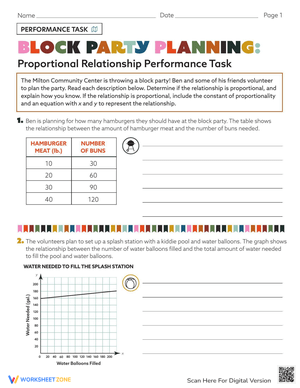
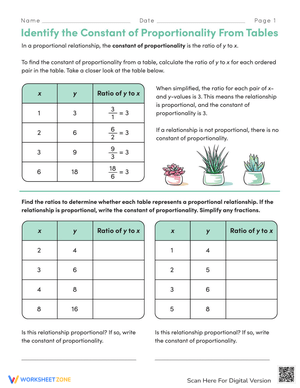
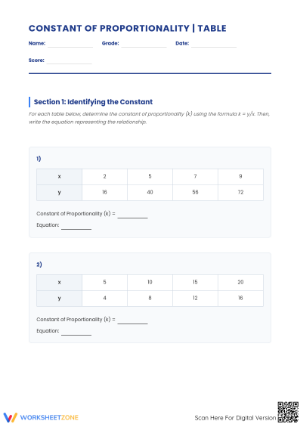
- Equivalent ratios and ratio tables: Students complete and extend ratio tables, then use them to answer questions. The table structure works as a visual bridge between concrete comparison and formal proportion-solving.
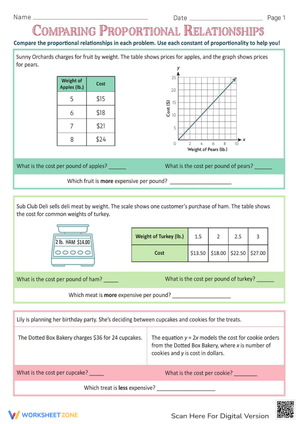
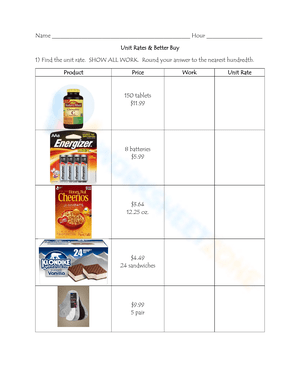
- Unit rates: Problems ask students to find miles per hour, cost per unit, and calories per serving — rate contexts that recur in science and social studies throughout middle school.
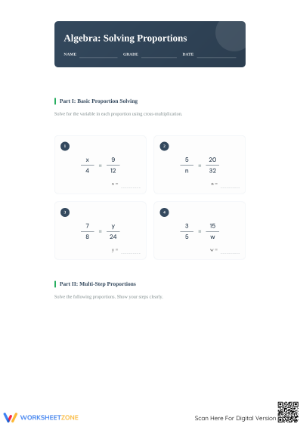
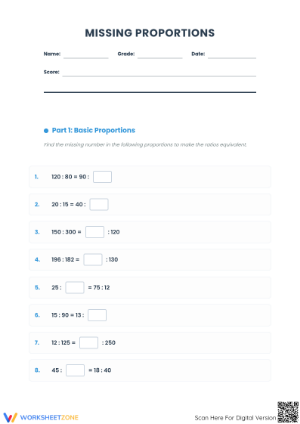
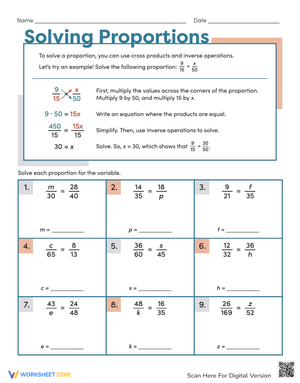
- Setting up and solving proportions: Students write the proportion, label the unknown, and solve using equivalent fractions before cross-multiplication is introduced as a second method.
- Word problems with real-world contexts: Multi-step problems require students to identify the ratio relationship, choose a solution method, and interpret the answer in context — not just produce a number.
Standard Alignment
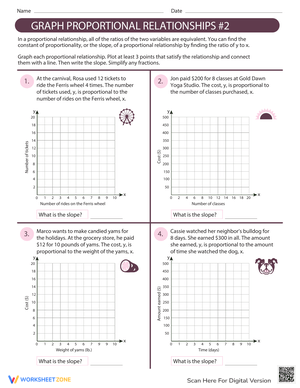
These worksheets address the 6.RP and 7.RP domains of the Common Core State Standards for Mathematics. The 6.RP cluster asks 6th graders to understand ratio concepts and use ratio reasoning to solve problems — including 6.RP.A.2, which introduces unit rate as a ratio where the second quantity is one, and 6.RP.A.3, which covers equivalent ratios, ratio tables, tape diagrams, and percent as a rate per hundred. The 7.RP cluster extends this to analyzing and representing proportional relationships (7.RP.A.2), computing unit rates involving complex fractions (7.RP.A.1), and solving multi-step ratio and percent problems (7.RP.A.3). The ratios proportions printable worksheets here are tagged by standard code, so a teacher targeting 7.RP.A.2c — identifying unit rate as the slope of a proportional relationship — can pull exactly those worksheets without browsing through mixed-skill material.
Working These Worksheets Into Your Instructional Sequence
The most effective placement for ratio and proportion practice is not the end of a unit but the middle — after conceptual work with physical models and before formal assessment. Dropping a ratio table worksheet during the first 12 minutes of class on day three of a unit gives teachers an immediate read on which students are still confused about direction and which are ready for multi-step problems. That information shapes the small-group instruction that follows more efficiently than waiting for a quiz result.
Unit rate worksheets work especially well in the 8 minutes between morning meeting and the first lesson block. Students complete three or four problems independently, then partners compare and reconcile any differences before the whole-class lesson begins. The disagreements that surface during partner comparison — "I got $1.50 and you got $0.67, so one of us divided the wrong way" — are more instructionally productive than anything scripted in advance.
These ratios proportions printable worksheets also fit naturally into the review session the day before a unit assessment. Rather than reteaching everything, select the two worksheets that target skills with the most documented errors from earlier practice and work through them as a guided class activity, using a document camera to display and annotate student work in real time. The annotation conversation — not the worksheet itself — is where the reteaching happens.
Adapting the Worksheets Across Readiness Levels
For students still building fraction fluency, the ratio table worksheets offer the most accessible entry point. The table's structure manages the organizational demands, letting students focus on the multiplicative relationship without simultaneously tracking format. Providing a partially completed table — two or three values already filled in — reduces working memory load without changing the mathematics being practiced.
Students who have already mastered equivalent ratios and basic proportion-solving benefit from the word problem worksheets used differently: cover the question, read only the situation, and ask them to write every ratio relationship they can identify before looking at what's being asked. This shifts the cognitive work from answer-getting to problem structure. It adds about two minutes per worksheet and produces markedly stronger transfer when novel problem types appear on assessments.
For English language learners working on ratios proportions printable worksheets alongside grade-level peers, a posted anchor chart — visual definitions of ratio, rate, unit rate, and proportion, each paired with a worked example — removes the language barrier without simplifying the mathematics. Students reference it independently during practice, which preserves their agency and reduces procedural interruptions during independent work time.
Frequently Asked Questions
What is the difference between a ratio and a proportion, and how should I explain it to students?
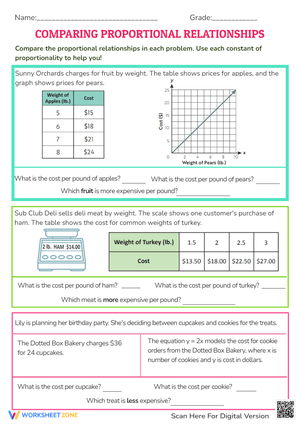
A ratio compares two quantities — 3 red tiles to 5 blue tiles. A proportion states that two ratios are equal — 3/5 = 6/10. The clearest explanation uses a ratio table: point out that every row represents an equivalent ratio, then show that any two rows together form a proportion. Framing a proportion as a comparison between two table entries, rather than introducing it as an abstract equation from the start, reduces confusion and transfers more reliably when students encounter proportion problems in word problem form.
When in the unit should cross-multiplication be introduced?
After students can set up a proportion correctly using equivalent fractions and can explain why the two ratios are equal. Introducing cross-multiplication too early — before students understand what a proportion represents — produces students who can solve 3/5 = x/20 mechanically but cannot verify whether the answer is reasonable. The worksheets sequence equivalent-fraction methods first; cross-multiplication appears only after the conceptual work is solid. Teachers who follow that sequence consistently report fewer "I don't know where to start" reactions during unit assessments.
Are these worksheets organized by grade level, by skill, or both?
Both. Each worksheet carries a grade-level indicator (6th or 7th) and a skill-cluster tag covering ratio language, unit rates, equivalent ratios, proportion-solving, and word problems. A 6th-grade teacher who needs focused practice on unit rate — standard 6.RP.A.2 — can locate exactly those worksheets without sorting through unrelated material. A 7th-grade teacher who wants to review prior-year ratio language before beginning the 7.RP unit can access the 6th-grade set directly from the same collection.













 Interactive Worksheet Maker
 Quiz Maker
 Word Search Maker
 Crossword Puzzle Maker
 Word Scramble Generator
 Sentence Scramble Generator
 Handwriting Worksheet Generator
 Name Tracing Generator
 Fill In The Blank Generator