


























Views
Downloads

Comparing Better Buy Worksheet | Grade 7-9 Essential
Paste this activity's link or code into your existing LMS (Google Classroom, Canvas, Teams, Schoology, Moodle, etc.).
Students can open and work on the activity right away, with no student login required.
You'll still be able to track student progress and results from your teacher account.
This Grade 7-9 math worksheet provides students with practical experience in calculating unit prices to determine the most cost-effective purchasing options. By engaging with real-world scenarios ranging from grocery items to luxury goods, learners develop the critical thinking skills necessary to make informed consumer decisions while mastering foundational ratio and proportion concepts.
At a Glance
- Grade: 7-9 · Subject: Math
- Standard:
CCSS.MATH.CONTENT.7.RP.A.1— Compute unit rates associated with ratios of quantities measured in different units- Skill Focus: Unit price comparison
- Format: 2 pages · 12 problems · Answer key included · PDF
- Best For: Independent practice or quick formative assessment
- Time: 15–20 minutes
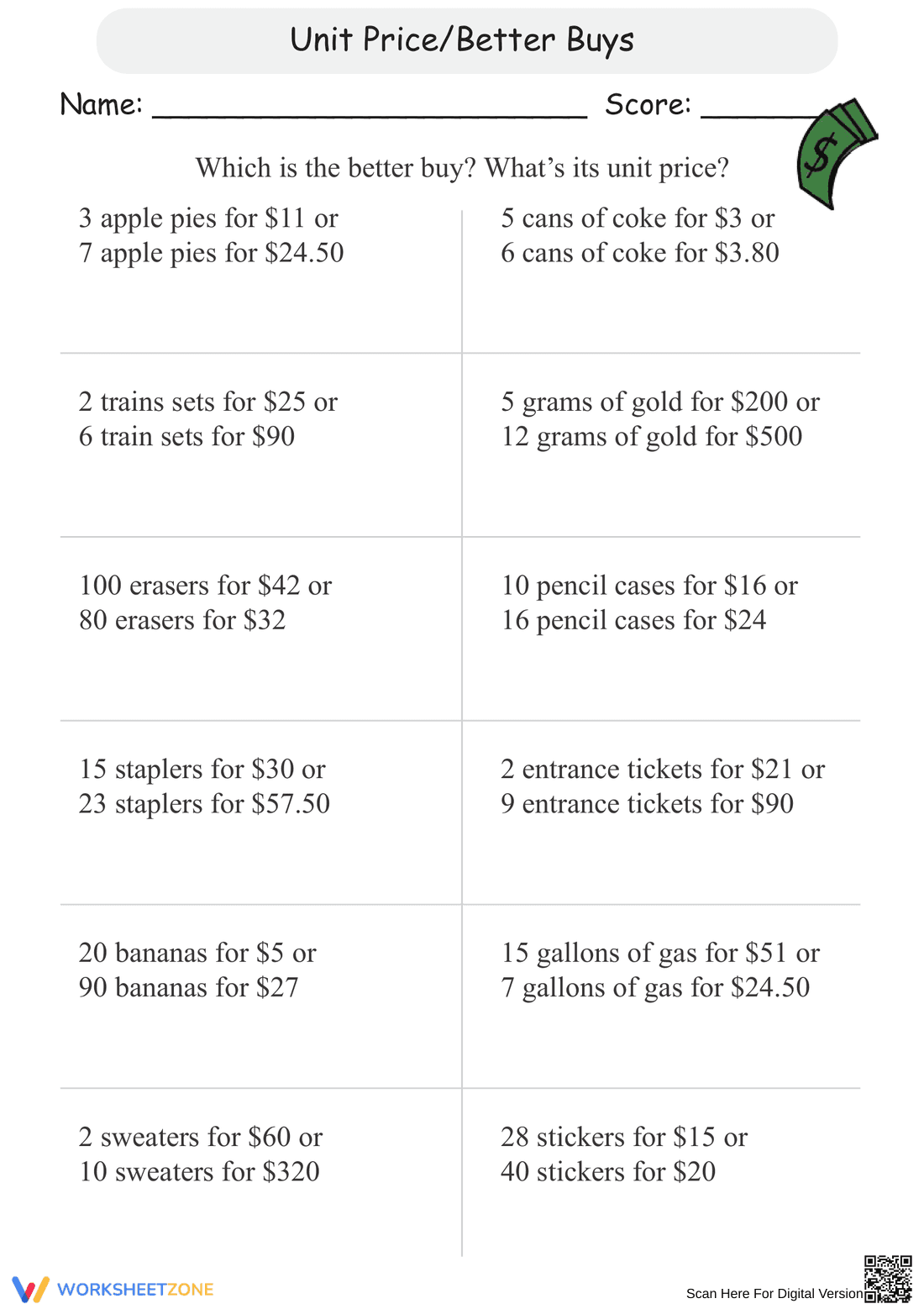
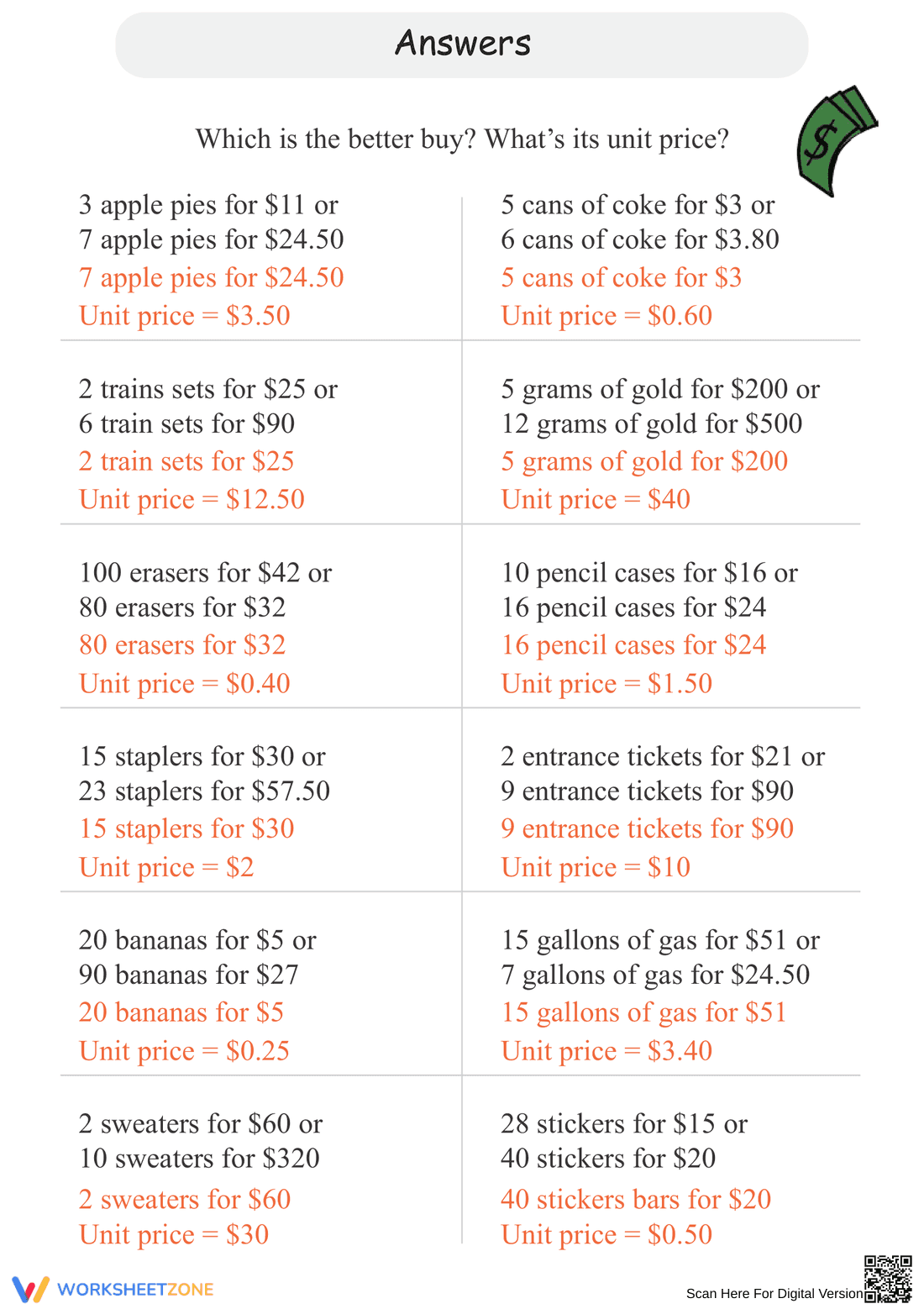
What's Inside: This resource features a clean, two-column layout containing 12 distinct comparison problems. Students are presented with two different pricing options for items such as apple pies, grams of gold, and gallons of gas. The second page provides a full answer key with the correct unit price calculations and the identified "better buy" highlighted for easy grading.
Zero-Prep Workflow
- Print (30 seconds): Simply download the PDF and print enough copies for your class. The high-contrast design ensures clear visibility even on standard school copiers.
- Distribute (1 minute): Hand out the single-page worksheet as a bell ringer or a transition activity between direct instruction and independent work.
- Review (1 minute): Use the included answer key to quickly check student work or project it on a whiteboard for immediate self-correction and peer review.
Standards Alignment: This worksheet is primarily aligned with `CCSS.MATH.CONTENT.7.RP.A.1`, which requires students to compute unit rates. It also supports 6th-grade foundational skills in unit rates and 8th-grade applications of proportional relationships. Both standard codes can be copied directly into lesson plans, IEP goals, or district curriculum mapping tools.
How to Use It: This resource is ideal for the "You Do" phase of a gradual release lesson. Assign it as a mid-lesson check for understanding to identify students who may be struggling with division or decimal placement. Alternatively, use it as a high-interest sub plan that requires no prior teacher setup or specialized materials.
Who It's For: While designed for middle school math students, this worksheet is also highly effective for high school consumer math courses or life skills programs. It pairs naturally with a lesson on grocery store math or a classroom discussion about inflation and bulk purchasing strategies.
According to research by Fisher & Frey (2014), providing students with structured, repetitive practice in real-world contexts is essential for the long-term retention of mathematical procedures. This worksheet addresses the `CCSS.MATH.CONTENT.7.RP.A.1` standard by forcing students to move beyond simple division and into comparative analysis. By calculating the unit price for 12 different scenarios, students internalize the relationship between total cost and quantity, a skill that NAEP data suggests is a significant indicator of adult financial literacy. The inclusion of diverse items—from stickers to entrance tickets—ensures that the mathematical concept of unit rates is decoupled from specific contexts, allowing for broader cognitive transfer. This resource serves as a reliable tool for building the procedural fluency required for more complex algebraic reasoning in later grades.


