


























Views
Downloads

Complete Better Buy Decisions Worksheet | Grade 6 Math
Paste this activity's link or code into your existing LMS (Google Classroom, Canvas, Teams, Schoology, Moodle, etc.).
Students can open and work on the activity right away, with no student login required.
You'll still be able to track student progress and results from your teacher account.
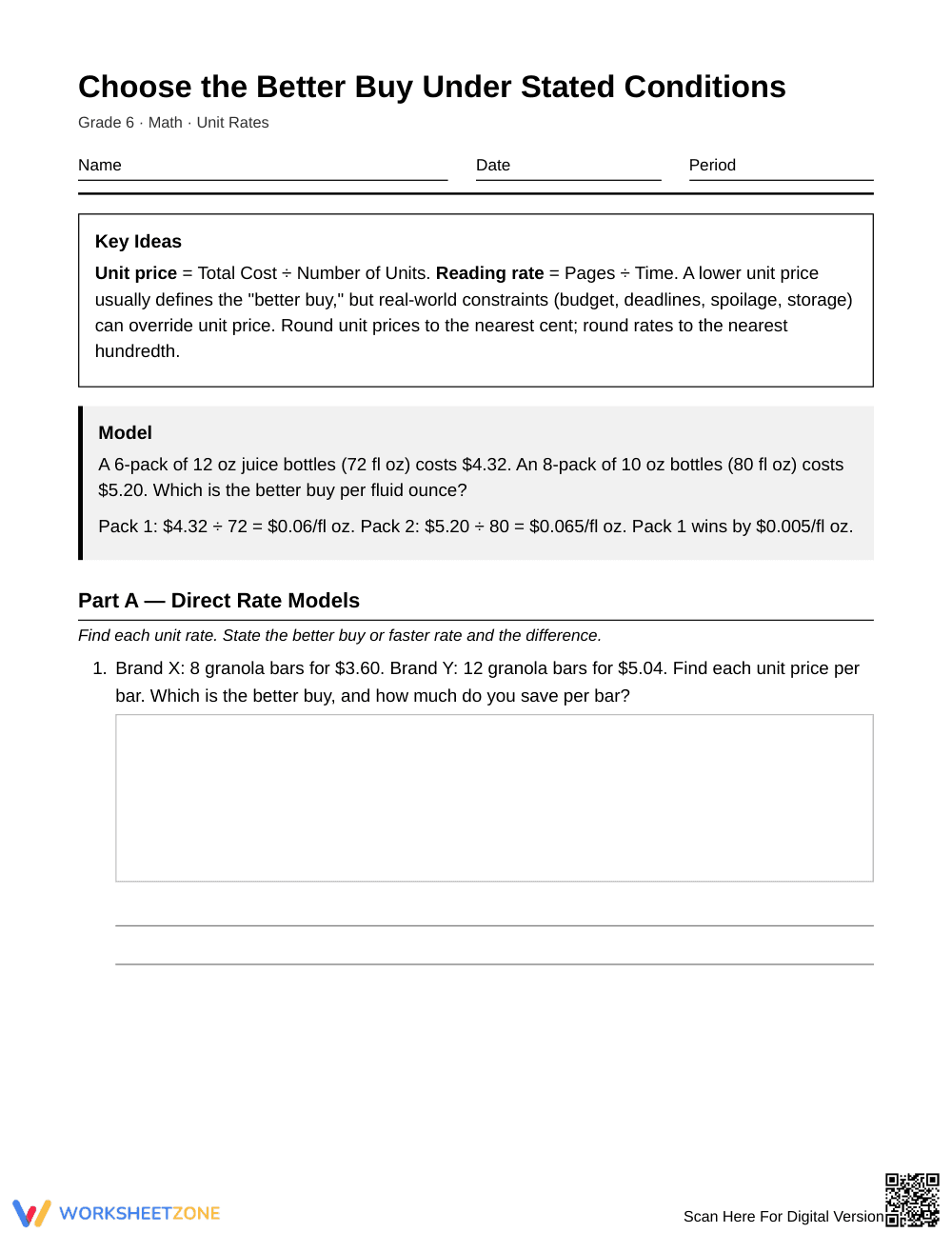
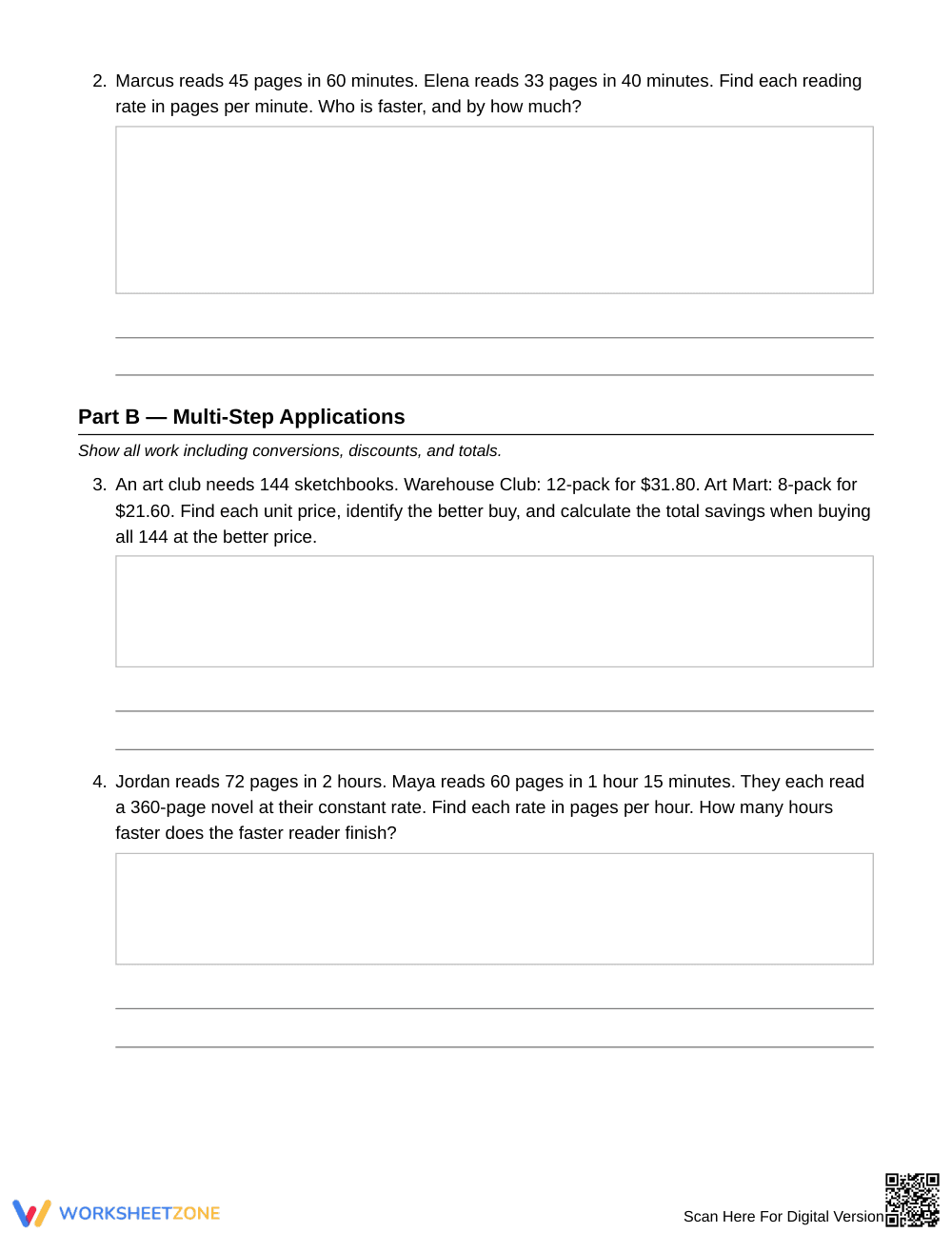
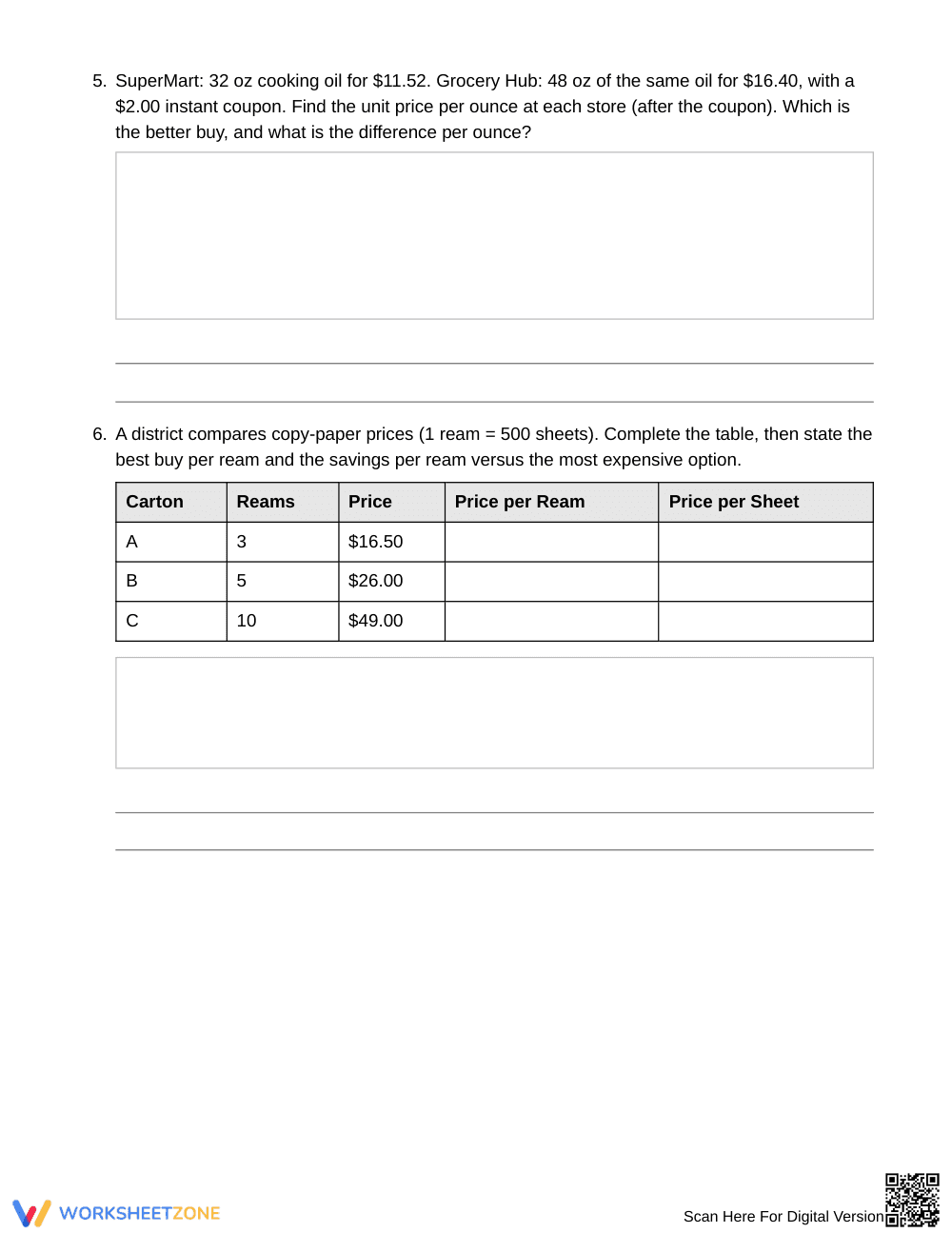
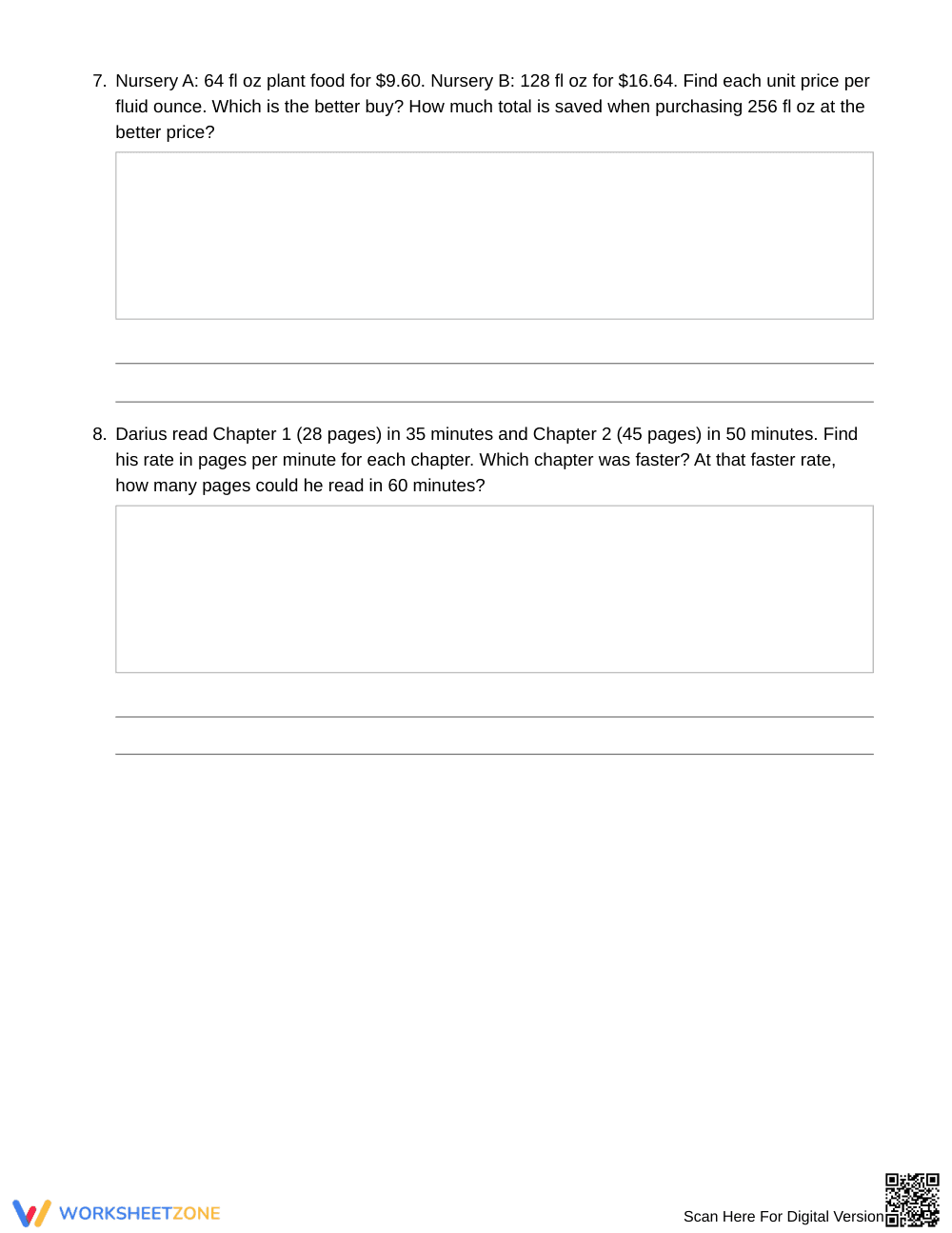
Mastering unit rates requires students to evaluate real-world trade-offs beyond simple division. This worksheet provides sixth-grade math students with ten structured problems to calculate unit rates, compare proportional values, and select optimal purchases when restricted by budget limits, shelf life, and shipping deadlines.
At a Glance
- Grade: 6 · Subject: Math
- Standard:
6.RP.A.3— Solve unit rate problems including unit pricing and constant speed comparisons- Skill Focus: Better Buy Comparisons Under Practical Constraints
- Format: 5 pages · 10 problems · Answer key included · PDF
- Best For: Guided practice and real-world application
- Time: 40–50 minutes
What's Inside
This five-page PDF includes ten targeted problems, a concise reference box, and a worked sample problem modeling per-ounce calculations. Students solve direct rate models, multi-step applications involving discounts and unit conversions, and structured comparison tables. A comprehensive two-page answer key provides step-by-step arithmetic and sample written justifications.
Skill Progression
- Guided practice (Part A, 2 problems): Direct two-item price and reading rate comparisons provide foundational practice with explicit formula prompts.
- Supported practice (Part B, 6 problems): Multi-step tasks incorporate fluid ounce conversions, coupon discounts, table analysis, and bulk quantity requirements.
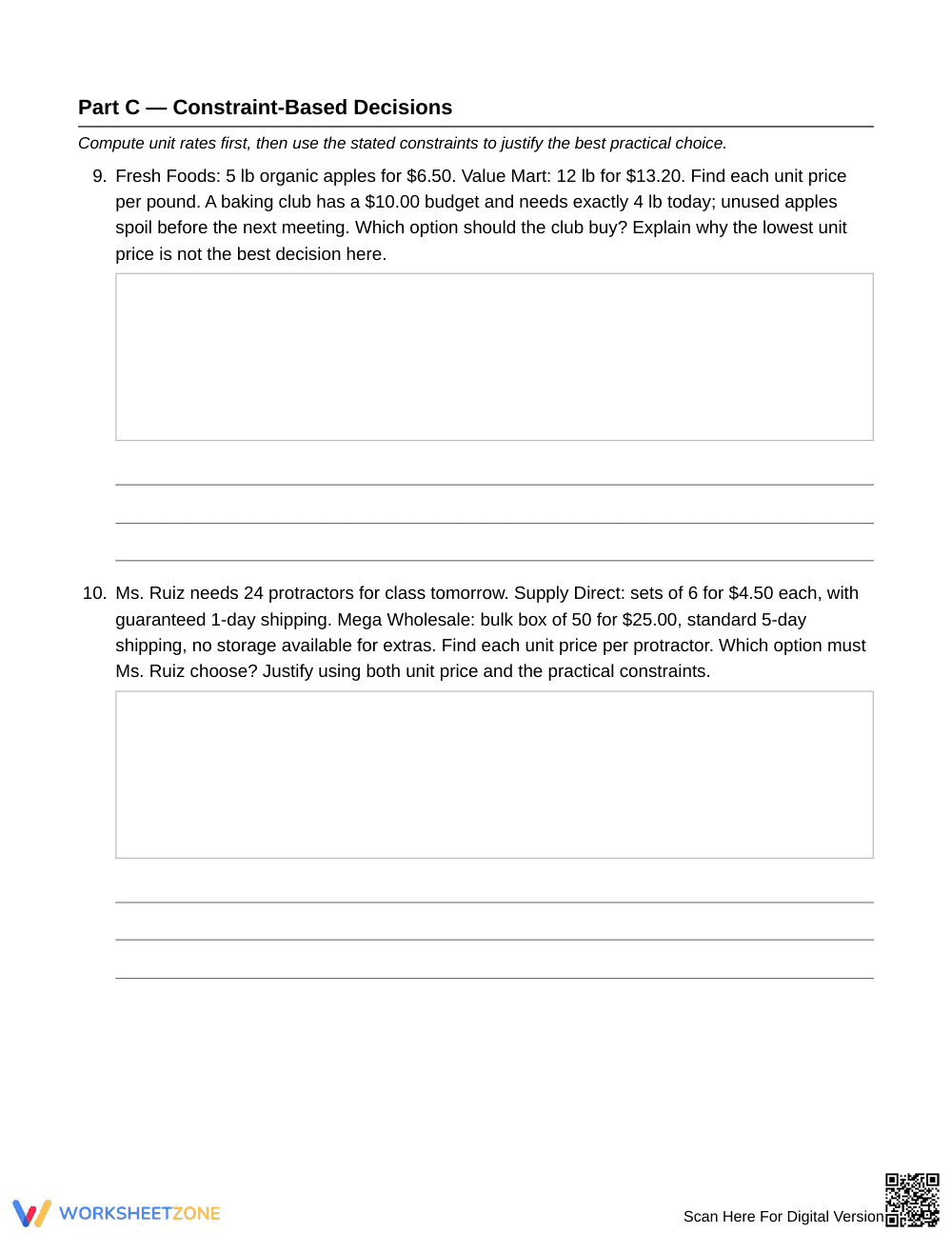
- Independent practice (Part C, 2 problems): Evaluative scenarios challenge students to balance calculated unit rates against real-world constraints like spoilage, budget caps, and delivery dates.
This progression mirrors the gradual release model, moving learners smoothly from computational fluency to reasoned economic evaluation.
Standards Alignment
This activity aligns with 6.RP.A.3: Use ratio and rate reasoning to solve real-world and mathematical problems, including unit pricing and constant speed. It also supports 6.RP.A.2 as students interpret unit rates in context. Both standard codes can be copied directly into lesson plans, IEP goals, or district curriculum mapping tools.
How to Use It
Deploy this worksheet after direct instruction on rates and unit pricing. Begin with Part A during whole-class modeling to reinforce rounding rules. Next, have students collaborate on Part B before completing Part C independently. Formatively check whether students look beyond the lowest numerical quotient to examine non-monetary restrictions in Part C. The expected completion time is 40 to 50 minutes.
Who It's For
This resource supports Grade 6 math classrooms, advanced Grade 5 students, and Grade 7 intervention groups reviewing ratio reasoning. Clear formula headers provide access for striving learners, while contextual analysis challenges advanced thinkers. Pair this worksheet directly with an introductory lesson on unit rates or a consumer math circular activity.
According to research from Fisher & Frey (2014) on the gradual release of responsibility framework, structured instructional design that moves intentionally from teacher-modeled examples to independent contextual problem-solving significantly strengthens mathematical reasoning and conceptual retention. When addressing standard 6.RP.A.3, middle school learners frequently memorize division algorithms without grasping how unit pricing operates under genuine operational constraints. This worksheet implements targeted scaffolding by first grounding students in direct rate calculations, expanding into multi-step problems with discounts and bulk packaging, and culminating in open-ended justifications where non-cost variables such as storage capacity, timelines, and product spoilage dictate the optimal choice. By combining computational rigor with authentic practical evaluation, students build the critical quantitative literacy necessary to justify economic decisions. Educators can rely on this systematic progression to foster deep conceptual mastery and independent problem-solving skills across diverse classroom environments.


