


























Views
Downloads

Printable Cursive Letter X Worksheet | Grade 3 ELA
Paste this activity's link or code into your existing LMS (Google Classroom, Canvas, Teams, Schoology, Moodle, etc.).
Students can open and work on the activity right away, with no student login required.
You'll still be able to track student progress and results from your teacher account.
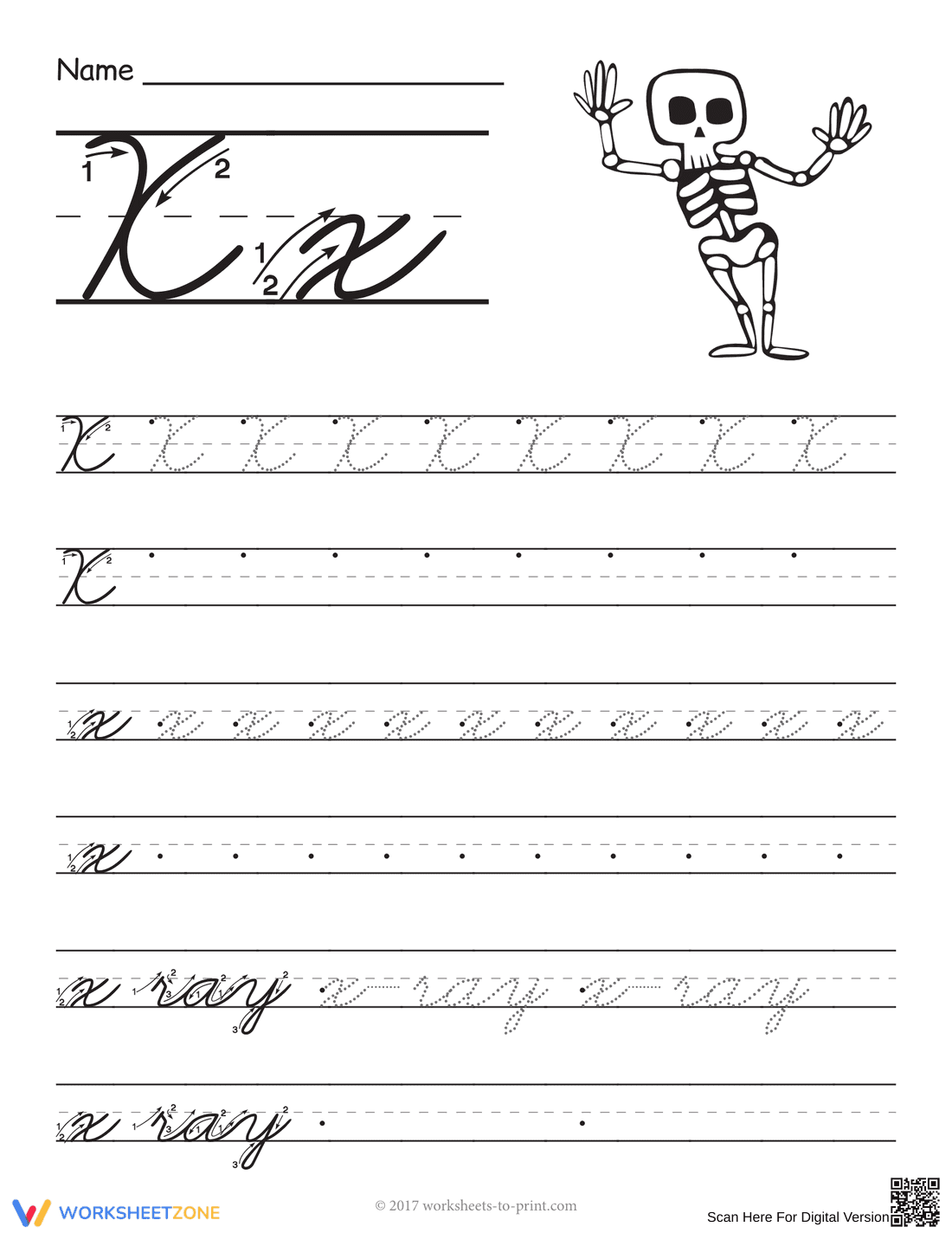
This printable cursive letter X worksheet helps students develop fluid, legible handwriting through targeted tracing and independent practice. Featuring a fun skeleton theme, this resource guides young learners through uppercase and lowercase letter formation, culminating in writing the word "x-ray" to build fine motor confidence.
At a Glance
- Grade: 3 · Subject: ELA
- Standard:
CCSS.ELA-LITERACY.L.3.2— Demonstrate command of writing conventions- Skill Focus: Cursive Letter X Formation
- Format: 1 page · 6 practice rows · No answer key needed · PDF
- Best For: Morning work or handwriting centers
- Time: 10–15 minutes
This single-page resource provides a structured approach to cursive handwriting. It includes directional arrows for the initial uppercase and lowercase X to guide pencil strokes. Students then complete six distinct rows of practice: tracing uppercase X, writing uppercase X independently, tracing lowercase x, writing lowercase x independently, tracing the word "x-ray," and finally writing "x-ray" on their own. The engaging skeleton graphic adds a playful, thematic element to routine handwriting practice.
Zero-Prep Workflow
This worksheet is designed for immediate classroom implementation with absolutely no teacher preparation required.
- Print (1 minute): Simply download the PDF and print a class set. The black-and-white design is ink-friendly.
- Distribute (1 minute): Hand out to students during morning work, literacy centers, or as a fast-finisher activity.
- Review (0 minutes): The directional arrows and tracing guides make this completely self-explanatory for students, requiring zero direct instruction setup.
Standards Alignment
This handwriting practice aligns with CCSS.ELA-LITERACY.L.3.2, which requires students to demonstrate command of the conventions of standard English capitalization, punctuation, and spelling when writing. While the Common Core does not explicitly mandate cursive, many state-specific adaptations of this standard include legible cursive writing as a foundational expectation for second and third graders.
How to Use It
This worksheet is highly versatile for early elementary classrooms. Use it as a focused morning work activity to settle students into the day with a quiet, fine-motor task. Alternatively, place it in a literacy center dedicated to handwriting and spelling practice. As a formative assessment tip, observe students while they transition from the tracing rows to the independent writing rows; watch for proper pencil grip and correct stroke direction, intervening gently if they begin forming the letter from the bottom up. Expected completion time is 10 to 15 minutes.
Who It's For
This resource is primarily designed for second and third-grade students who are being introduced to cursive or need targeted remediation on specific letter formations. For differentiation, students who struggle with fine motor control can use a highlighter to trace the independent writing lines before using a pencil. This worksheet pairs perfectly with a direct instruction lesson on cursive loops and slants, or alongside a seasonal Halloween writing prompt featuring the skeleton graphic.
Mastering cursive requires consistent repetition to build muscle memory. Structured practice that gradually releases responsibility from tracing to independent production is essential for developing fluent writing skills and reducing cognitive load. This resource supports that progression by moving students from guided arrows to independent word writing. Aligned with CCSS.ELA-LITERACY.L.3.2, this worksheet helps students demonstrate command of writing conventions by ensuring legible communication. When students no longer consciously think about letter formation, they can dedicate more working memory to vocabulary and sentence structure. Integrating this fine motor practice into daily routines improves writing stamina, spelling retention, and academic confidence.


