


























Views
Downloads
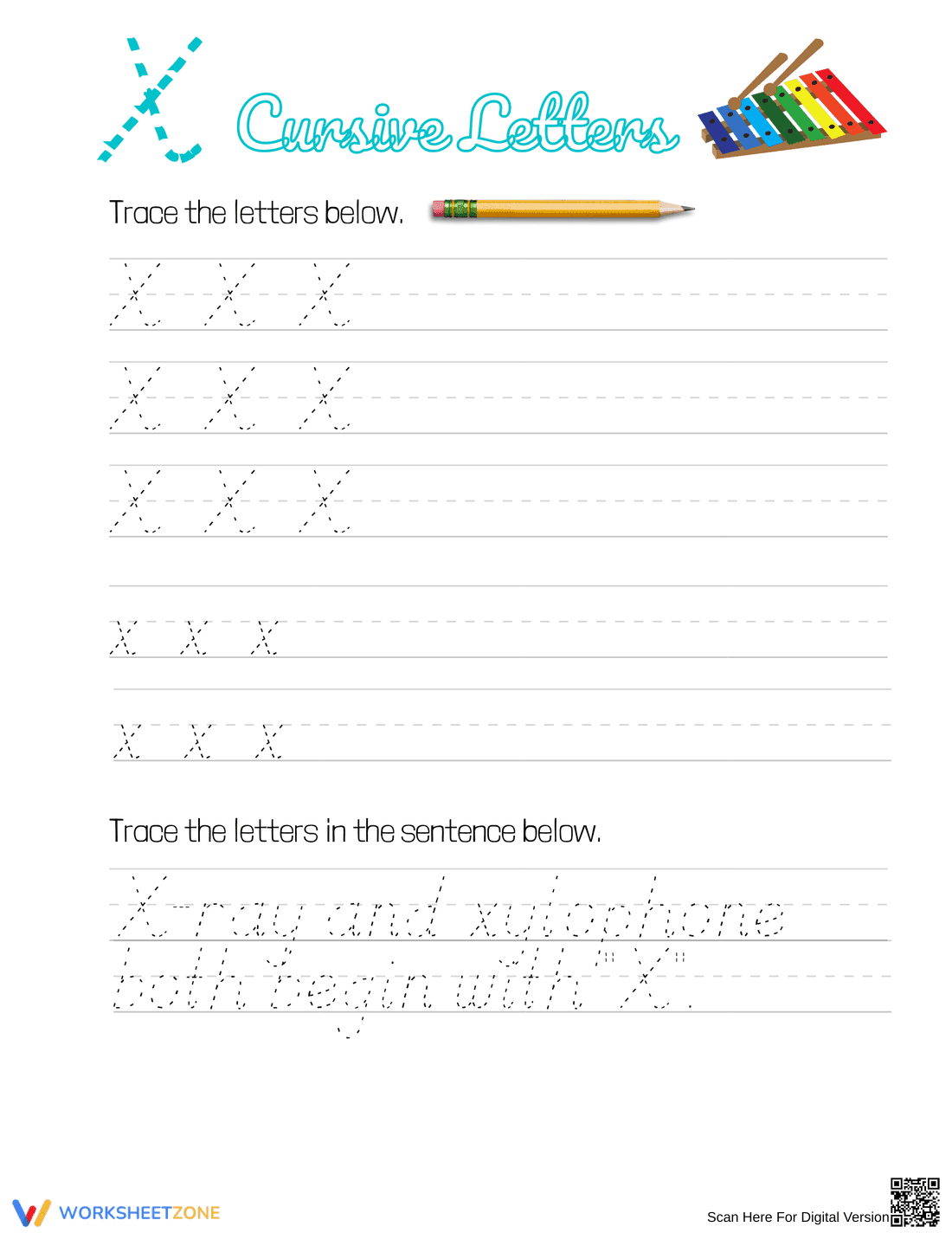

Cursive Letter X Practice | Essential Grade 2-3 Worksheet
Paste this activity's link or code into your existing LMS (Google Classroom, Canvas, Teams, Schoology, Moodle, etc.).
Students can open and work on the activity right away, with no student login required.
You'll still be able to track student progress and results from your teacher account.
This Grade 2 and Grade 3 cursive handwriting worksheet provides a focused environment for students to master the letter X. By combining isolated letter formation with contextual sentence practice, learners develop the fine motor control necessary for cursive fluency. This resource ensures students understand the unique cross-stroke required for the cursive X.
At a Glance
- Grade: 2-3 · Subject: English Handwriting
- Standard:
CCSS.ELA-LITERACY.L.3.1.j— Write legibly in cursive or joined italics to produce clear text.- Skill Focus: Cursive Letter X Formation
- Format: 1 page · 16 tasks · No-prep · PDF
- Best For: Daily handwriting warm-ups or literacy centers
- Time: 10–15 minutes
The worksheet features a clean, distraction-free layout designed for young learners. It includes five rows of dashed-line tracing guides for the letter X, totaling 15 individual practice opportunities. Below the isolated practice, a complete sentence—"X-ray and xylophone both begin with 'X'"—allows students to practice connecting letters and maintaining consistent slant and spacing across a full line of text.
This resource is designed for a zero-prep classroom workflow. First, print the single-page PDF in under 30 seconds. Second, distribute the sheets during your morning transition or handwriting block. Third, review student stroke order as they work, providing immediate corrective feedback on the "X" cross-point. Total teacher preparation time is under two minutes, making it an ideal sub-plan addition.
This resource aligns with `CCSS.ELA-LITERACY.L.3.1.j`, which requires students to write legibly in cursive. While handwriting is often introduced in second grade, third-grade standards emphasize the production of legible, joined text. This worksheet supports that transition by moving from isolated characters to word-level connections. Both standard codes can be copied directly into lesson plans, IEP goals, or district curriculum mapping tools.
Use this worksheet as a formative assessment tool during your ELA block. Observe students to ensure they start the letter at the correct point. It serves as an excellent quiet-time activity for early finishers. Completion typically takes 10 to 15 minutes depending on the student's motor proficiency.
This page is tailored for second and third-grade students transitioning to cursive. It is also effective for students requiring Tier 2 handwriting intervention or occupational therapy support. Pair this with a cursive alphabet anchor chart for maximum instructional impact.
Research by Fisher & Frey (2014) emphasizes that handwriting fluency is a foundational component of the writing process, reducing cognitive load on working memory. The repetitive nature of tracing provides the kinesthetic feedback necessary for muscle memory. According to the RAND AIRS 2024 report, consistent, short-burst practice of specific letterforms like the cursive X significantly improves legibility scores. By isolating the letter X, this resource addresses a common hurdle in cursive mastery. The inclusion of sentence-level tracing bridges the gap between mechanical formation and functional writing. This evidence-based approach ensures students move beyond simple imitation toward automaticity in their cursive production, meeting national standards for legible communication.


