


























Views
Downloads

Printable Cursive Letter X Worksheet | Grade 1
Paste this activity's link or code into your existing LMS (Google Classroom, Canvas, Teams, Schoology, Moodle, etc.).
Students can open and work on the activity right away, with no student login required.
You'll still be able to track student progress and results from your teacher account.
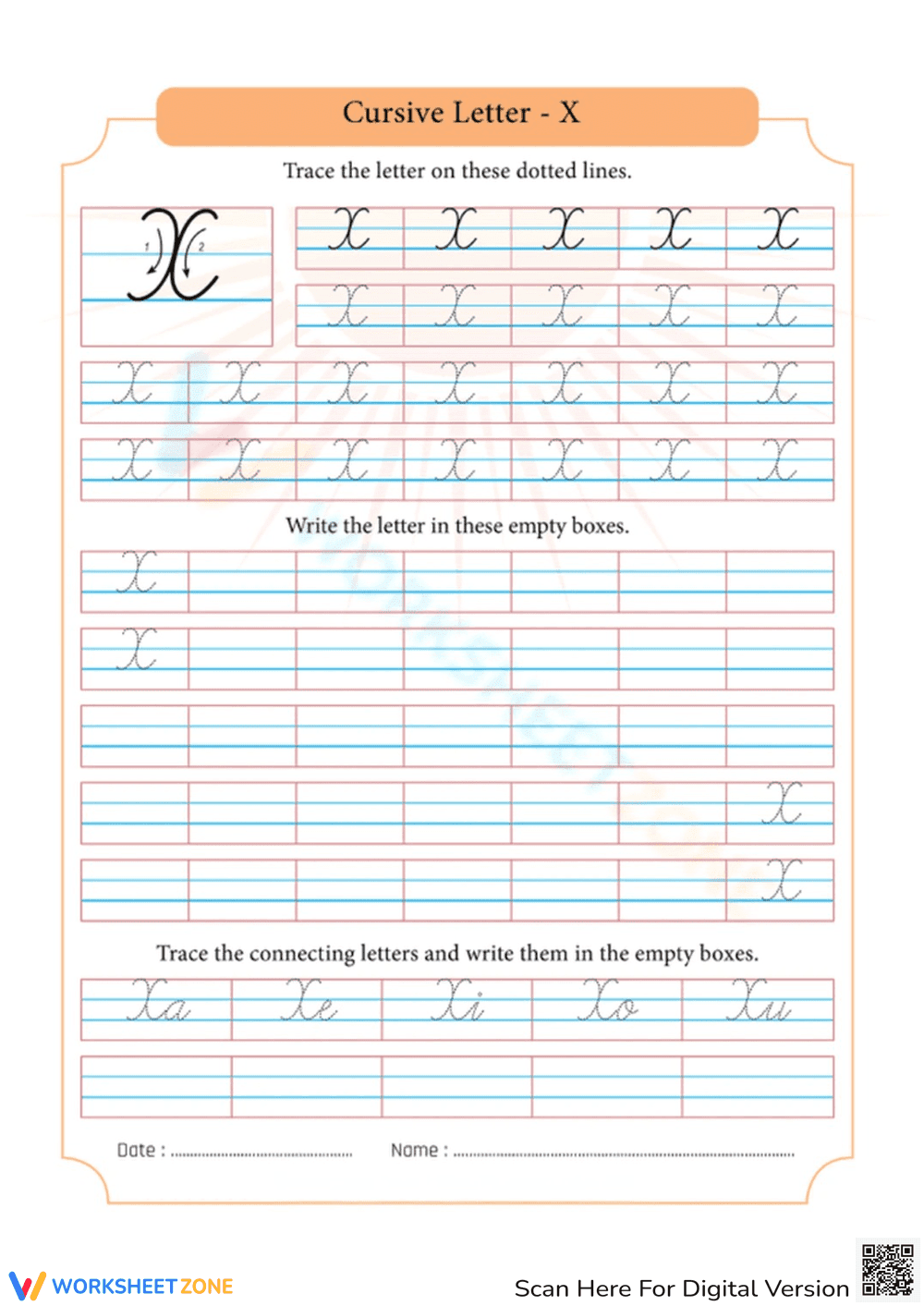
This printable cursive letter X worksheet helps young learners master proper letter formation and build fine motor skills. Students practice tracing, writing independently, and connecting the letter X to vowels, ensuring they develop fluid and legible handwriting habits from the very beginning.
At a Glance
- Grade: 1 · Subject: Handwriting
- Standard:
CCSS.ELA-LITERACY.L.1.1.A— Form upper- and lowercase letters accurately- Skill Focus: Cursive Letter X Formation
- Format: 1 page · 62 problems · No answer key · PDF
- Best For: Independent practice and centers
- Time: 10–15 minutes
This single-page resource features a structured progression of handwriting exercises. It begins with a numbered directional guide for forming the cursive X. Students complete four rows of guided tracing on dotted lines, followed by six rows of independent writing in empty boxes. Finally, the worksheet includes a section for tracing and writing connecting letters (Xa, Xe, Xi, Xo, Xu) to help students transition to fluid word formation.
Zero-Prep Workflow
- Print (1 min): Simply download the PDF and print the required number of copies. The black-and-white design is ink-friendly and ready immediately.
- Distribute (1 min): Hand out the worksheets along with sharpened pencils. The visual instructions and directional arrows make the task self-explanatory for early readers.
- Review (0 min): As a handwriting exercise, this requires no formal grading key. Teachers can quickly scan completed pages to check for proper stroke direction and line adherence.
With under two minutes of prep, this resource is perfect for sub plans or morning work.
Standards Alignment
This worksheet aligns with CCSS.ELA-LITERACY.L.1.1.A, requiring students to print all upper- and lowercase letters, adapted here for early cursive instruction. It supports the foundational development of fine motor control and legible written expression. Both standard codes can be copied directly into lesson plans, IEP goals, or district curriculum mapping tools.
How to Use It
Deploy this worksheet during morning work or dedicated handwriting blocks after modeling the cursive X on the board. It also functions perfectly as an independent literacy center activity. While students work, teachers can conduct formative assessments by observing pencil grip and stroke sequence, gently correcting students who start from the wrong point. Expected completion time is 10 to 15 minutes.
Who It's For
This resource is designed for Kindergarten and Grade 1 students beginning their cursive handwriting journey. It provides necessary scaffolding for learners who struggle with spatial awareness on lined paper, offering ample tracing opportunities before requiring independent formation. Pair this worksheet with a tactile activity, like tracing the letter X in sand or shaving cream, to reinforce muscle memory before moving to pencil and paper.
Effective handwriting instruction requires explicit modeling followed by structured, repetitive practice. According to Fisher & Frey (2014), gradual release of responsibility is critical for motor skill acquisition, moving students from heavily guided tracing to independent execution. This worksheet embodies that progression by targeting CCSS.ELA-LITERACY.L.1.1.A, helping students form upper- and lowercase letters accurately. By breaking down the cursive letter X into directional strokes, isolated tracing, independent writing, and finally, vowel connections, the resource minimizes cognitive load while maximizing motor repetition. Early mastery of fluid handwriting is linked to improved written composition and spelling fluency in later grades, as students no longer need to dedicate working memory to letter formation. This targeted practice ensures learners build the automaticity required for successful, expressive writing across all academic subjects.


