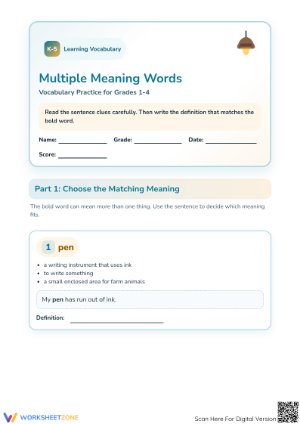
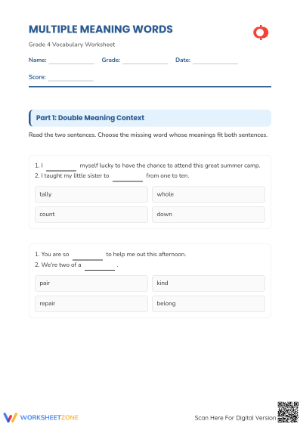
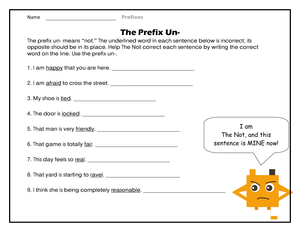
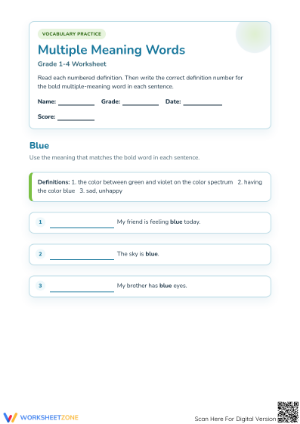
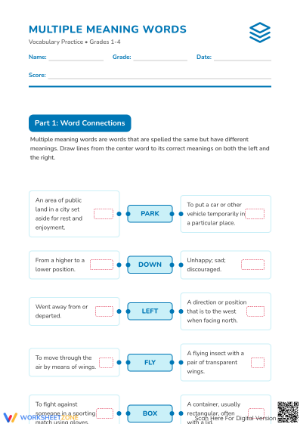
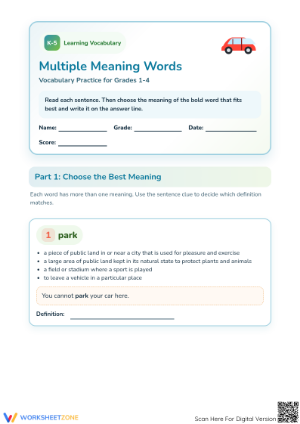
These 3rd grade multiple meaning words printable worksheets resources give teachers ready-to-use vocabulary practice built around the exact skill that derails third graders most during the shift from early reading to content-area texts. The set covers words with distinct, unrelated definitions—the kind that look identical on the page but carry completely different meanings depending on the sentence—and trains students to use surrounding text to sort out which meaning the author intends.
The Skills Each Worksheet Targets
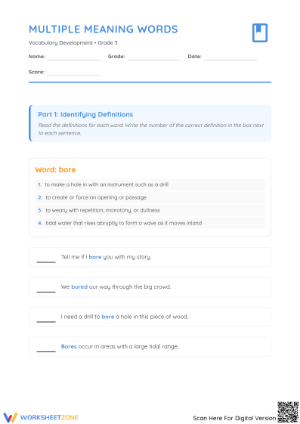
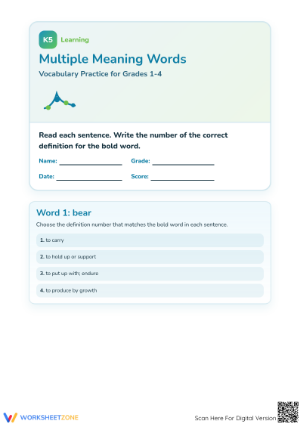
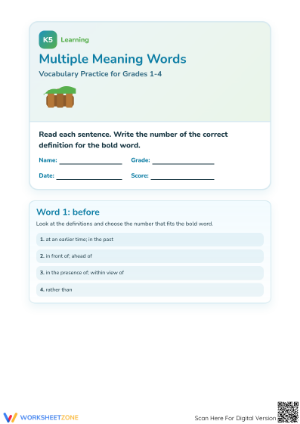
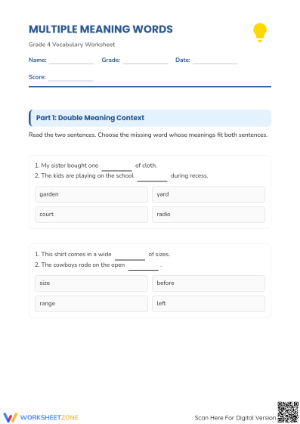
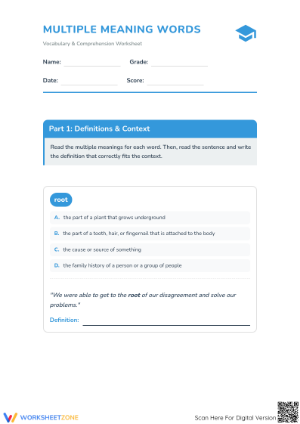
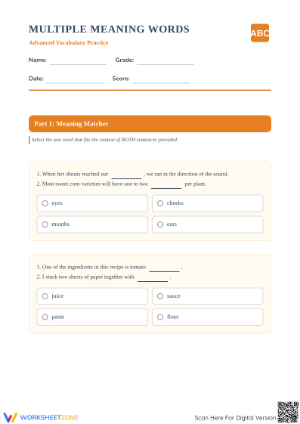
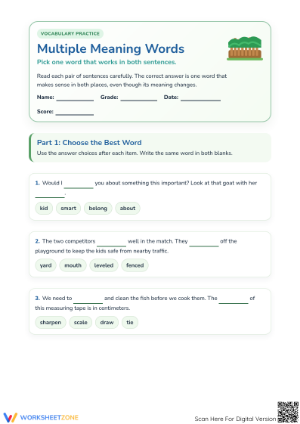
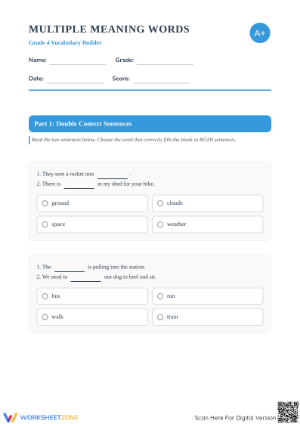
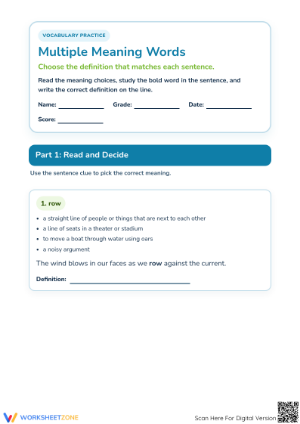
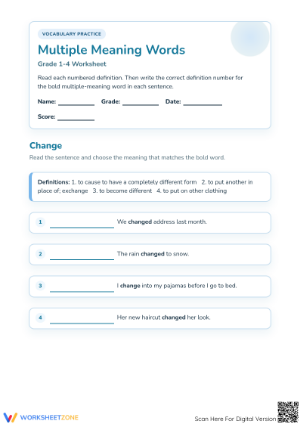
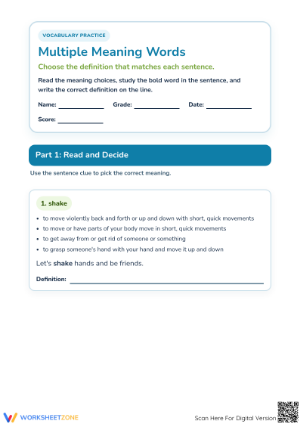
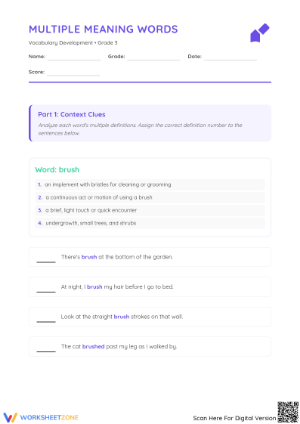
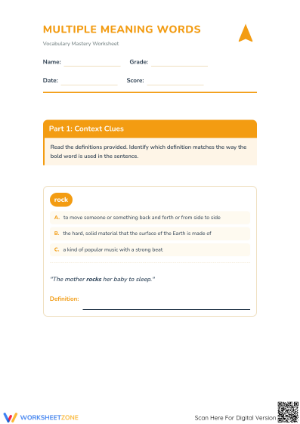
The core skill across the set is context-dependent meaning selection. Students read sentences containing target words—bat, bark, pitch, scale, spring—and identify which definition fits based on what surrounds the word. That reading-and-deciding sequence is the actual comprehension move third graders need to make inside real texts, and practicing it in short, focused bursts before it appears inside a multi-paragraph passage is what builds the habit.
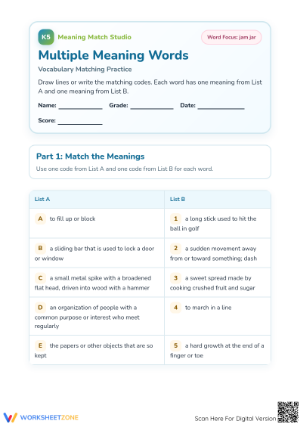
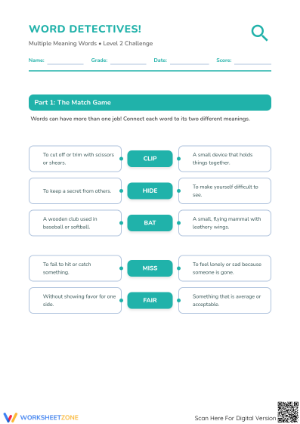
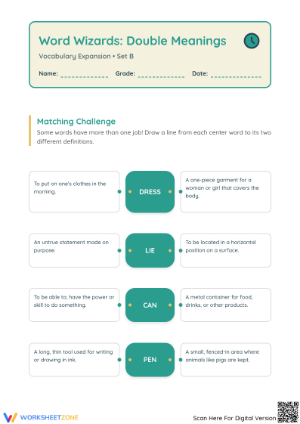
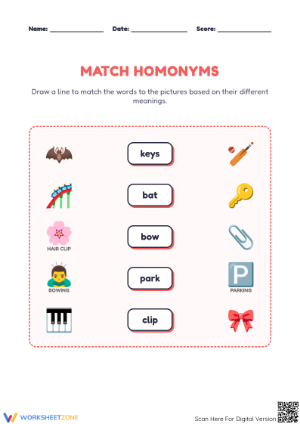
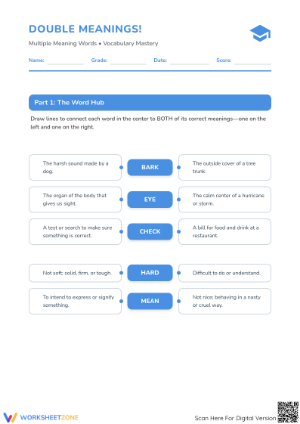
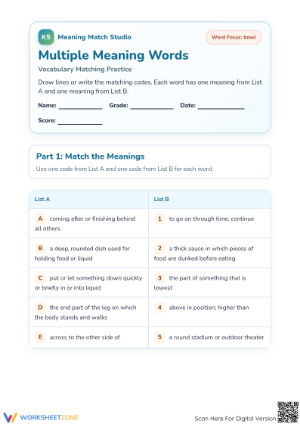
Beyond definition selection, each worksheet includes sentence-writing tasks where students produce their own sentences for two different meanings of the same word. Writing "the pitcher wound up and threw a fastball" and then "they had to pitch the tent before dark" requires qualitatively different ownership than circling an answer. Students who can do both with accuracy have genuinely internalized the concept—not merely recognized it. The set also includes visual tasks that ask students to draw both meanings of a word side by side, and short matching activities that pair sentences to dictionary entries.
Where Students Get Stuck: Errors Worth Watching For
The most reliable predictor of difficulty here is vocabulary range. A student who has never seen a tent being pitched or heard a musical pitch will collapse both meanings of that word into the only one they know, regardless of what the surrounding sentence says. The context-clue strategy only works when students have at least a thin anchor definition to reach toward, which is why briefly pre-teaching both meanings of two or three of the trickier target words before distributing each worksheet matters more than it might seem.
The other consistent pattern: students who read context clues too narrowly. When a sentence reads "Maya used the scale to weigh her science project," a student who latches onto the single word "weigh" may circle the right answer—but that same student will struggle when the clue is more diffuse, as in "the fish had shiny silver scales that caught the light." They are scanning for one confirming word rather than reading the full picture the sentence paints. Teaching students to underline the entire chunk of the sentence that matters—not just one trigger word—breaks that habit. It shows up consistently in third-grade work on this standard, and it is worth an explicit correction before students practice independently.
Fitting These Worksheets Into the Week
The Monday-morning warm-up slot is one natural placement. One worksheet on the desk when students arrive, three to five minutes to work independently, and the room is already focused before the lesson opens. The format is self-explanatory enough that students can get started while attendance is taken and materials are distributed.
Literacy word-work centers are the other reliable option. Because each worksheet targets a closed, concrete task—read the sentence, decide the meaning, mark the answer—students complete them without direct teacher supervision, which makes them useful during guided reading rotations when the teacher is pulled to a small group. The 3rd grade multiple meaning words printable worksheets format also holds up well in intervention blocks: a reading specialist can work through one worksheet with a small group, pausing after each item to ask students to point to the specific words in the sentence that tipped them off.
For whole-group instruction, project one worksheet on the board and use a gradual release approach for the first two items—think aloud, then hand off. "I see light here. I know it can mean a lamp, not heavy, or pale in color. So let me read the whole sentence: 'she packed a light bag for the trip.' Is a bag a color? Is it a lamp? The sentence is about packing for travel, so this is about weight." That eight-minute modeling sequence pays forward into every independent practice session that follows, because students have watched the actual thought process rather than just been handed a definition.
Standard Alignment
These worksheets directly address CCSS.ELA-LITERACY.L.3.4.A, which requires students to use sentence-level context as a clue to the meaning of a word or phrase. In classroom terms, this standard marks the difference between a student who stops reading when a familiar word doesn't fit and one who reads forward, uses what surrounds the word, and reconstructs the meaning. The 3rd grade multiple meaning words printable worksheets format isolates that process sentence by sentence, word by word, before students have to apply it inside longer connected text—which is where this standard gets tested on both informal checks and state reading benchmarks. Placing this practice at the start of a vocabulary unit, before students encounter these words inside passages, gives the standard instruction somewhere to land.
Adjusting the Set for a Range of Readers
For students reading below grade level or working on English language development, the visual tasks in the set—drawing both meanings side by side—offer a way into the concept that doesn't depend on writing fluency. Pairing the drawing task with a brief verbal check ("tell me what's happening in each picture") gives an informal read on whether the concept landed. Adding a small picture dictionary or word card alongside each worksheet provides enough grounding to make the practice accessible without removing the cognitive work.
For students who need extension, the sentence-writing tasks grow with one added constraint: each sentence must contain at least two context clues that make the meaning unmistakable without stating the definition outright. A student who writes "the bat flew out of the cave at sunset, circling the dark field" is making deliberate word choices to signal meaning—that level of intentional language use in third-grade writing is exactly the transfer the standard is aiming for.
The 3rd grade multiple meaning words printable worksheets set spans a range of word difficulty. Start students newer to the concept on words with concrete, visually distinct meanings—bat, bark, cap—and reserve words with subtler distinctions—fair, right, light—for students who have the basic concept and are ready for more nuanced context work.
Frequently Asked Questions
Which words does the set cover?
The worksheets use high-frequency multiple-meaning words from third-grade reading: bat, bark, match, pitch, spring, fall, light, right, block, scale, fair, and cap, among others. These words were selected because students typically know at least one meaning already, which makes the second meaning a reachable challenge rather than a confusing unknown from the start.
Can I use these for formative assessment?
The sentence-writing tasks work particularly well as a quick formative check. A student who writes two clearly differentiated sentences for the same word—each containing its own internal context clues—demonstrates genuine mastery of the concept. That evidence is more useful than a circled multiple-choice answer for deciding whether a student is ready to move forward or needs more targeted practice before encountering these words inside connected text.
Are these worksheets appropriate for ELL students?
With some preparation, yes. The visual tasks give students new to English a non-writing pathway into the concept. Pre-teaching both definitions of the target word—using images, physical objects, or brief demonstrations—before distributing each worksheet makes the context-clue task genuinely meaningful rather than a process of elimination. The matching activities also work well as a first exposure because they present both sentences and definitions at the same time, giving students a concrete reference point as they work.












 Interactive Worksheet Maker
 Quiz Maker
 Word Search Maker
 Crossword Puzzle Maker
 Word Scramble Generator
 Sentence Scramble Generator
 Handwriting Worksheet Generator
 Name Tracing Generator
 Fill In The Blank Generator