


























Views
Downloads



Multiple Meaning Words Worksheet | Grade 4 Printable Essential
Paste this activity's link or code into your existing LMS (Google Classroom, Canvas, Teams, Schoology, Moodle, etc.).
Students can open and work on the activity right away, with no student login required.
You'll still be able to track student progress and results from your teacher account.
This Grade 4 Multiple Meaning Words worksheet provides a comprehensive Vocabulary Builder experience designed to strengthen students' semantic flexibility. By engaging with words that share spellings but differ in meaning, learners develop the essential ability to decode complex texts. This Printable resource ensures students can accurately resolve linguistic ambiguity in both literary and informational passages.
At a Glance
- Grade: 4 · Subject: English Language Arts (ELA)
- Standard:
CCSS.ELA-LITERACY.L.4.4— Determine the meaning of words with multiple meanings using context clues- Skill Focus: Multiple meaning words (Homonyms)
- Format: 5 pages · 15 problems · Answer key included · PDF
- Best For: Vocabulary building and semantic context practice
- Time: 25–35 minutes
What's Inside
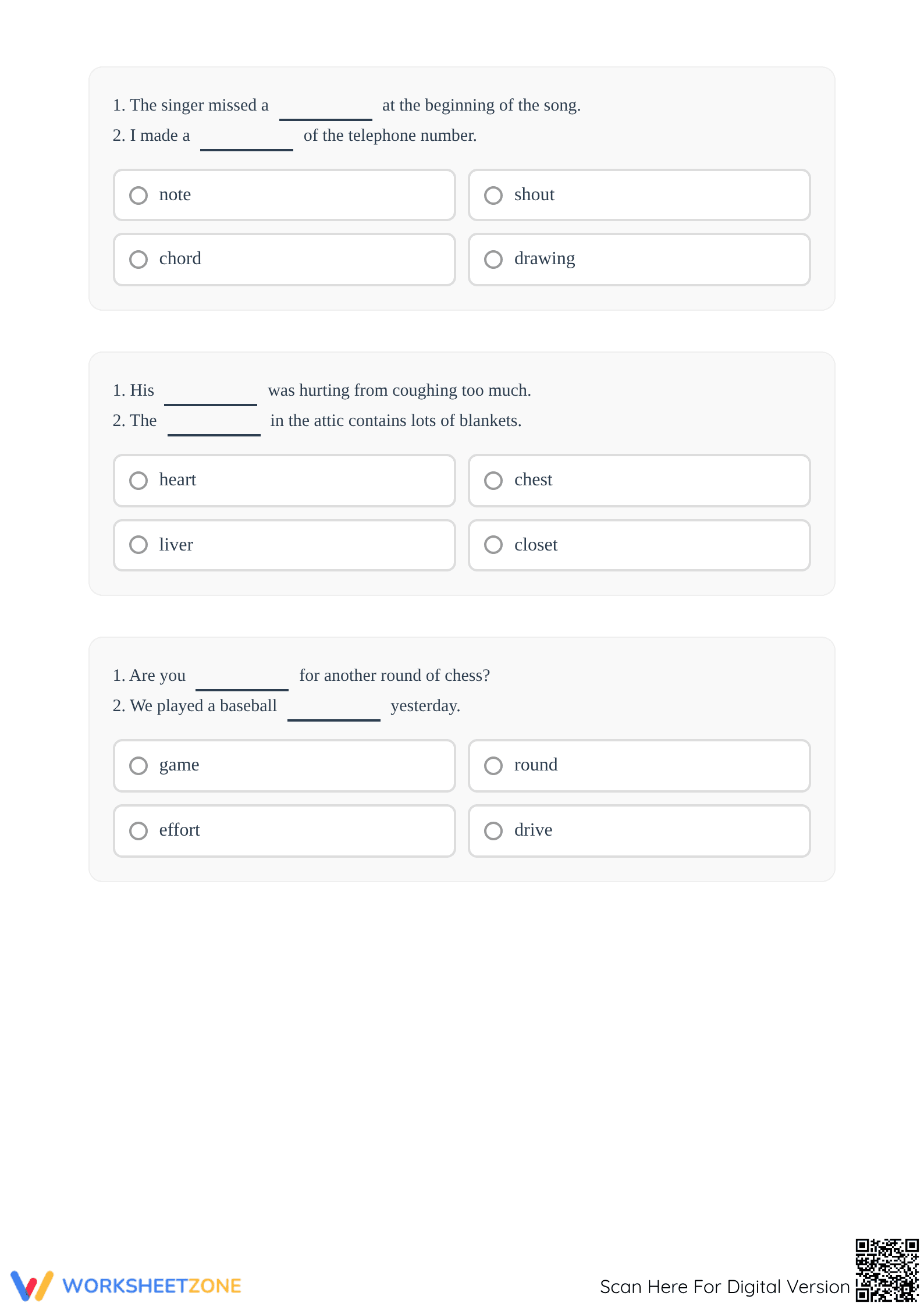
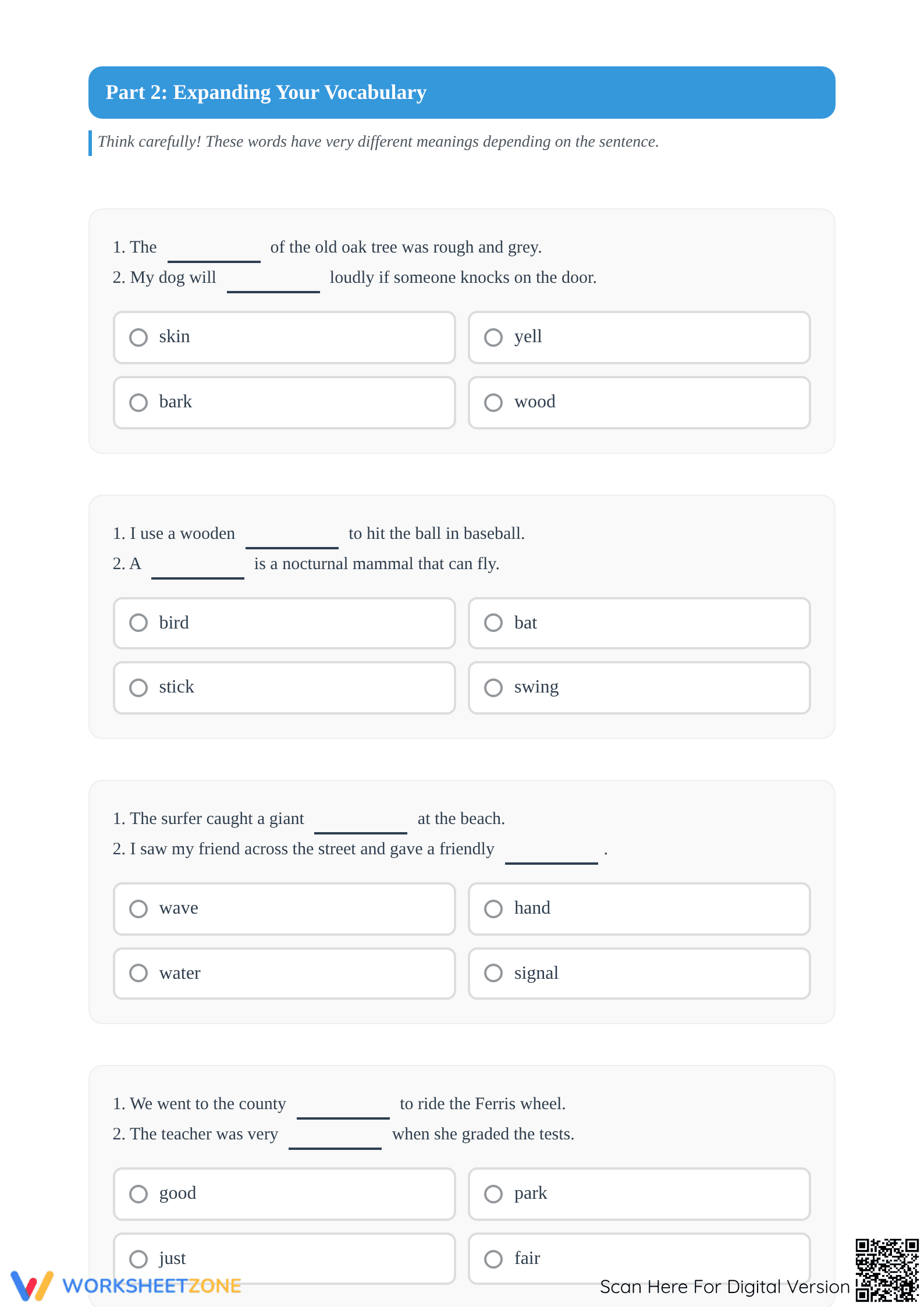
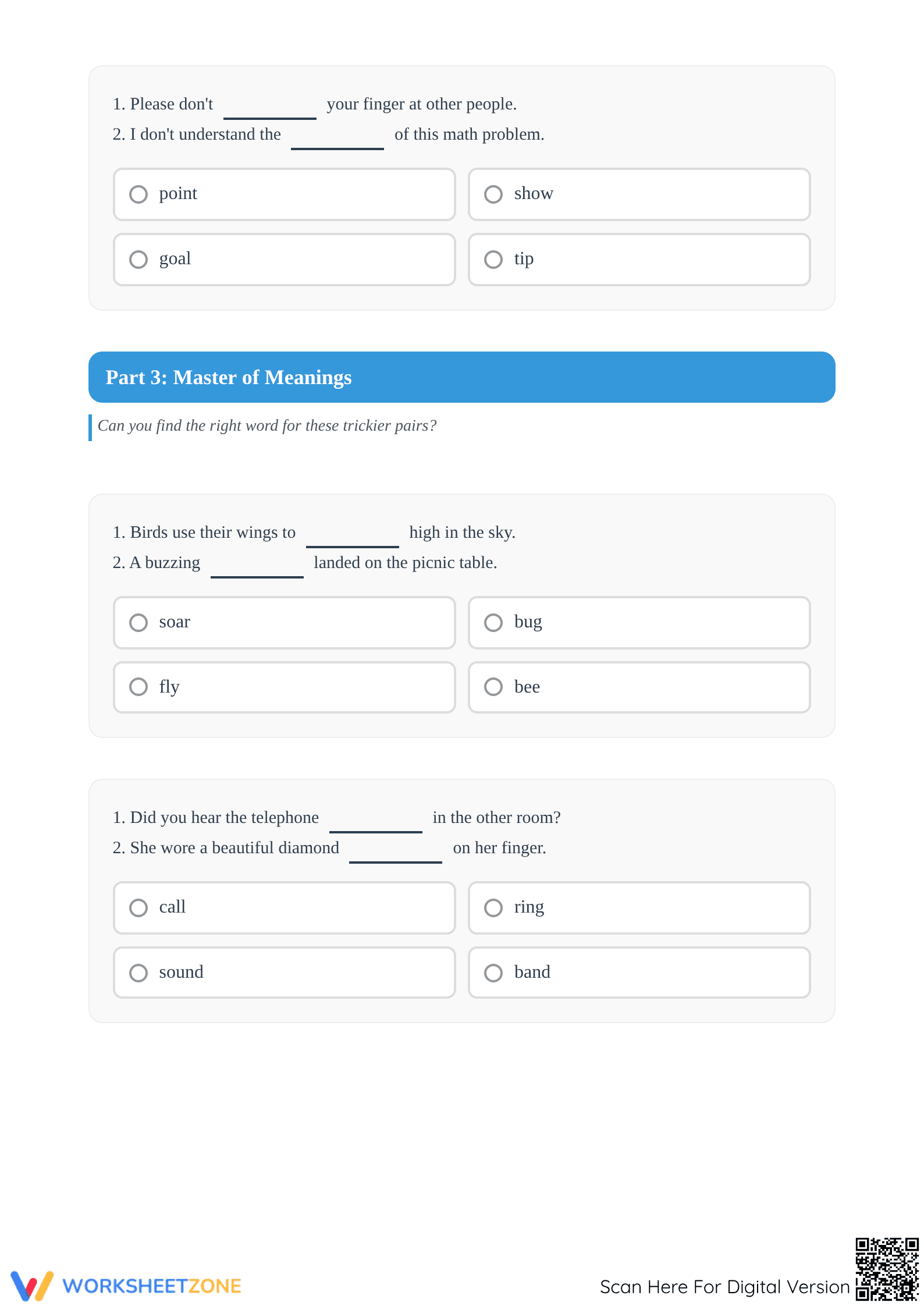
The PDF includes 15 distinct context-based problems spread across five high-quality pages. Each task presents two unique sentences with a shared blank space, requiring students to select the one word from a multiple-choice list that fits both contexts correctly. A full answer key is included to facilitate immediate feedback and student self-correction.
Skill Progression
- Guided Practice: The initial pages feature 5 tasks using common concrete nouns like "space" and "train" to build foundational confidence in identifying dual meanings.
- Supported Practice: The middle section introduces 7 intermediate problems where verbs and nouns intersect, such as "bark" and "wave," requiring closer reading of sentence syntax.
- Independent Practice: The final pages present 3 sophisticated pairings like "fair" and "kind," challenging students to distinguish between subtle abstract meanings.
Standards Alignment
This resource is specifically aligned to CCSS.ELA-LITERACY.L.4.4, which states that students should "Determine or clarify the meaning of unknown and multiple-meaning words and phrases." It also supports CCSS.ELA-LITERACY.L.4.4.A by requiring the use of context clues as clues to the meaning of a word. Both standard codes can be copied directly into lesson plans, IEP goals, or district curriculum mapping tools.
How to Use It
Use this worksheet as a targeted vocabulary intervention after direct instruction on homonyms. For a formative assessment, observe students during the second page; if they struggle with the "chest" or "game" tasks, they likely need more work on parts of speech. The 15 problems typically take 30 minutes to complete during independent station rotations.
Who It's For
This activity is ideal for 4th-grade students mastering grade-level ELA standards, but it also serves as an excellent scaffold for English Language Learners (ELL) who often find multiple-meaning words particularly confusing. It pairs naturally with a lesson on dictionary skills or a short story passage containing high-frequency homonyms.
The CCSS.ELA-LITERACY.L.4.4 standard requires students to determine the meaning of unknown and multiple-meaning words using context clues. This Printable worksheet targets that exact skill through 15 structured exercises. Multiple-meaning words, or homonyms, pose a significant linguistic challenge for Grade 4 learners as they encounter more specialized academic vocabulary. Fisher & Frey (2014) argue that vocabulary instruction is most impactful when students engage with words in varied contexts rather than rote memorization of definitions. By presenting two distinct sentences for every word, this resource forces students to evaluate how syntax and semantics shift based on surrounding text. This process builds the cognitive flexibility required for fluent reading and precise writing. Using 15 targeted problems, learners develop a robust strategy for resolving ambiguity in informational and literary texts. This systematic approach ensures that students can confidently navigate the nuances of the English language while meeting rigorous grade-level expectations for vocabulary builder mastery.


