


























Views
Downloads


Printable Multiple Meaning Words Practice | Grades 1-4
Paste this activity's link or code into your existing LMS (Google Classroom, Canvas, Teams, Schoology, Moodle, etc.).
Students can open and work on the activity right away, with no student login required.
You'll still be able to track student progress and results from your teacher account.
Mastering words with multiple meanings is a critical milestone for developing readers in elementary school. This Grades 1-4 vocabulary worksheet helps students distinguish between definitions of common homonyms using context clues. By matching numbered definitions to usage examples, learners build the linguistic flexibility required for reading comprehension and writing.
At a Glance
- Grade: 1-4 · Subject: English Language Arts
- Standard:
CCSS.ELA-LITERACY.L.2.4.A— Use sentence-level context as a clue to the meaning of a word- Skill Focus: Multiple Meaning Words (Homonyms)
- Format: 3 pages · 12 problems · Answer key included · PDF
- Best For: Vocabulary centers and independent practice
- Time: 15–25 minutes
What's Inside
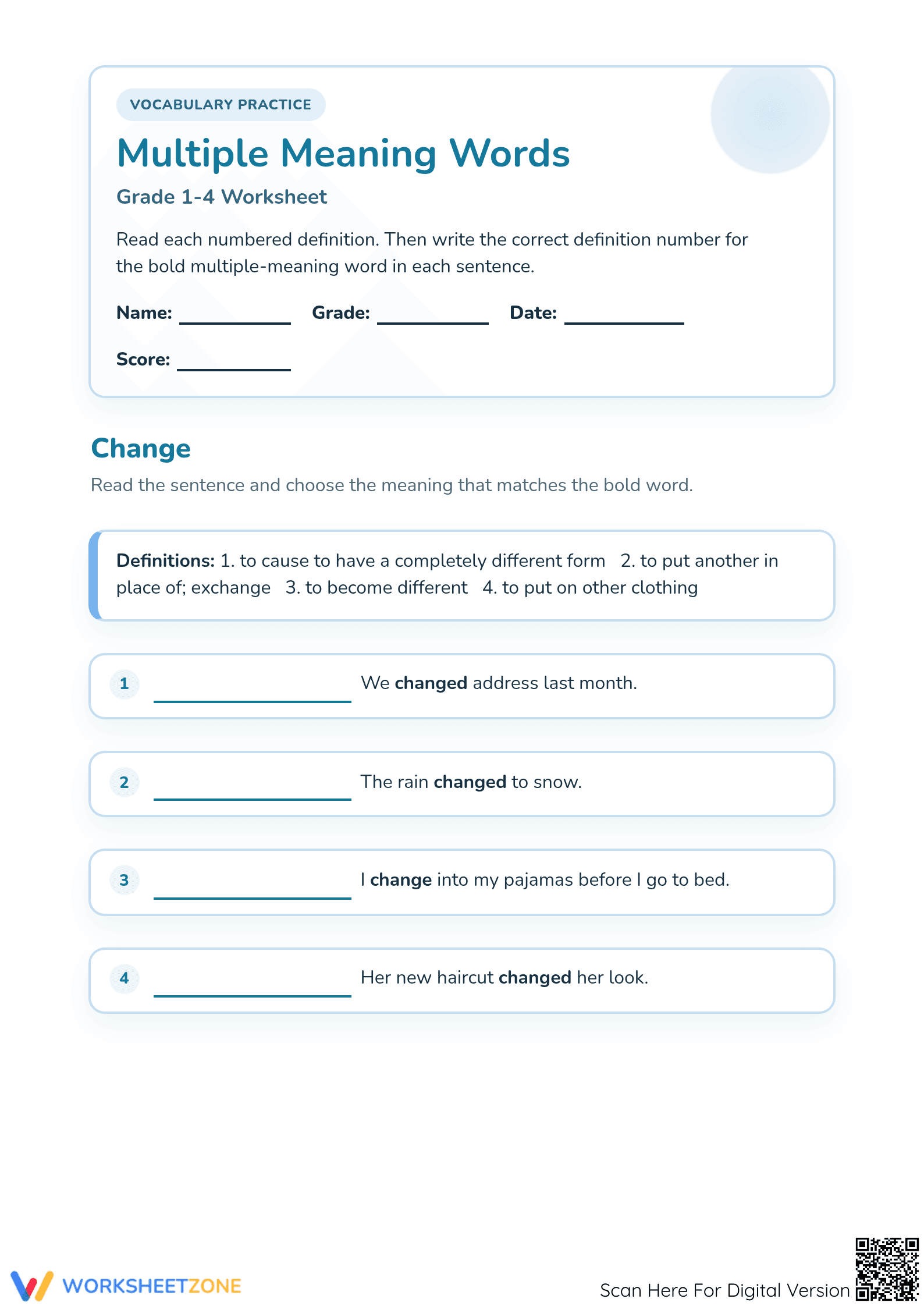
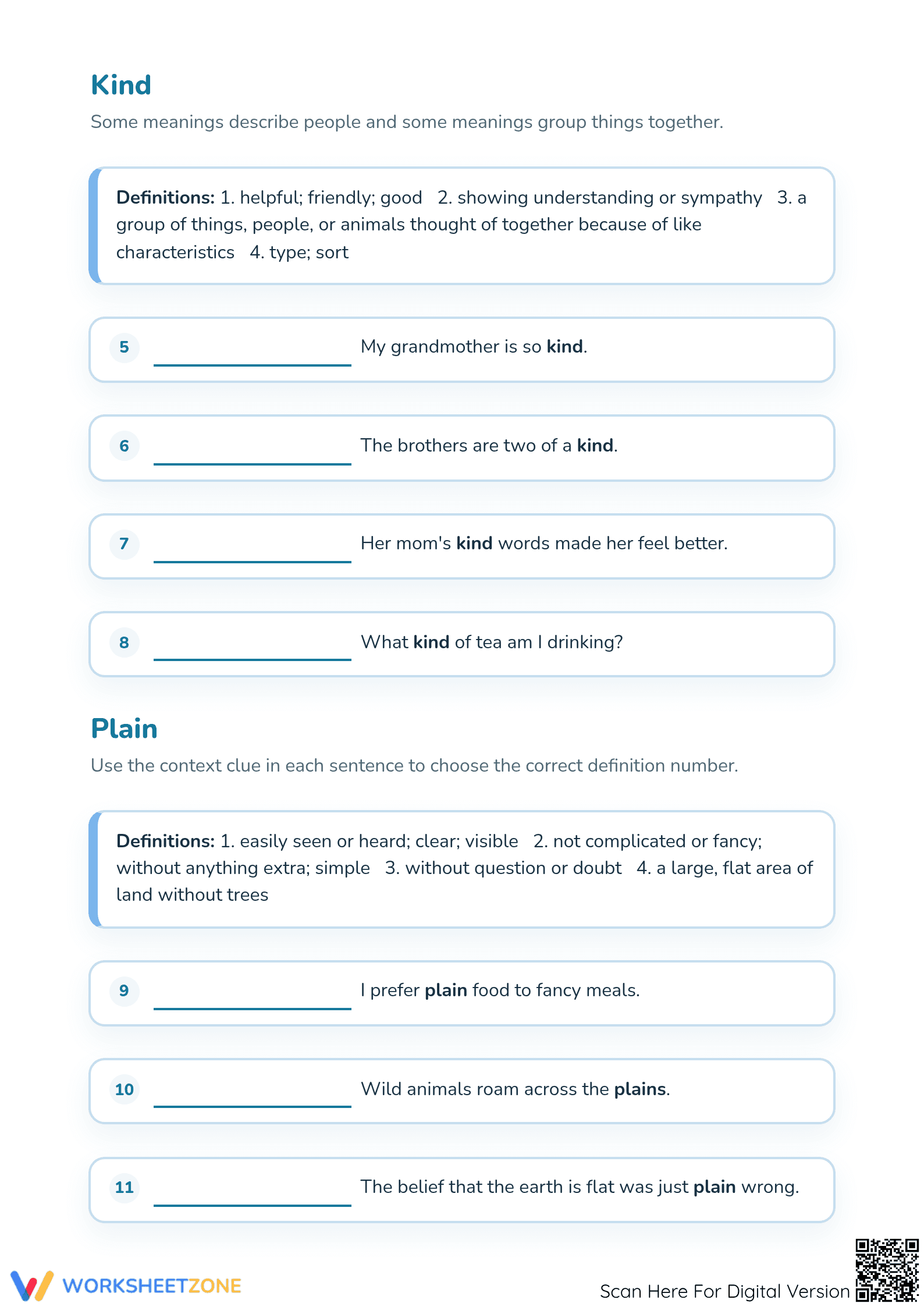
This three-page PDF resource features twelve structured practice items centered on high-frequency multiple-meaning words: "change," "kind," and "plain." Each section provides a clear bank of four numbered definitions followed by a series of sentences where the word is used in a different sense. The layout includes dedicated spaces for names and dates, along with a full answer key to facilitate rapid grading and immediate student feedback.
Skill Progression
- Guided practice: The first section focuses on "change," allowing students to familiarize themselves with the matching format using common daily scenarios.
- Supported practice: Items five through eight transition to "kind," requiring students to differentiate between descriptions of people and categories of objects.
- Independent practice: The final tasks tackle "plain," challenging students to identify meanings ranging from geography to visual clarity without additional support.
This gradual release model ensures students develop the confidence to decode complex vocabulary across various literary and informational text types.
Standards Alignment
The primary alignment for this resource is CCSS.ELA-LITERACY.L.2.4.A, which requires students to use sentence-level context as a clue to the meaning of a word or phrase. It also supports higher-grade skills like CCSS.ELA-LITERACY.L.4.4.A by focusing on the precise selection of meaning from multiple valid options. Both standard codes can be copied directly into lesson plans, IEP goals, or district curriculum mapping tools.
How to Use It
Introduce this worksheet during the independent practice phase of a vocabulary lesson after modeling how to substitute different definitions into a sentence. Use it as a formative assessment by observing students as they work; if they struggle to differentiate between parts of speech, provide a brief anchor chart on nouns versus adjectives. Completion typically takes twenty minutes.
Who It's For
Designed for Grade 1 through Grade 4 students, this is an ideal tool for mixed-ability classrooms or reading intervention groups. It is especially helpful for English Language Learners (ELLs) who are navigating the polysemous nature of English vocabulary. Pair this resource with a dictionary exploration activity to deepen the connection between isolated practice and real-world application.
Developing a robust vocabulary is not merely about memorizing definitions but about understanding how word meanings shift based on semantic environments. Research by Fisher & Frey (2014) emphasizes the importance of "word-solving," where students use context clues to resolve ambiguity in complex texts. This worksheet targets CCSS.ELA-LITERACY.L.2.4.A by providing twelve deliberate practice opportunities for students to analyze multiple meaning words in action. By requiring students to map specific definitions to sentence-level usage, the resource bridges the gap between basic recognition and cognitive mastery of homonyms. This approach aligns with NAEP recommendations for integrated vocabulary instruction, ensuring that Grade 1-4 learners build the necessary schema to navigate academic language. Providing structured practice with high-frequency words reduces the cognitive load during independent reading, allowing students to focus on deeper comprehension.


