




























Views
Downloads
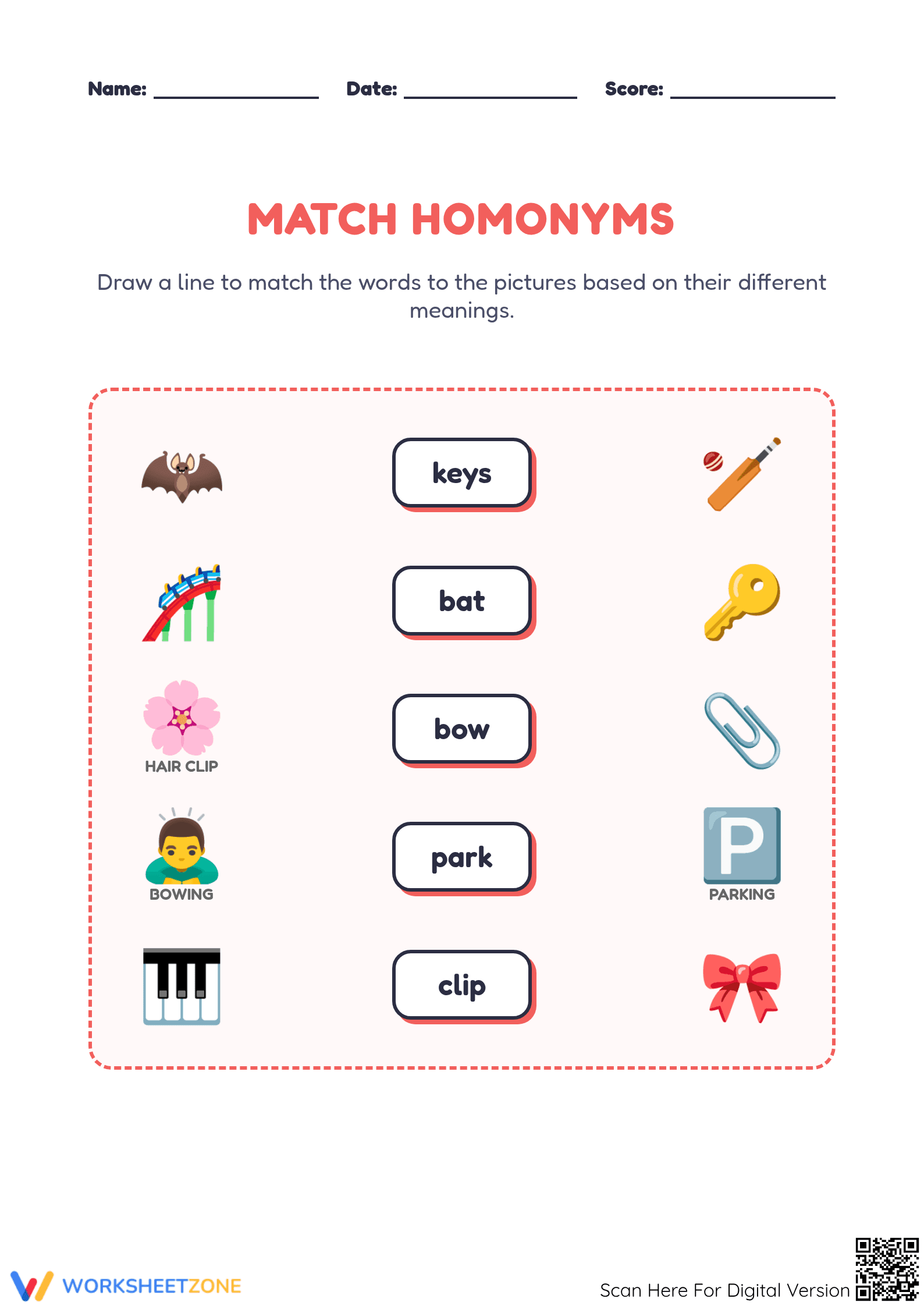

Match the Homonyms Worksheet | Grade 4 Essential

Paste this activity's link or code into your existing LMS (Google Classroom, Canvas, Teams, Schoology, Moodle, etc.).
Students can open and work on the activity right away, with no student login required.
You'll still be able to track student progress and results from your teacher account.
This Grade 4 homonyms worksheet helps students master multiple-meaning words through visual association. By matching a single word to two distinct pictorial representations, learners develop a deeper understanding of how context dictates meaning. This activity strengthens vocabulary acquisition and linguistic flexibility, ensuring students can distinguish between various definitions of common English terms.
At a Glance
- Grade: 4 · Subject: ELA
- Standard:
CCSS.ELA-LITERACY.L.4.4— Determine or clarify the meaning of unknown and multiple-meaning words- Skill Focus: Homonyms and Visual Context
- Format: 1 page · 10 tasks · Answer key included · PDF
- Best For: Independent practice or quick vocabulary review
- Time: 10–15 minutes
Inside this resource, you will find a single-page layout featuring five central homonyms: keys, bat, bow, park, and clip. Surrounding these words are ten vibrant illustrations, with two images corresponding to each word's different meanings. The clear, minimalist design includes a header for student names, dates, and scores, making it easy to track individual progress throughout the school year.
The zero-prep workflow is designed for maximum efficiency. First, print the single-page PDF in less than 30 seconds. Second, distribute the sheets to your class; the intuitive "draw a line" instructions require no additional teacher explanation. Finally, review the completed matches in under two minutes using the included answer key. This makes it an ideal choice for emergency sub plans or transition periods.
This worksheet is aligned with CCSS.ELA-LITERACY.L.4.4, which requires students to determine or clarify the meaning of unknown and multiple-meaning words and phrases. It specifically addresses the ability to use context clues—in this case, visual clues—to identify the correct application of a word. Both standard codes can be copied directly into lesson plans, IEP goals, or district curriculum mapping tools.
Use this worksheet as a formative assessment after a direct instruction lesson on homonyms to check for immediate understanding. Alternatively, assign it as a "bell-ringer" activity to settle the class at the start of an ELA block. Teachers should observe if students struggle with specific pairs, such as "bow" (the ribbon) versus "bow" (the action), to identify needs for further scaffolding. Completion typically takes 10 to 15 minutes.
This resource is perfect for general education students in grades 3 through 6, as well as English Language Learners (ELL) who benefit from the visual support provided by the illustrations. It pairs naturally with a classroom anchor chart on multiple-meaning words or a short reading passage where these specific homonyms appear in a narrative context to reinforce the skill.
According to the RAND AIRS 2024 report on literacy instruction, visual-to-verbal matching is a high-impact strategy for vocabulary retention in elementary learners. This worksheet targets CCSS.ELA-LITERACY.L.4.4 by requiring students to resolve ambiguity in multiple-meaning words like "bat" or "clip." By providing two distinct visual contexts for a single lexical entry, the activity forces the brain to categorize and store semantic variations separately, a process essential for reading fluency. Research from Fisher & Frey (2014) suggests that such "word-solving" tasks are most effective when they move from concrete visual representations to abstract textual application. This 10-task activity provides that concrete foundation, ensuring students can accurately identify homonyms before encountering them in complex informational texts. The structured layout supports cognitive load management, allowing students to focus entirely on the linguistic relationship between the word and its varied meanings.


