


























0
Views
0
Downloads

0.0
0
Save
0 Likes
Share
The Prefix 'Un' Worksheet
0 Views
0 Downloads
Paste this activity's link or code into your existing LMS (Google Classroom, Canvas, Teams, Schoology, Moodle, etc.).
Students can open and work on the activity right away, with no student login required.
You'll still be able to track student progress and results from your teacher account.
Information
Description
What It Is:
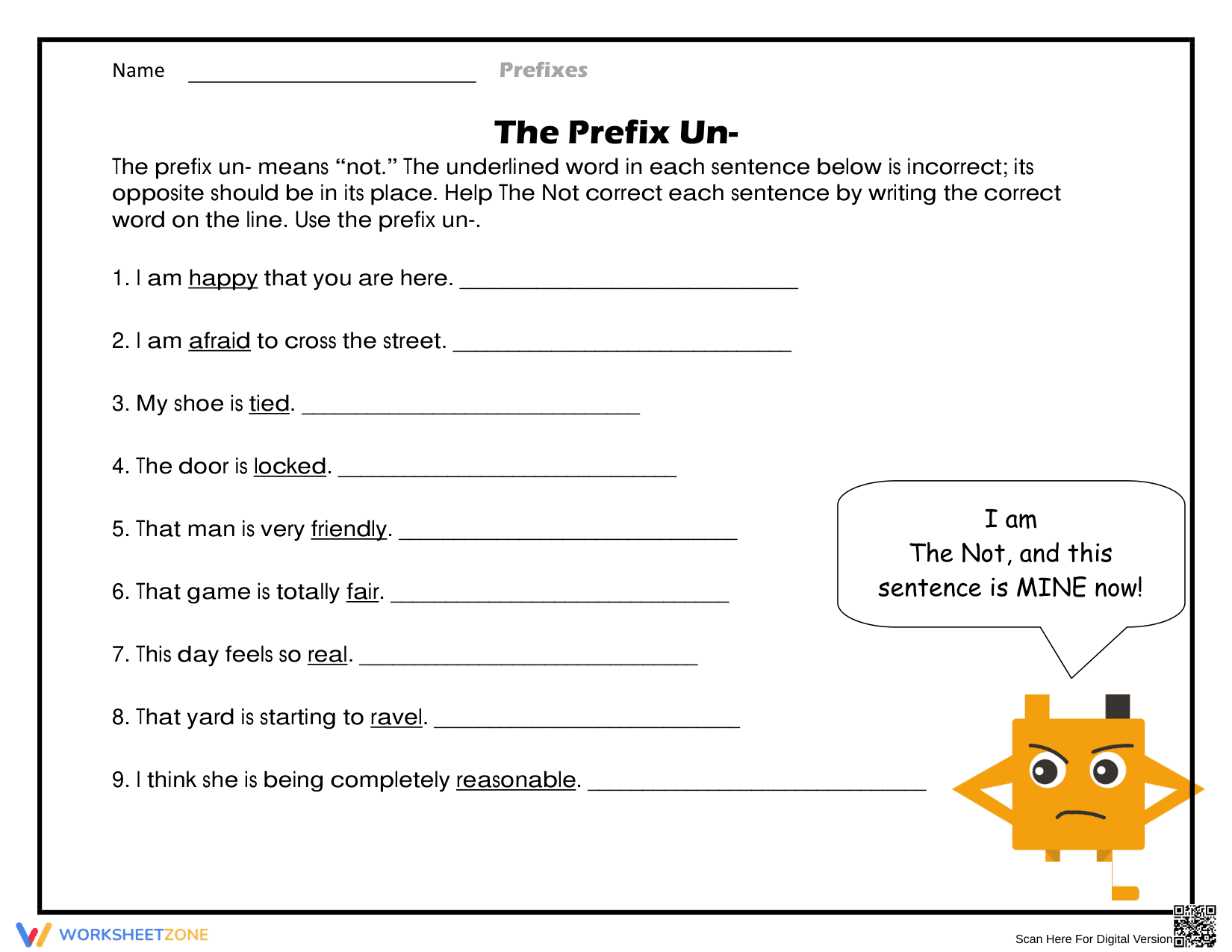
A worksheet focusing on the prefix 'un-'. It presents sentences with an underlined word that needs to be replaced with its opposite, using the prefix 'un-'. Students are instructed to rewrite the correct word on the provided line. The worksheet includes nine sentences for practice, with an example sentence 'I am happy that you are here' and includes a cartoon character called 'The Not' to engage students.
Grade Level Suitability:
Suitable for grades 2-4. The concept of prefixes and opposites is typically introduced in these grades. The worksheet's simple sentence structure and clear instructions make it accessible for this age group.
Why Use It:
This worksheet helps students understand and apply the prefix 'un-' to create opposites. It reinforces vocabulary skills, improves reading comprehension, and builds an understanding of how prefixes change the meaning of words. The engaging character can make learning prefixes more fun.
How to Use It:
Students should read each sentence carefully, identify the underlined word, and determine its opposite. They then add the prefix 'un-' to the opposite word and write the new word on the line provided. Ensure students understand the meaning of 'un-' before starting the activity.
Target Users:
Elementary school students learning about prefixes, particularly those in grades 2-4. It's also useful for students who need extra practice with vocabulary and word building. Can be used for classroom activities, homework, or supplemental learning.
A worksheet focusing on the prefix 'un-'. It presents sentences with an underlined word that needs to be replaced with its opposite, using the prefix 'un-'. Students are instructed to rewrite the correct word on the provided line. The worksheet includes nine sentences for practice, with an example sentence 'I am happy that you are here' and includes a cartoon character called 'The Not' to engage students.
Grade Level Suitability:
Suitable for grades 2-4. The concept of prefixes and opposites is typically introduced in these grades. The worksheet's simple sentence structure and clear instructions make it accessible for this age group.
Why Use It:
This worksheet helps students understand and apply the prefix 'un-' to create opposites. It reinforces vocabulary skills, improves reading comprehension, and builds an understanding of how prefixes change the meaning of words. The engaging character can make learning prefixes more fun.
How to Use It:
Students should read each sentence carefully, identify the underlined word, and determine its opposite. They then add the prefix 'un-' to the opposite word and write the new word on the line provided. Ensure students understand the meaning of 'un-' before starting the activity.
Target Users:
Elementary school students learning about prefixes, particularly those in grades 2-4. It's also useful for students who need extra practice with vocabulary and word building. Can be used for classroom activities, homework, or supplemental learning.


