


























Views
Downloads
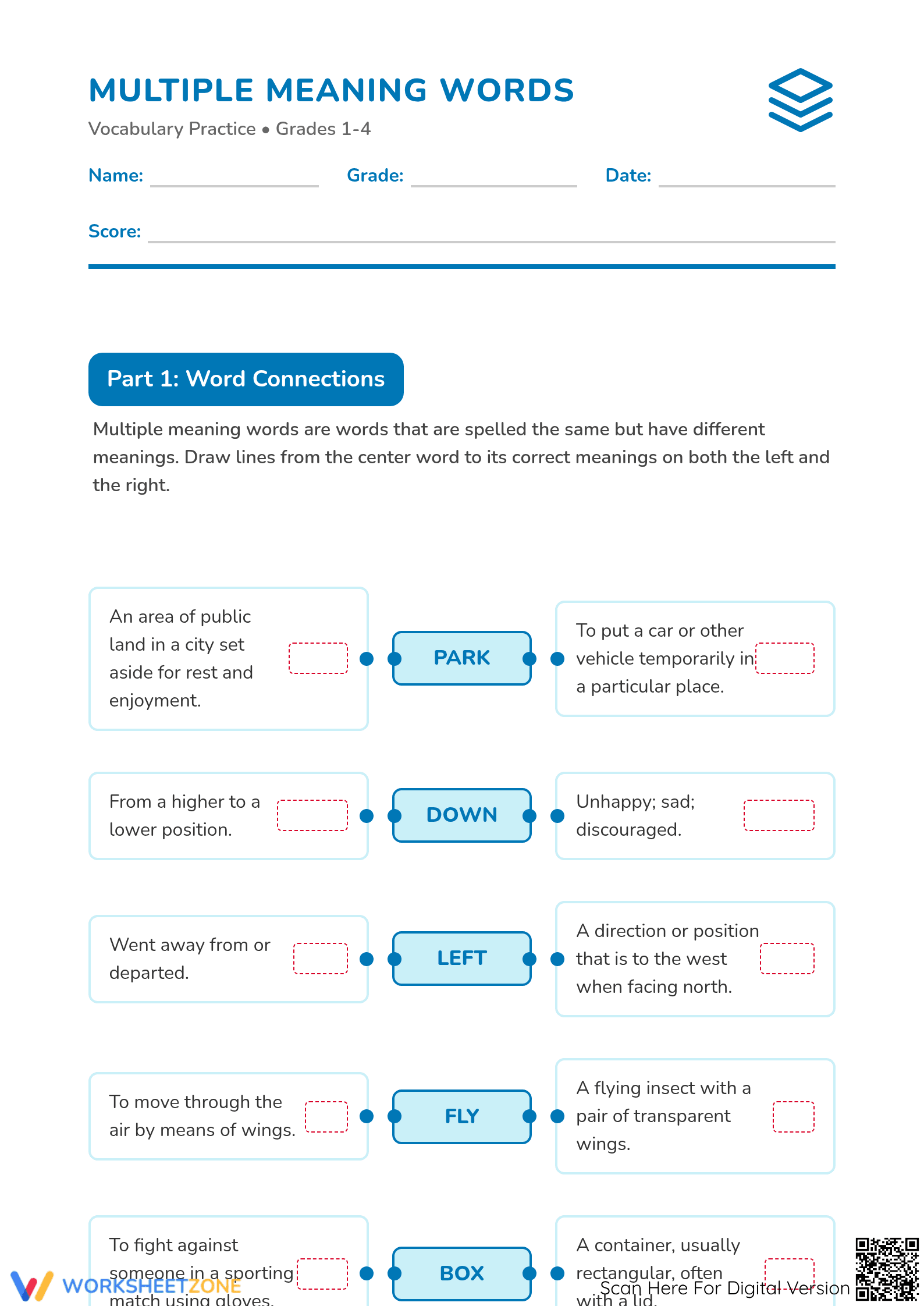

Multiple Meaning Words Worksheet | Printable Grade 1-4 ELA
Paste this activity's link or code into your existing LMS (Google Classroom, Canvas, Teams, Schoology, Moodle, etc.).
Students can open and work on the activity right away, with no student login required.
You'll still be able to track student progress and results from your teacher account.
This multiple meaning words worksheet helps students in grades 1 through 4 distinguish between different definitions for the same word. By connecting common homonyms to their distinct meanings, learners develop the essential vocabulary skills needed for reading comprehension and linguistic precision. It is an effective tool for building semantic awareness across early elementary levels.
At a Glance
- Grade: 1-4 · Subject: English Language Arts
- Standard:
CCSS.ELA-LITERACY.L.2.4— Determine or clarify the meaning of multiple-meaning words and phrases- Skill Focus: Homonyms and Semantic Connections
- Format: 1 page · 10 tasks · Answer key included · PDF
- Best For: Independent vocabulary practice and literacy centers
- Time: 10–15 minutes
What's Inside
This one-page PDF resource features a "Word Connections" activity centered on five high-frequency words: Park, Down, Left, Fly, and Box. For each word, students are presented with two distinct definitions—one on the left and one on the right. The clear, uncluttered layout facilitates easy matching, while the included answer key ensures immediate feedback for students and quick grading for educators.
Skill Progression
- Guided Practice: The worksheet begins by introducing the concept of homonyms with a clear instructional header that defines the skill.
- Supported Practice: Students engage with visual matching, using 10 specific definition boxes to anchor the 5 central vocabulary terms.
- Independent Practice: Learners must independently evaluate which definition matches the context provided in each text box.
This sequence follows a gradual-release model, moving from conceptual understanding to the active application of word knowledge.
Standards Alignment
The primary focus is CCSS.ELA-LITERACY.L.2.4, which requires students to determine or clarify the meaning of unknown and multiple-meaning words. It also supports CCSS.ELA-LITERACY.L.3.4 by encouraging the use of context to distinguish between word senses. Both standard codes can be copied directly into lesson plans, IEP goals, or district curriculum mapping tools.
How to Use It
Use this worksheet during a direct instruction lesson on homonyms as a guided practice activity to ensure students can see the divergence in meaning. It also serves as a robust formative-assessment tool; teachers should observe if students struggle with the more abstract definitions versus literal ones. Expected completion time for this task is between 10 to 15 minutes.
Who It's For
Designed for primary elementary students in grades 1-4, this resource is particularly useful for English Language Learners (ELL) who are navigating the complexities of English vocabulary. It pairs naturally with a homonym anchor chart or a reading passage that features the target words in a narrative context for deeper reinforcement.
According to the RAND AIRS 2024 report on vocabulary acquisition, explicit instruction in multiple-meaning words is a critical component of closing the literacy gap in early elementary education. This worksheet targets CCSS.ELA-LITERACY.L.2.4 by providing structured matching tasks for 5 high-frequency homonyms, totaling 10 semantic connections. Research from Fisher & Frey (2014) suggests that visual mapping of word meanings, as seen in this matching format, significantly improves long-term retention of "Tier 2" vocabulary. By requiring students to differentiate between literal and figurative senses of words like "down" or "left," the activity builds the cognitive flexibility necessary for advanced reading comprehension. This resource provides a time-efficient, evidence-based method for teachers to assess and reinforce word-level mastery in a classroom setting, ensuring students are prepared for the increasing linguistic demands of higher grade levels.


