


























Views
Downloads

Printable Multiple Meaning Words Worksheet | Grades 1-4
Paste this activity's link or code into your existing LMS (Google Classroom, Canvas, Teams, Schoology, Moodle, etc.).
Students can open and work on the activity right away, with no student login required.
You'll still be able to track student progress and results from your teacher account.
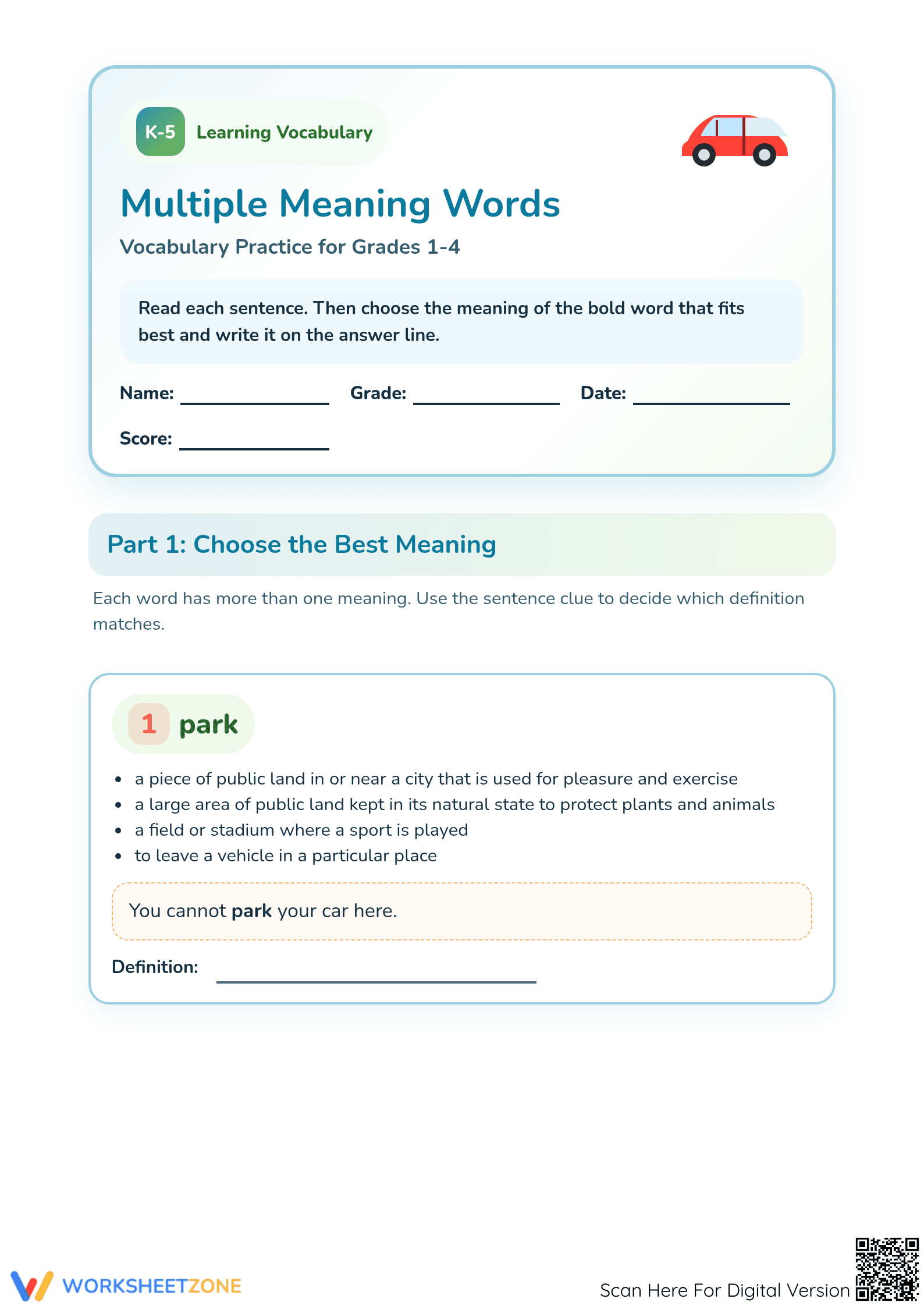
Mastering multiple meaning words is vital for reading comprehension and vocabulary agility. This 3-page worksheet provides students in grades 1-4 with targeted practice identifying how the same word represents different concepts based on context. By engaging with these tasks, learners build essential linguistic flexibility and confidence in their reading abilities.
At a Glance
- Grade: 1-4 · Subject: ELA / Vocabulary
- Standard:
CCSS.ELA-LITERACY.L.2.4— Use context clues to determine the meaning of unknown or multiple-meaning words.- Skill Focus: Homonyms and Context Clues
- Format: 3 pages · 6 problems · Answer key included · PDF
- Best For: Independent practice or literacy centers
- Time: 15–20 minutes
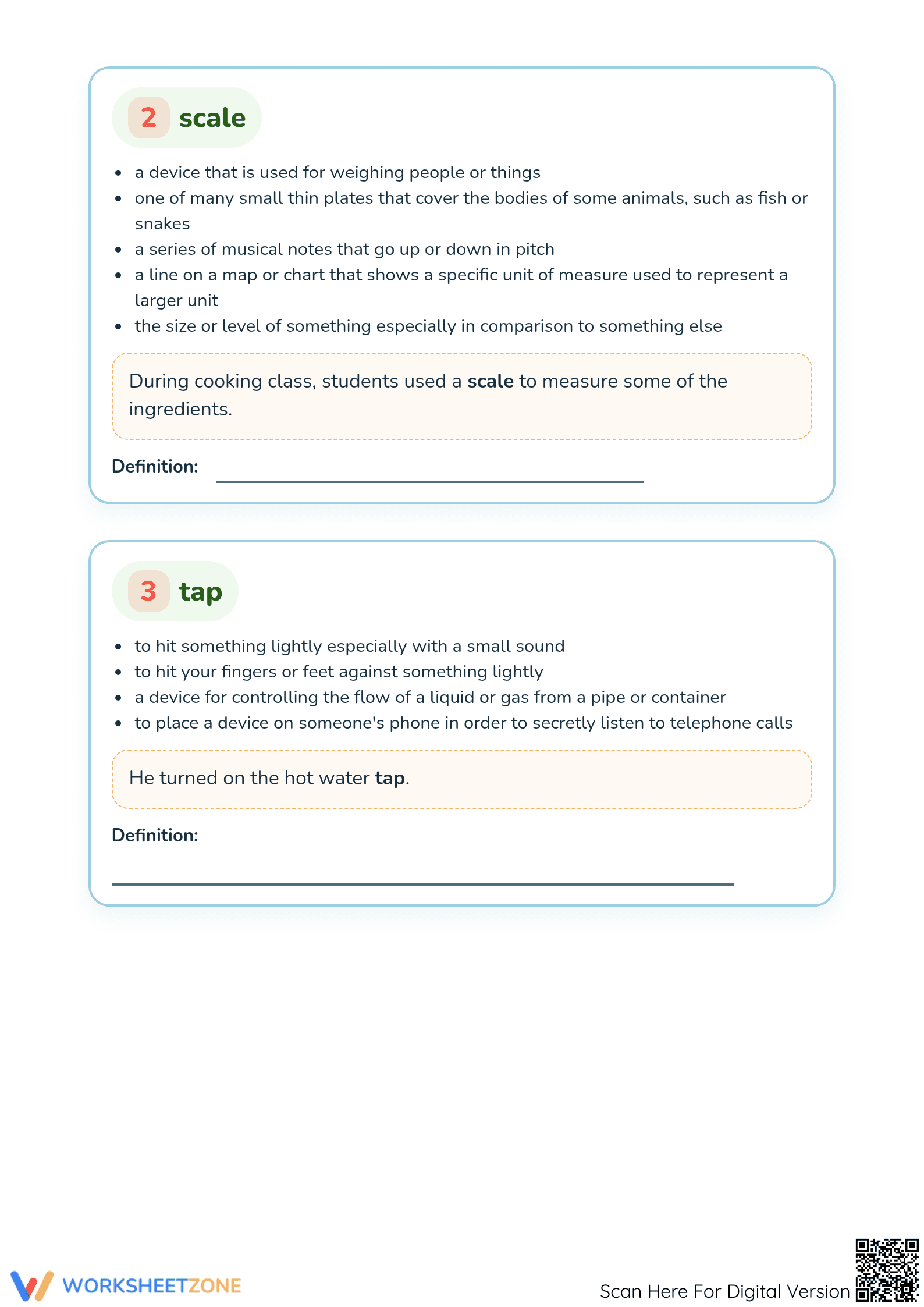
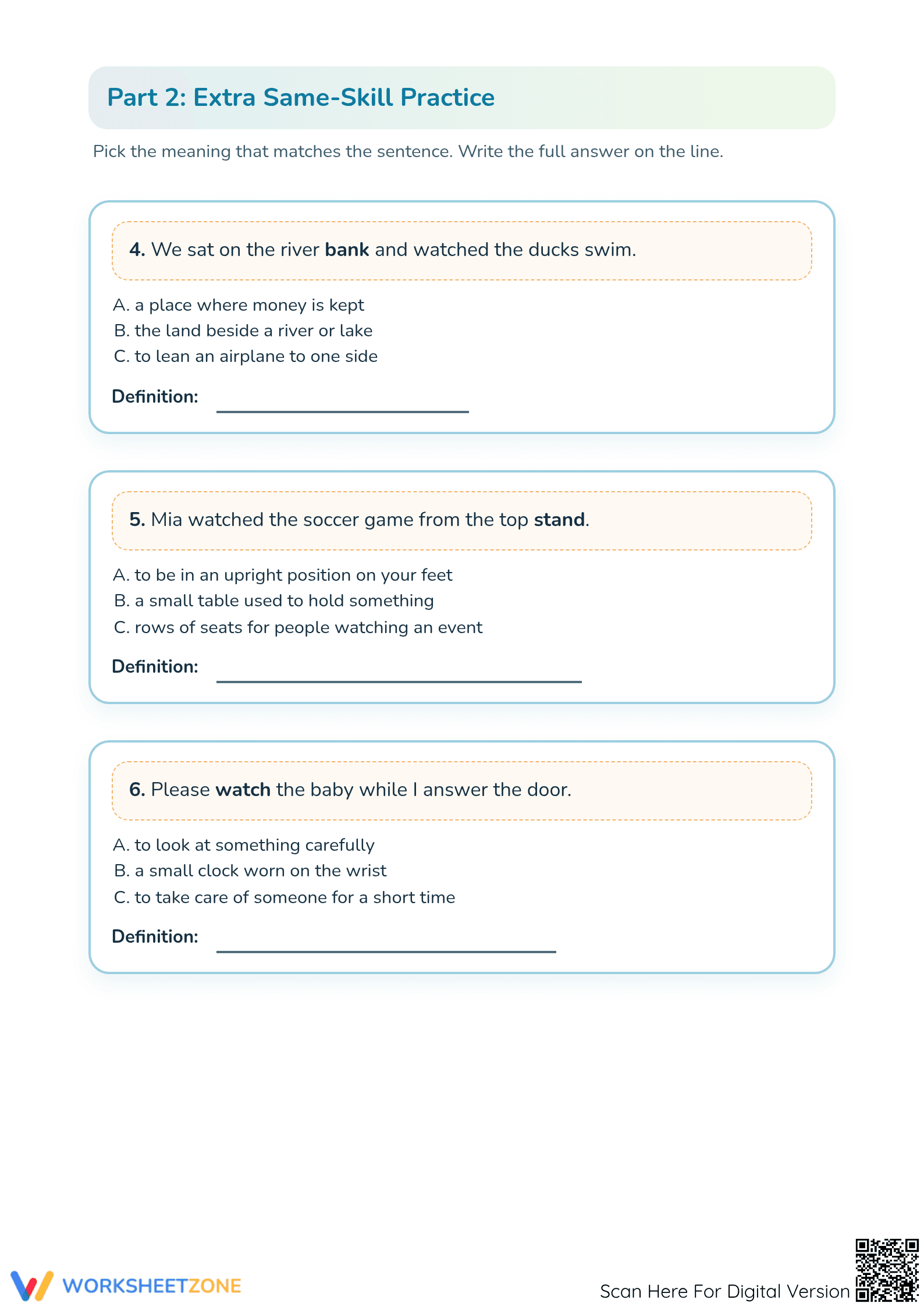
This resource contains three pages focusing on common homonyms like "park," "scale," and "watch." The first two pages present words with four definitions and a sample sentence, requiring students to match the correct definition. The third page offers multiple-choice practice to reinforce retention. The layout is clean, featuring clear bolding and ample writing space.
Zero-Prep Workflow
- Print: Generate the 3-page PDF in seconds for your entire class.
- Distribute: Hand out during your vocabulary block or as a morning warm-up.
- Review: Check answers together to provide immediate feedback on context clue usage.
Its self-explanatory nature makes it ideal for sub plans or fast-finisher activities.
The primary focus is CCSS.ELA-LITERACY.L.2.4, requiring students to clarify the meaning of multiple-meaning words. It specifically addresses using sentence-level context as a clue. This standard is foundational for the transition from decoding to active meaning-making. This standard code can be copied directly into lesson plans, IEP goals, or curriculum mapping tools.
Use this as a formative assessment after a homonym lesson. Circulate to observe if students read the entire sentence or guess based on the first definition; this provides insight into their context clue usage. It also works well as homework to reinforce weekly lessons, with an expected completion time of 20 minutes.
This is designed for grades 1-4, especially students who need to expand semantic understanding. It serves as an excellent scaffolded resource for English Language Learners (ELLs) navigating English vocabulary. It pairs naturally with a classroom anchor chart displaying homonym pairs or a reading passage featuring the target words.
The ability to navigate homonyms is a critical indicator of lexical depth, a component of vocabulary knowledge that significantly predicts overall reading success. According to the RAND AIRS 2024 report, explicit instruction in context clue strategies is essential for students in the primary grades as they encounter increasingly complex informational texts. This worksheet directly supports CCSS.ELA-LITERACY.L.2.4 by providing structured practice that forces students to move beyond surface-level word recognition. Research by Fisher & Frey (2014) emphasizes that "word-solving" skills are most effectively developed through repeated exposure in varied contexts. By isolating six common multiple-meaning words across six unique tasks, this resource ensures that students internalize the relationship between syntax and semantics. This printable practice tool bridges the gap between basic decoding and the higher-order reasoning required for academic literacy, making it a valuable asset for evidence-based ELA instruction.


