


























Views
Downloads

Printable Multiple Meaning Words Worksheet | Grade 1-4
Paste this activity's link or code into your existing LMS (Google Classroom, Canvas, Teams, Schoology, Moodle, etc.).
Students can open and work on the activity right away, with no student login required.
You'll still be able to track student progress and results from your teacher account.
Strengthen student vocabulary and linguistic flexibility with this comprehensive Grade 1–4 Multiple Meaning Words worksheet. By focusing on homonyms that students encounter daily, this resource ensures that learners can distinguish between various definitions based entirely on sentence-level context clues. Students move beyond simple recognition toward true mastery and application of complex word study skills.
At a Glance
- Grade: 1–4 · Subject: ELA
- Standard:
CCSS.ELA-LITERACY.L.3.4.A— Use sentence-level context as a clue to the meaning of a word- Skill Focus: Homonym identification and usage
- Format: 4 pages · 6 tasks · Answer key included · PDF
- Best For: Vocabulary centers and independent practice
- Time: 20–30 minutes
What's Inside
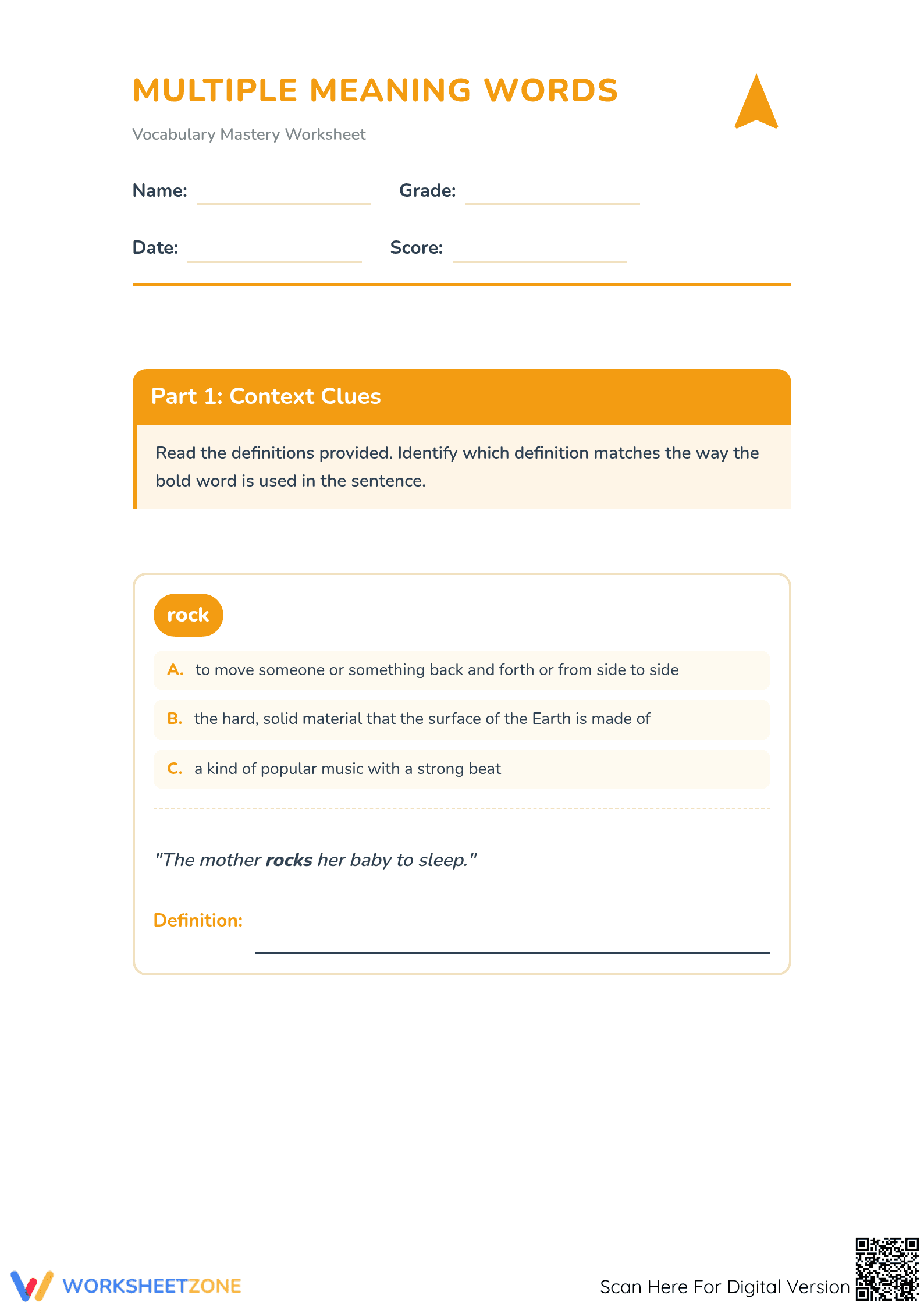
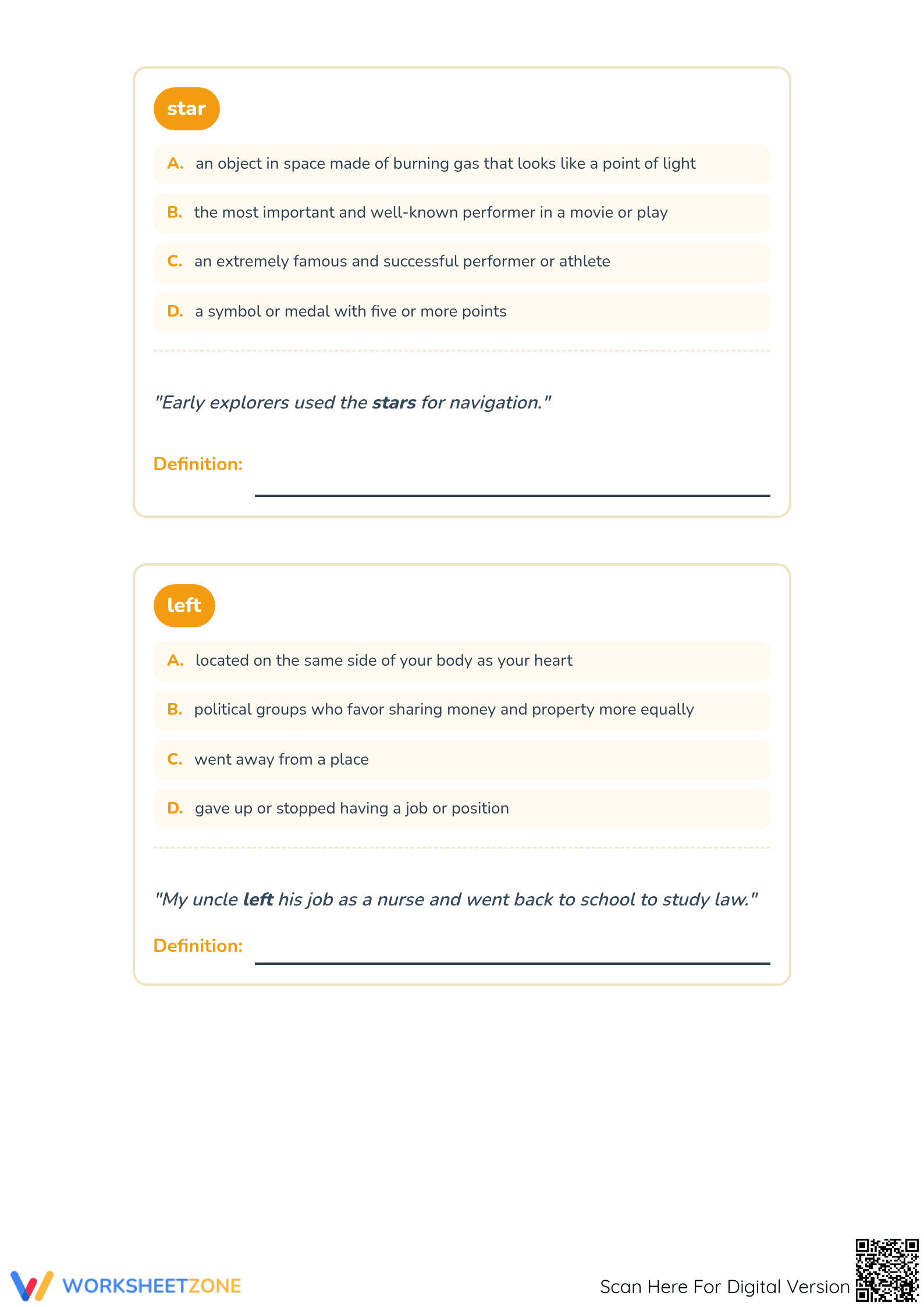
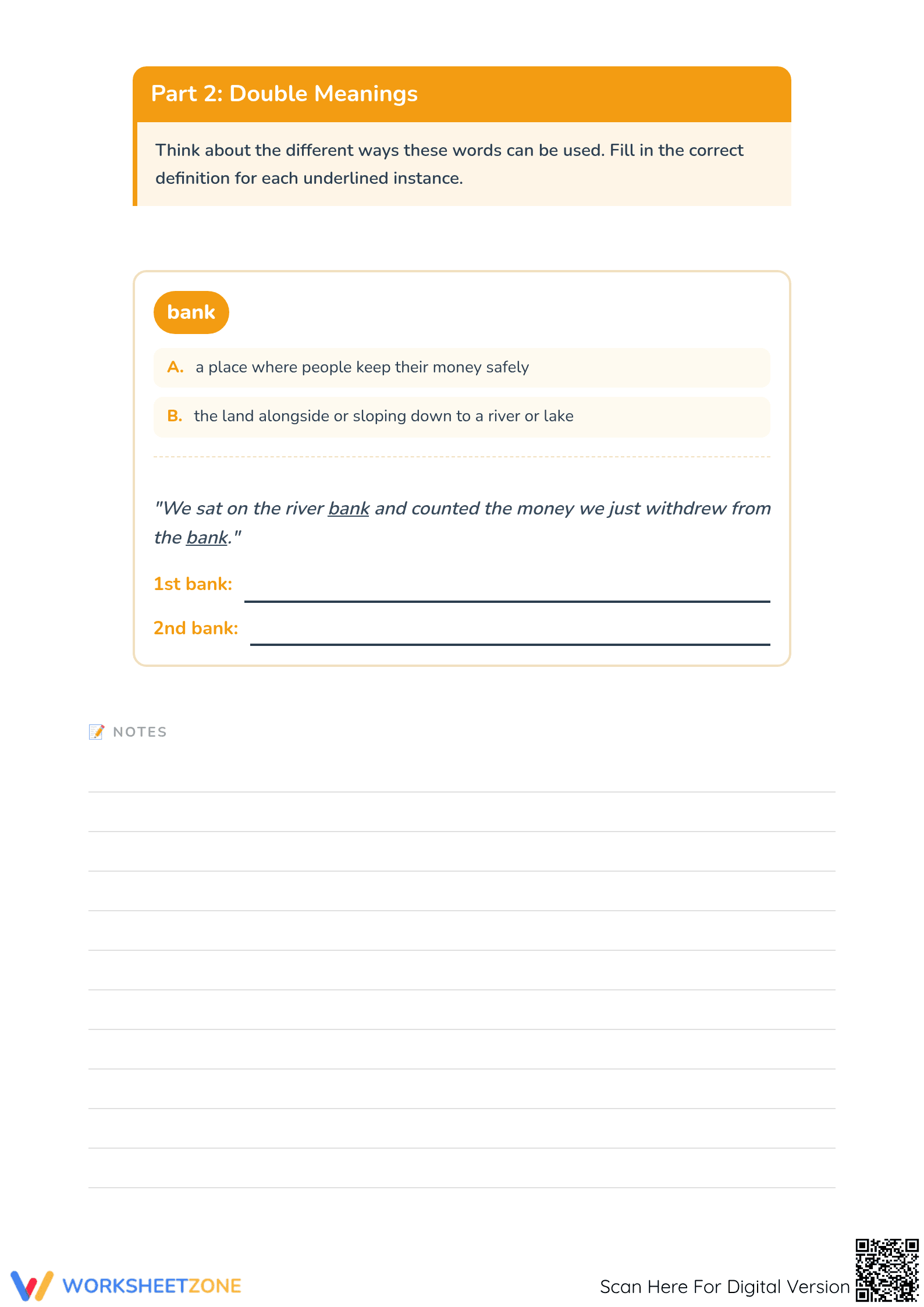
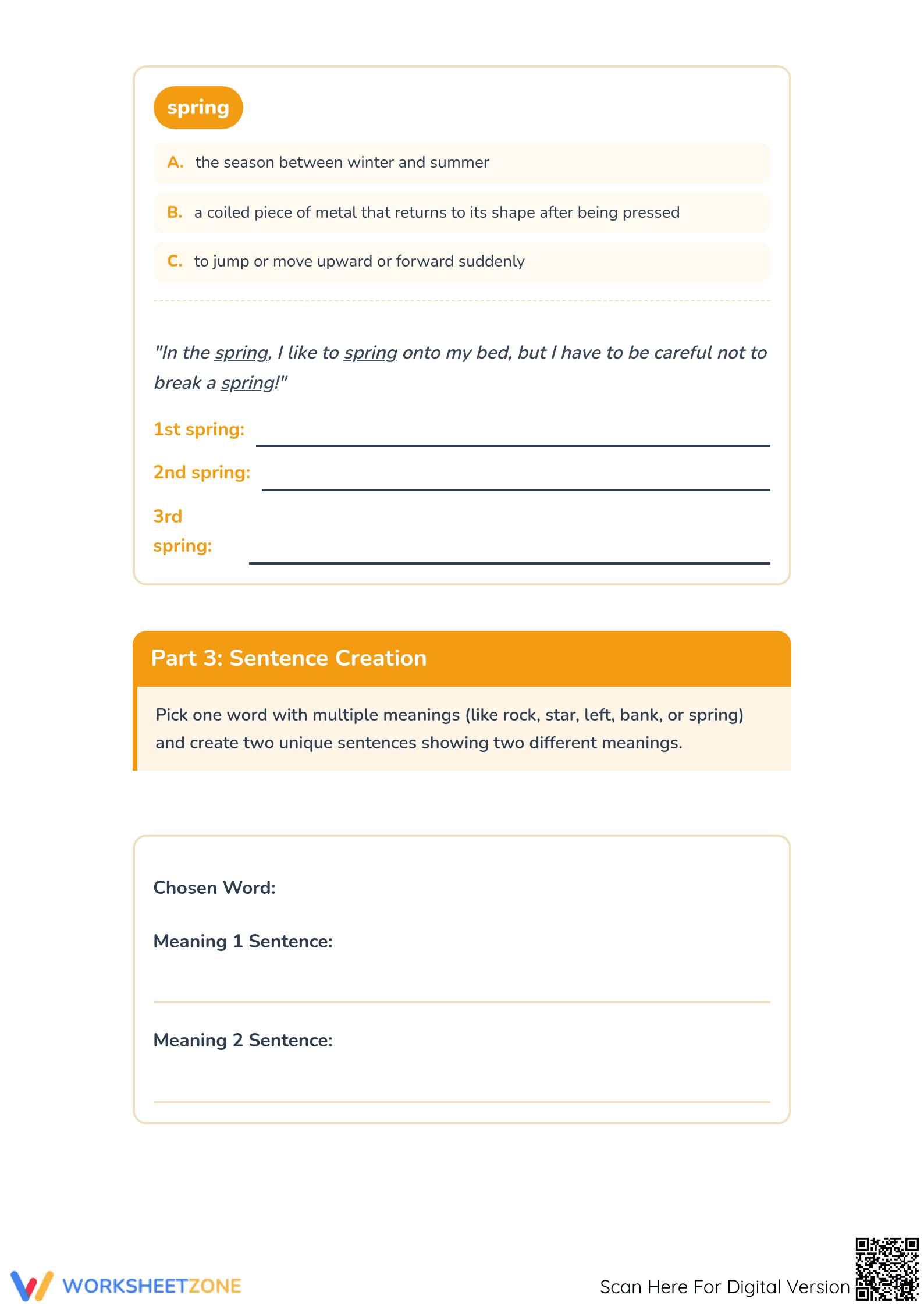
This four-page instructional packet provides a structured exploration of five high-frequency homonyms: rock, star, left, bank, and spring. The worksheet features clear definition menus for each term, followed by targeted application sentences. The layout includes a dedicated notes section for student observations and a final creative section for original sentence construction, all supported by a full answer key for grading efficiency.
Skill Progression
- Guided Practice: Part 1 uses three high-interest words where students match bolded terms in simple sentences to a menu of 3-4 specific definitions, building confidence in basic context clue recognition.
- Supported Practice: Part 2 increases the challenge by providing sentences with two or more instances of the same word (e.g., bank, spring), requiring students to distinguish multiple meanings within a single context.
- Independent Practice: The final section shifts to creative application, tasking students with selecting a word and composing two original sentences that clearly demonstrate two distinct meanings without external prompts.
This sequence follows a gradual-release model, moving from identification to analysis and finally to synthesis.
Standards Alignment
This resource is primarily aligned with `CCSS.ELA-LITERACY.L.3.4.A`: "Use sentence-level context as a clue to the meaning of a word or phrase." It also supports foundational skills in Grade 1 and 2 related to homonym recognition and Grade 4 standards regarding the use of reference materials to clarify meaning. Both standard codes can be copied directly into lesson plans, IEP goals, or district curriculum mapping tools.
How to Use It
Deploy this worksheet during the practice phase of a vocabulary lesson after introducing the concept of homonyms. It serves as an excellent formative assessment tool; observe if students struggle with words having more than three definitions, such as "star" or "left," to identify needs for further scaffolding. Expect a completion time of 25 minutes for most elementary learners.
Who It's For
This packet is designed for Grade 1–4 students, particularly those in 2nd and 3rd grade who are transitioning to more complex reading passages. It is an ideal resource for English Language Learners (ELLs) who may find multiple-meaning words confusing. Pair this worksheet with a dictionary exploration activity or a short reading passage to reinforce lexical variety.
The efficacy of this worksheet is supported by research emphasizing gradual release models in vocabulary acquisition (Fisher & Frey, 2014). By requiring students to navigate context clues (CCSS.ELA-LITERACY.L.3.4.A) through definition matching, sentence analysis, and original composition, this resource builds deep semantic understanding, not just memorization. This direct instruction approach helps students accurately distinguish homonyms like 'bank' and 'spring'. The structured tasks provide scaffolding for Grade 1–4 learners to transition from guided identification to independent application. Utilizing these standards-aligned materials helps educators target lexical gaps, ensuring student outcomes align with national literacy benchmarks. The included answer key facilitates immediate corrective feedback, reinforcing correct semantic associations.


