


























Views
Downloads


Multiple Meaning Words Worksheet | Grade 3 Printable
Paste this activity's link or code into your existing LMS (Google Classroom, Canvas, Teams, Schoology, Moodle, etc.).
Students can open and work on the activity right away, with no student login required.
You'll still be able to track student progress and results from your teacher account.
Mastering homonyms is a vital step in developing reading fluency and vocabulary depth. This worksheet guides students through the nuances of multiple-meaning words, requiring them to distinguish between distinct definitions for the same spelling and sound. By completing these exercises, learners move from simple recognition to sophisticated application in varied linguistic contexts.
At a Glance
- Grade: 3 · Subject: English Language Arts
- Standard:
L.3.4— Use sentence-level context clues to determine the meaning of multiple-meaning words- Skill Focus: Homonym Identification and Contextual Application
- Format: 3 pages · 13 complex tasks · Answer key included · PDF
- Best For: Vocabulary centers and independent practice
- Time: 25–35 minutes
What's Inside
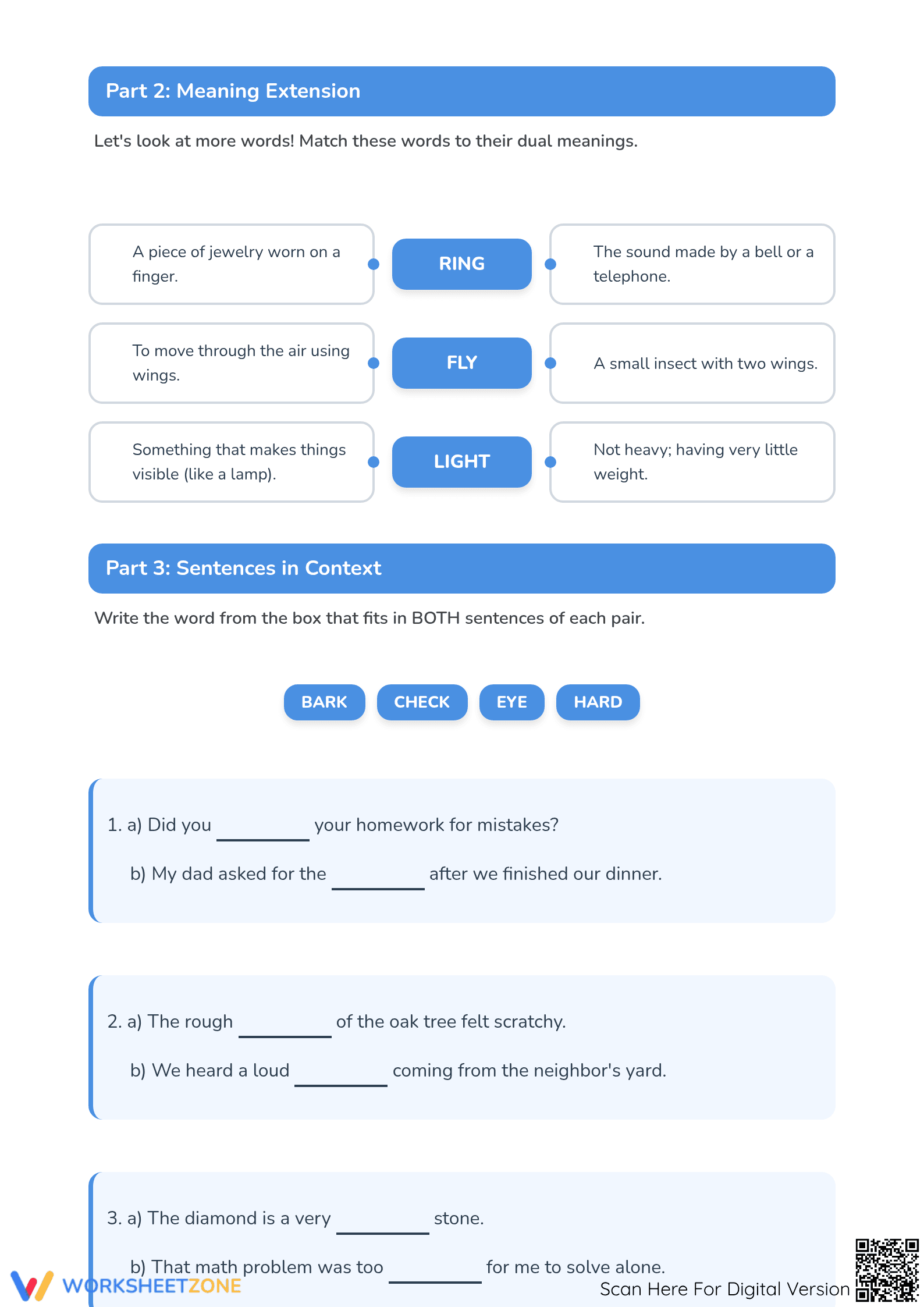
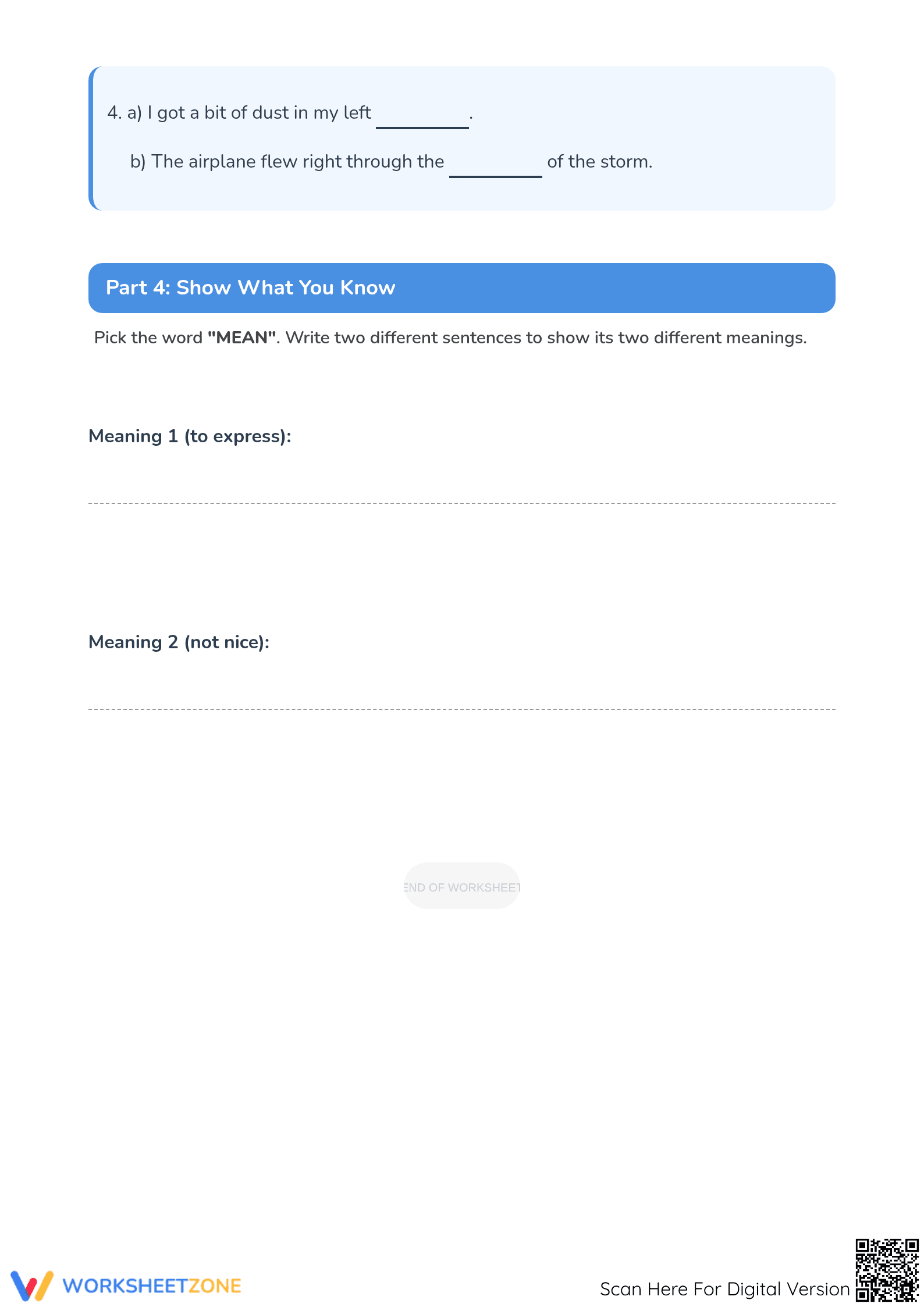
This comprehensive three-page PDF pack contains four distinct instructional segments. The first two parts feature matching exercises where students connect a central word to two different definitions. Part three, "Sentences in Context," challenges students to identify the correct homonym to fill blanks in paired sentences. Finally, "Show What You Know" requires original sentence construction, ensuring students can independently apply their understanding of multiple meanings.
Zero-Prep Workflow
- Print (30 seconds): Select "Fit to Page" and print the three-page sequence for your class or small group.
- Distribute (1 minute): Hand out the packets to students during your vocabulary block or as a transition activity.
- Review (5 minutes): Use the included answer key to quickly check for accuracy or lead a whole-class review session.
Because these pages are self-explanatory and structured logically, they serve as an ideal substitute teacher plan or an "early finisher" option that requires zero additional teacher setup.
Standards Alignment
This resource is specifically designed to meet L.3.4, which focuses on determining or clarifying the meaning of unknown and multiple-meaning words. It also supports L.4.4.C by encouraging precise word choice and definition matching. Both standard codes can be copied directly into lesson plans, IEP goals, or district curriculum mapping tools.
How to Use It
Assign this worksheet after a direct instruction lesson on homonyms. It works best as a "You Do" independent practice phase where students can demonstrate their ability to navigate word nuances. To use it as a formative assessment, observe students during Part 3; if they struggle to fit the same word into two different contexts, they likely need additional support with contextual reading strategies.
Who It's For
This material is designed for Grade 3 and Grade 4 students but provides excellent remediation for older learners working on Tier 2 vocabulary. It is an ideal pairing for an anchor chart on "Double Meaning Words" or a guided reading passage that features high-frequency homonyms. Differentiation is naturally built-in through the shift from matching to writing.
According to the RAND AIRS 2024 analysis of vocabulary acquisition, explicit instruction in multiple-meaning words is a significant predictor of reading comprehension success in the middle grades. This worksheet aligns with research-based practices by providing structured, repetitive exposure to homonyms like "bark," "eye," and "check." By requiring students to connect one word to two distinct semantic categories, the activity builds cognitive flexibility and lexical precision. The inclusion of context-dependent sentence pairs mirrors the "cloze" procedures validated by Fisher & Frey (2014) for promoting transfer of learning. Students who master these 13 tasks are better equipped to handle the linguistic ambiguity often found in complex informational texts and literary narratives. This standards-aligned resource provides the "essential" practice needed to bridge the gap between simple word recognition and the sophisticated semantic analysis required for standardized testing and high-level academic writing.


