


























Views
Downloads



Essential Multiple Meaning Words Worksheet | Grades 1-4
Paste this activity's link or code into your existing LMS (Google Classroom, Canvas, Teams, Schoology, Moodle, etc.).
Students can open and work on the activity right away, with no student login required.
You'll still be able to track student progress and results from your teacher account.
This comprehensive Multiple Meaning Words worksheet helps elementary students master homonyms through contextual analysis and creative writing. By navigating distinct definitions for common terms like "root" and "wave," students build the critical vocabulary stamina required for reading complex texts. This four-page resource ensures students can accurately identify and apply word meanings across various sentence structures.
At a Glance
- Grade: 1-4 · Subject: English Language Arts (ELA)
- Standard:
CCSS.ELA-LITERACY.L.4.4— Use context clues to determine the meaning of multiple-meaning words- Skill Focus: Homonym Contextual Analysis
- Format: 4 pages · 9 problems · Answer key included · PDF
- Best For: Independent practice and vocabulary reinforcement
- Time: 20–30 minutes
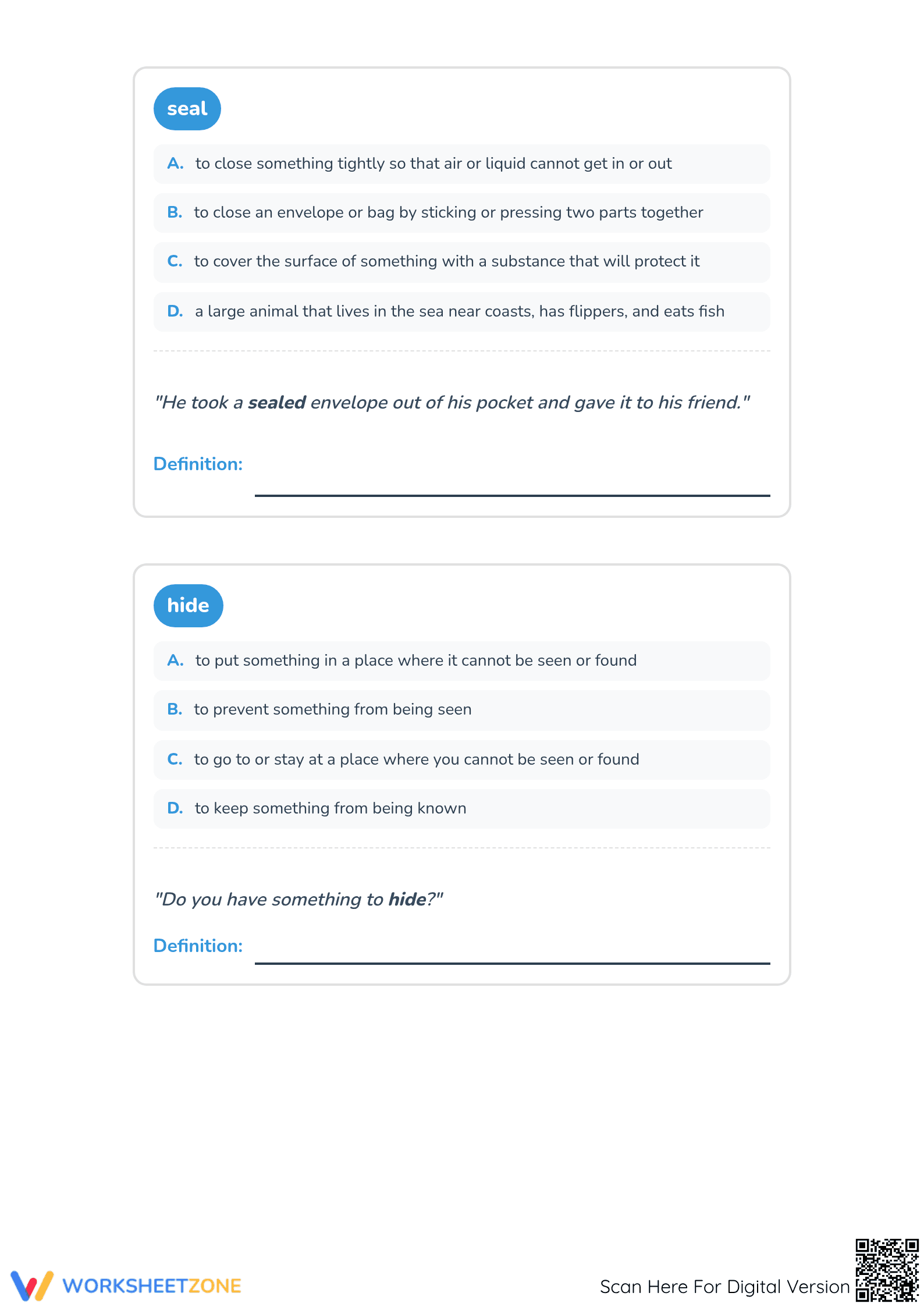
This resource contains four high-quality pages focused on five core homonyms: root, seal, hide, park, and wave. The worksheet features multiple-choice definition matching, sentence-level context identification where two meanings appear in one sentence, and an independent writing section. A full answer key is included, providing clear definitions and correct context placements to facilitate immediate student feedback and grading efficiency.
Skill Progression
- Guided practice: Students begin with 3 tasks matching specific definitions to a single sentence context, providing a high level of scaffolded support.
- Supported practice: The middle section features 4 tasks requiring students to distinguish between two different meanings used within the same sentence frame.
- Independent practice: Students conclude with 2 sentences where they must generate original writing for a chosen word to demonstrate total mastery.
This sequence follows the gradual-release I Do, We Do, You Do model to ensure students move from recognition to application.
Standards Alignment
This resource is directly aligned to `CCSS.ELA-LITERACY.L.4.4`, which requires students to determine or clarify the meaning of unknown and multiple-meaning words and phrases. It specifically addresses sub-standard L.4.4.A by emphasizing the use of context as a clue to word meaning. This standard code can be copied directly into lesson plans, IEP goals, or district curriculum mapping tools.
How to Use It
Ideally used during the apply phase of a vocabulary lesson, this worksheet serves as an excellent formative assessment. Teachers should distribute the pages after a direct instruction session on homonyms to observe how students handle shifting meanings in Part 2. A formative observation tip is to watch for students who struggle to articulate the difference between noun and verb forms of words like "park" or "wave."
Who It's For
Designed for students in Grades 1 through 4, this worksheet is particularly beneficial for English Language Learners and students needing explicit vocabulary support. The clear formatting and numbered definitions provide necessary scaffolding for struggling readers. It pairs naturally with any short story or informational text passage that utilizes varied vocabulary, serving as a focused bridge to deeper reading comprehension.
Academic research consistently highlights the importance of explicit instruction in word-learning strategies, particularly for words with multiple meanings. According to an EdReports 2024 analysis, high-quality instructional materials must provide students with frequent opportunities to engage with words in varied contexts to build a robust mental lexicon. This worksheet targets CCSS.ELA-LITERACY.L.4.4 by requiring students to perform semantic mapping—linking specific definitions to distinct sentence clues. This process of homonym contextual analysis reinforces the cognitive flexibility needed to navigate linguistic ambiguity in complex Grade 4 texts. By shifting from passive definition matching to active sentence generation, students move beyond rote memorization toward authentic word mastery. Teachers can utilize the included data points and task counts to track progress toward specific IEP vocabulary goals or general education literacy benchmarks, ensuring that students meet the rigorous demands of state and national English Language Arts standards.


